
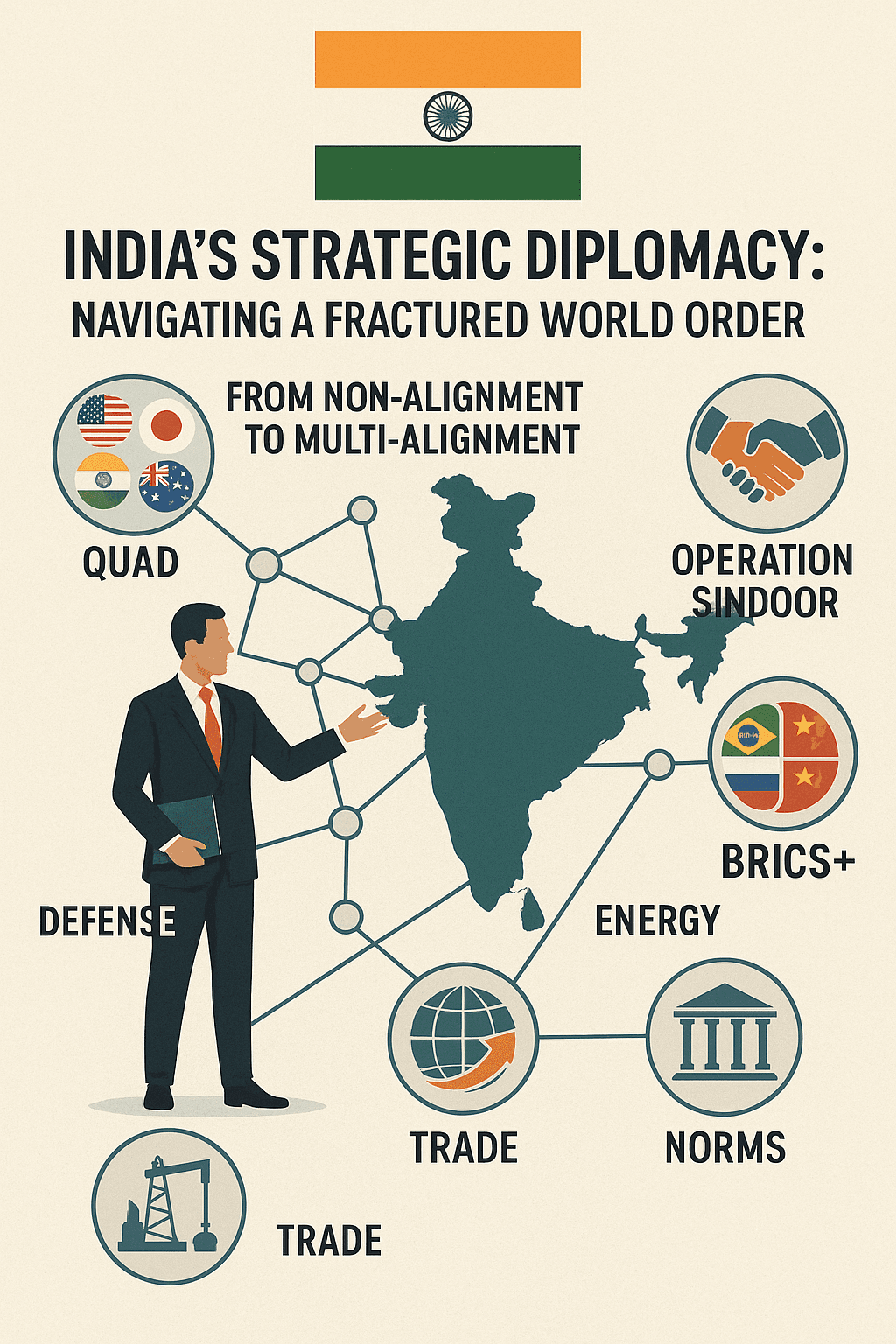
New Delhi (ABC Live): As global power dynamics fracture and regional conflicts intensify, India’s foreign policy faces critical tests. India’s strategic diplomacy must evolve quickly to meet these challenges. From military operations like Operation Sindoor to diplomatic balancing acts in the Middle East, India’s strategic posture is being tested across multiple fronts. Operation Sindoor, launched in May 2025, marked a strong military response to cross-border terrorism, but New Delhi struggled to translate this into diplomatic leverage. Despite battlefield success, India failed to isolate Pakistan globally. In contrast, Islamabad secured leadership roles in UN counter-terrorism bodies and received loans from the IMF, World Bank, and ADB despite Indian objections. No nation at the UNSC explicitly branded Pakistan a terror state, leaving India diplomatically cornered.
China’s vocal support for Pakistan deepened the China–Pakistan strategic nexus, undercutting India’s South Asian influence. Meanwhile, the information war tilted away from New Delhi. India’s delayed narrative allowed global media to focus on tactical losses (like jets downed), not Pakistan’s role in sponsoring terror. The vacuum revealed a key gap in India’s strategic diplomacy: a disjointed approach between military action and strategic communication.
India’s post-Sindoor parliamentary outreach was a late acknowledgement of this gap, but it also highlighted how global focus has shifted from terrorism to great power rivalries, climate, and trade disruptions. Sustaining strategic gains now requires persistent diplomacy, sharper information campaigns, and coalition-building.
Navigating Middle East Conflict: Iran–Israel War and Indian Diplomacy
The Iran–Israel war has amplified the pressures on India’s strategic diplomacy. With oil and gas flows at risk due to Houthi attacks in the Red Sea and the threat of conflict in the Strait of Hormuz (through which 60–65% of India’s crude flows), India faces direct economic fallout. A $10 rise in oil prices could spike inflation by 0.5%, straining India’s macroeconomic stability (Economic Times).
Strategically, India walks a tightrope. It has deep-rooted ties with Iran (notably Chabahar Port) and robust partnerships with Israel, the US, and Gulf monarchies. A wider Middle East war could compel India to take sides—something it has carefully avoided. Defence expert Praful Bakshi notes India’s credibility lies in balancing both relationships and advocating peace. India’s strategic diplomacy demands neutrality without passivity.
National Security and Strategic Defence Diplomacy
Enhancing Deterrence Through Precision Capabilities
India used BrahMos cruise missiles, air-launched munitions, and loitering drones in Operation Sindoor. Building on this, India must expand stand-off strike systems and accelerate indigenous R&D, while selectively importing systems from allies like Israel and France (War on the Rocks).
Missile Defence and Homeland Security
To deter future reprisals, India must invest in S-400 systems, Barak-8 defences, and domestic air-shield technology. The Aatmanirbhar Bharat push should prioritise anti-drone and early-warning systems to protect vital assets.
Naval Diplomacy and Maritime Power Projection
India’s strategic diplomacy hinges on credible naval deterrence. Naval patrols must intensify around the Arabian Sea and Indian Ocean. Joint drills with QUAD, Israel, and Gulf navies must include missile defense and anti-piracy coordination. Hosting multilateral drills will enhance India’s role as a regional security provider.
Energy Security and Foreign Trade Strategy
Trade Diversification and Economic Resilience
India must reduce its over-reliance on West Asian energy. Boosting imports from Russia, West Africa, the US, and Latin America will provide insurance against Gulf disruptions. For LNG, expanding Qatar partnerships and securing long-term deals with Australia and the US is critical (LiveMint).
Leveraging Gulf Trade for Foreign Policy Influence
India–Gulf trade exceeds $160 billion annually. Strengthening pacts with Saudi Arabia, Oman, and Israel, beyond the UAE CEPA, will protect market access. Promoting rupee-dirham swaps will cushion against dollar sanctions (Atlantic Council).
Sanctions and Strategic Trade Navigation
If US/EU sanctions on Iran tighten, India must revive rupee-rial trade and barter mechanisms for humanitarian goods. For Russian trade, continue rupee settlements in key areas like fertilisers and oil.
Supply Chain Resilience in Strategic Sectors
India should build strategic reserves (oil, food, fertilisers), enhance domestic output, and develop alternate logistics corridors such as INSTC (via Central Asia) or maritime routes around Africa.
Messaging and Multilateral Diplomacy
Strategic Communication for Diplomatic Gains
India’s strategic diplomacy must project India as a neutral yet principled actor. Public appeals for restraint, backed by private diplomacy, reinforce credibility. On Kashmir and Pakistan-sponsored terror, avoid rhetoric that alienates moderates.
Multilateral Forums and Global Partnerships
India should use the UN, G20, ASEAN, and SCO to press for action against terror financing and secure trade lanes. Even if Chinese or Russian vetoes block progress, India’s proactive stance builds moral and strategic capital (The Diplomat).
Controlling the Narrative Post-Conflict
Operation Sindoor highlighted India’s lag in narrative dominance. Coordinated spokespersons, rapid media outreach, and diaspora mobilisation must be institutionalised to fill future information vacuums (RUSI).
Strategic Alliances and Regional Influence
Indo-Pacific Partnerships and the QUAD
Quad forums must move beyond naval drills to cyber, space, and missile defence cooperation. Sharing maritime domain awareness and expanding Quad 2+2 contacts will strengthen deterrence across the Indo-Pacific (Stimson Centre).
Engaging BRICS and SCO for Multilateral Gains
Through BRICS and SCO, India must champion Global South interests—climate finance, infrastructure loans, and UNSC reform. While cooperating with China and Russia on common causes, India must hedge against their alignment with Pakistan.
Indo-Abrahamic Alliance and Economic Diplomacy
The India–Israel–UAE–US (I2U2) group offers transformative potential. Projects in desalination, semiconductors, and smart agriculture—such as solar farms in Rajasthan or Israeli tech in UAE farms—can redefine economic partnerships.
Expanding Gulf and West Asia Relations
Modi’s West Asia diplomacy needs expansion. New CEPA-like agreements with Saudi Arabia and Qatar, coupled with defence pacts and diaspora protection policies, will cement India’s Gulf presence. Naval access to Duqm (Oman) and joint drills with Saudi Arabia/Iran/UAE further this strategy.
Integrating Regional Coalitions Through Strategic Diplomacy
To maximise its global leverage, India must thread together its memberships—Quad (Pacific), I2U2 (West Asia), BRICS (Global South), and SCO (Eurasia). This tapestry of alliances is central to India’s strategic diplomacy.
India should propose a GCC–Quad strategic dialogue, align IORA/BIMSTEC efforts with maritime security, and build inter-regional coalitions around energy access and counter-terrorism. A coherent presence in global institutions transforms India from a balancing actor to a decisive force.
Conclusion: Leading Through Strategic Alignment
India’s strategic diplomacy must now evolve from reactive containment to proactive coalition-building. Operation Sindoor proved India’s military resolve, but sustaining influence in a volatile world demands integrated statecraft—merging defence, energy security, economic resilience, and information control.
India’s strategic posture should be one of purposeful alignment—aligning not with blocs, but with interests. Whether facing Chinese encirclement, Middle East volatility, or multilateral inertia, the choice before New Delhi is clear: lead, connect, and narrate—or risk marginalisation in the new world order.
Also Read: IAEA Condemns US Strikes on Iranian Nuclear Sites