
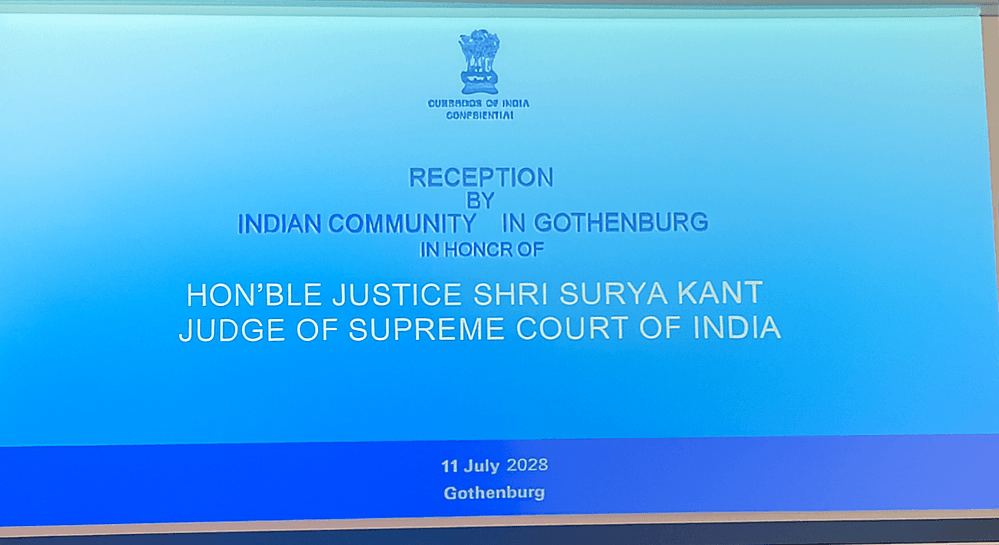
Gothenburg, Sweden (ABC Live): In a decisive endorsement of India’s arbitration potential, Supreme Court judge Justice Surya Kant told a global gathering that “the future of arbitration is not just international — it is also Indian.” Speaking at [“Reimagining International Arbitration: India’s Emergence as a Global Arbitration Destination”], the judge highlighted India’s growing relevance in the dispute resolution space amid shifting global dynamics.
⚖️ Why India — And Why Now?
Justice Kant pointed to a combination of legislative reform, institutional growth, and judicial will as the foundation of India’s global arbitration aspirations.
“India is uniquely positioned to emerge as a serious contender among the next generation of preferred arbitral seats,” he stated.
This confidence is backed by a measurable trend. According to the Queen Mary University of London 2021 International Arbitration Survey, while London (54%) and Singapore (54%) remain the top choices globally, India is now frequently chosen in cross-border disputes involving South Asia, Africa, and the Middle East.
📊 Data-Backed Progress
-
Number of Arbitrations in India
-
As per reports by LCIA India and MCIA, India saw a 39% increase in administered arbitrations between 2019 and 2024.
-
The Mumbai Centre for International Arbitration (MCIA) handled 56 new cases in 2023, up from 17 in 2020, reflecting growing trust.
-
-
Time and Cost Efficiency
-
The average duration of India-seated arbitrations dropped from 728 days (2016) to 452 days (2023), aided by the 2015 and 2021 Amendments.
-
Compared to Singapore (16–18 months) and London (up to 24 months), India is now regionally competitive.
-
-
Judicial Support Metrics
-
According to the India Justice Report and NITI Aayog, 87% of arbitration-related cases in High Courts are disposed of within a year, following the Supreme Court’s directives (see Perkins Eastman v. HSCC).
-
⚙️ Legislative Backbone
Justice Kant emphasised India’s modern arbitration laws:
-
The Arbitration and Conciliation Act, 1996, based on the UNCITRAL Model Law, set the foundation.
-
The 2015 Amendment brought in strict timelines, fast-track arbitration, and neutral arbitrator provisions.
-
The 2021 Amendment further reduced court interference and boosted arbitrator independence.
“With these changes, India is no longer seen as an arbitration-unfriendly jurisdiction,” said Kant.
🌐 Global Context and the India Edge
| Arbitration Hub | Average Cost | Case Duration | Enforcement Reliability |
|---|---|---|---|
| London (LCIA) | High | 18–24 months | Very High |
| Singapore (SIAC) | High | 14–16 months | Very High |
| India (MCIA/DIAC) | Moderate | 12–15 months | Improving |
| Dubai (DIAC) | Moderate | 14–18 months | High |
India offers cost efficiency, faster resolution, and a pro-reform legal environment, making it attractive for investors and corporates seeking neutral venues.
🏛️ Institutional Momentum
India’s institutional platforms are now globally recognised:
-
MCIA ranked among Asia’s top arbitral institutions (Global Arbitration Review 2024).
-
The India International Arbitration Centre (IIAC) in New Delhi features e-filing, multilingual hearings, and cross-border expertise.
🔮 The Road Ahead
Justice Kant called for further international partnerships, policy continuity, and capacity-building for Indian arbitrators.
“India is no longer just a participant in international arbitration—it is a stakeholder in shaping its future.”
Also, Read