
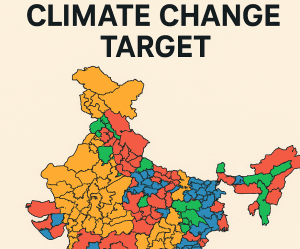
New Delhi (ABC Live): In a landmark development, India has achieved 50% of its installed electric power capacity from non-fossil fuel sources, fulfilling a major Nationally Determined Contribution (NDC) under the Paris Agreement, five years before the 2030 deadline. This milestone affirms India’s global leadership in climate action while maintaining robust economic growth.
The update was provided by Shri Kirti Vardhan Singh, Union Minister of State for Environment, Forest and Climate Change, in a written reply to the Lok Sabha today.
🌿 India’s Climate Strategy — Layered and Legalised
India’s climate policy has evolved into a multi-tiered framework, anchored in national law, international agreements, and community-driven campaigns.
Key Policy Frameworks:
-
National Action Plan on Climate Change (NAPCC): Launched in 2008 with 8 core missions; now expanded to 9.
-
State Action Plans on Climate Change (SAPCCs): 34 States and UTs have customised their plans under NAPCC.
-
Panchamrit Pledge (COP26): Commitments include net-zero by 2070 and 500 GW of non-fossil capacity by 2030.
-
Energy Conservation (Amendment) Act, 2022: Legalizes carbon markets and green building codes.
India is implementing climate strategy via executive action and international commitments.
🔋 India Climate Action Milestone: Data in Detail
| Indicator | 2014 | 2025 (June) | Change |
|---|---|---|---|
| Solar Installed Capacity | 2.82 GW | 116.25 GW | ↑ 41x |
| Share of Clean Power in Energy Mix | ~31% | 50% | Achieved NDC goal 5 years early |
| Emission Intensity vs 2005 (GDP) | 100% | 64% | ↓ 36% |
| CO₂ Per Capita Emissions (2022) | ~1.8 tCO₂e | ~1.9 tCO₂e (Est. 2025) | Below global average (~6.8 tCO₂e) |
| Total Non-Fossil Installed Capacity | ~80 GW | 256+ GW | Surpassed 250 GW mark |
🌎 Comparative Study — India vs Global Climate Leaders
| Country | Clean Power Goal | Achieved? | Per Capita CO₂ (2022) | Emission Intensity Drop | Net Zero Target |
|---|---|---|---|---|---|
| 🇮🇳 India | 50% by 2030 | ✅ 2025 | ~1.9 tCO₂e | ↓ 36% (2005–2020) | 2070 |
| 🇺🇸 USA | 100% by 2035 (electric) | ❌ | ~14.9 tCO₂e | ↓ 17% | 2050 |
| 🇨🇳 China | 25% non-fossil by 2030 | Partial | ~8.0 tCO₂e | ↓ 25% | 2060 |
| 🇪🇺 EU | 55% emissions cut by 2030 | Ongoing | ~6.4 tCO₂e | ↓ 33% | 2050 |
| 🇧🇷 Brazil | 45% renewables by 2030 | Partial | ~2.2 tCO₂e | ↓ 25% | 2050 |
📉 Decoupling Growth from Emissions
India’s GDP has grown significantly while reducing its carbon intensity. Between 2005 and 2020, India’s emission intensity fell by 36%, as confirmed by MoEFCC’s Biennial Update Reports.
Driving Programs:
-
PAT Scheme — Market-based energy efficiency.
-
UJALA — 37 crore LED bulbs distributed.
-
Faster Adoption and Manufacturing of Hybrid and Electric Vehicles (FAME) — Promotes e-mobility.
🌞 India’s Renewable Surge
| Technology | Capacity (2025) | % of Total |
|---|---|---|
| Solar | 116.25 GW | ~23% |
| Wind | ~46 GW | ~9% |
| Hydro | ~47 GW | ~9.5% |
| Nuclear | ~7.5 GW | ~1.5% |
💰 Financing India’s Climate Goals
India is using both domestic and global funding routes:
-
Sovereign Green Bonds: ₹16,000 crore mobilised in FY 2023–25.
-
National Adaptation Fund for Climate Change (NAFCC): Funds adaptation projects at the state level.
-
Budget 2025–26: ₹36,000 crore for renewables, including green hydrogen.
India continues to advocate for climate finance equity, demanding the USD 100 billion/year promise from developed countries.
🧩 Challenges Ahead
-
Coal Dependence: Still powers 50% of India’s electricity.
-
Urban Heat & Emissions: Cities are vulnerable hotspots.
-
Agriculture Stress: Climate variability affects farmers.
-
Carbon Market Development: Needs a transparent legal framework.
🇮🇳 Vision Viksit Bharat@2047
India is building a sustainable future with:
-
Net-zero by 2070
-
500 GW non-fossil capacity by 2030
-
Mass afforestation initiatives
-
Mission LiFE for behavioural change
🔚 Conclusion: India Climate Action Milestone Sets a Global Benchmark
India’s early success proves that economic growth can align with climate responsibility. With clean energy surpassing 50%, solar surging 41x, and emission intensity down 36%, India is walking the talk — becoming a model for emerging economies worldwide.
Also, Read