
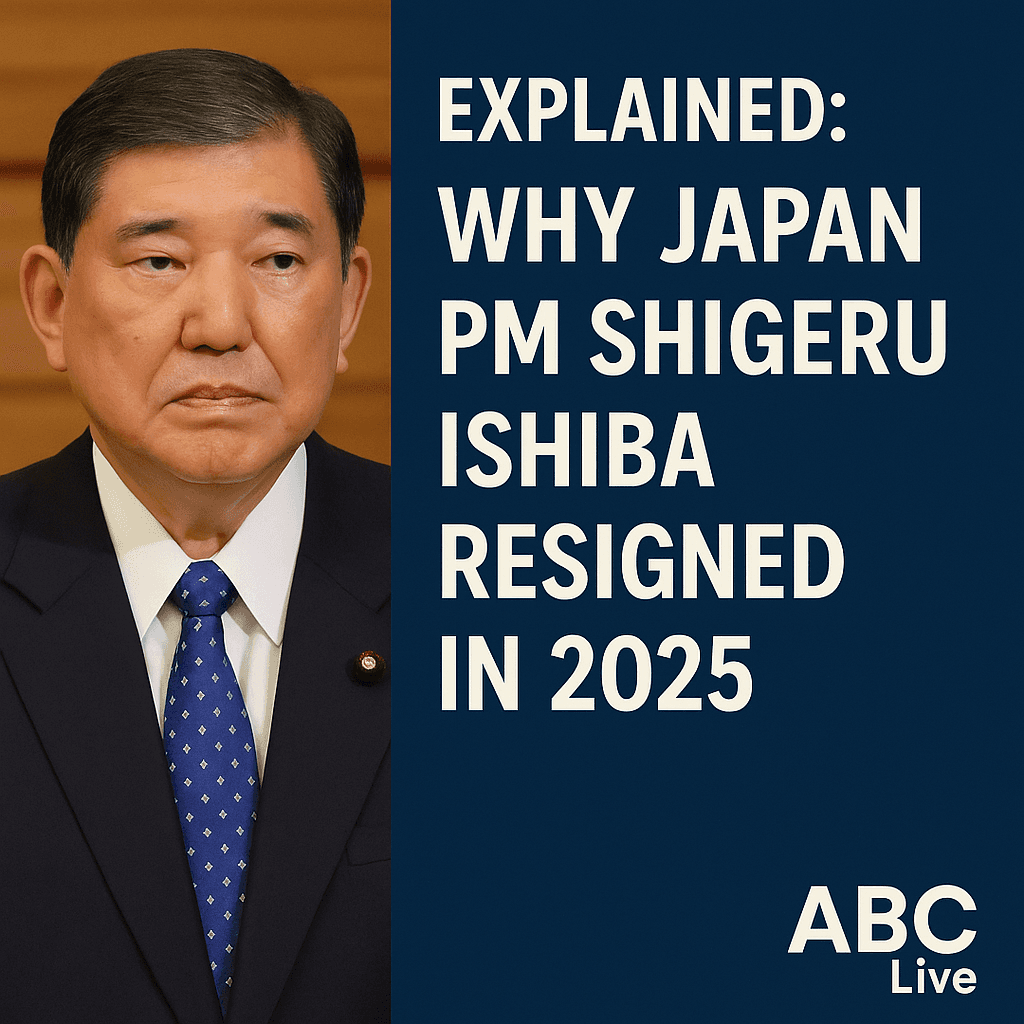
New Delhi (ABC Live): Japan’s Prime Minister Shigeru Ishiba resigned in September 2025, weeks after his ruling Liberal Democratic Party (LDP) suffered a humiliating defeat in the July Upper House elections. His departure signals more than a personal loss: it marks Japan’s political shift toward the right, driven by economic insecurity, Trump-era tariffs, and growing regional security threats.
Economic Pressures: Inflation and Tariff Shocks
The defining factor behind Ishiba’s fall was economic pain at home. Inflation reached 3.1% in July 2025, eroding household savings and fueling discontent. At the same time, former U.S. President Donald Trump’s renewed tariffs on Japanese autos and electronics — core export industries — intensified Japan’s vulnerabilities.
Though Ishiba rushed to conclude a U.S.–Japan trade deal before stepping down, critics argued it was reactive and insufficient. By the time concessions were negotiated, the political damage had already been done, with voters punishing the LDP at the ballot box.
Political Dynamics: A Party Revolt
Inside the LDP, Ishiba lacked the factional machinery needed to survive. Senior lawmakers accused him of being out of touch with voters and weak against external pressures. The July election rout stripped the LDP of its Upper House majority, emboldening conservatives like Sanae Takaichi, who framed Ishiba as incapable of steering Japan through a crisis.
Rather than risk a full-scale party split, Ishiba resigned — leaving the LDP to choose a successor in a moment of deep political instability.
Geopolitical Drivers: Security and Dependence on the U.S.
Japan’s external environment sharpened the domestic crisis:
-
China: Increased PLA activity near the Senkaku Islands and rising Taiwan tensions alarmed the public.
-
North Korea: Ballistic missile launches escalated regional insecurity.
-
United States: Trump’s transactional diplomacy underscored Japan’s dependence on Washington — both for security guarantees and for trade access.
Ishiba’s cautious stance was seen as too slow and too weak. Right-wing voices demanded a hardened military doctrine, higher defence spending, and stronger economic security nationalism.
The Rise of the Right Wing
Ishiba’s resignation signals the ascendancy of Japan’s nationalist right. Conservative factions inside the LDP are pushing for:
-
Constitutional revision to expand Japan’s military role.
-
Higher defence budgets (above 2% of GDP).
-
Supply-chain reshoring and diversification to reduce reliance on both the U.S. and China.
This rightward tilt means that even moderate successors will have to adopt hawkish positions to retain party support.
The Succession Race
The LDP leadership contest has already brought forward four key names:
-
Sanae Takaichi – Right-wing hawk, pro-defence, advocates economic stimulus and constitutional reform.
-
Shinjirō Koizumi – Young reformist, popular with voters, but lacking factional muscle; likely to balance moderation with right-wing concessions.
-
Toshimitsu Motegi – Veteran trade negotiator, promises continuity and pragmatism in dealing with Trump’s tariffs.
-
Yoshimasa Hayashi – Technocrat, capable administrator, but lacks mass appeal and bold vision.
Whoever emerges will inherit Trump’s tariff war, public discontent, and factional conservatism — making a rightward policy drift inevitable.
Implications for India–Japan Relations
For India, Ishiba’s resignation and Japan’s rightward shift present both risks and opportunities:
-
Defence & Security
-
A hawkish Japan will deepen Quad cooperation, especially in maritime security, surveillance, and joint exercises.
-
India benefits from a stronger Japan but must manage its own fragile balance with China.
-
-
Economic Security & Trade
-
Trump tariffs push Japanese firms to diversify production away from the U.S. market.
-
India can position itself as a tariff-resilient hub for semiconductors, autos, and critical minerals.
-
-
Global South Diplomacy
-
Japan’s hawkish turn may shift focus toward hard security, leaving a vacuum in climate and development diplomacy.
-
India can step in as a bridge — with Japan providing finance and tech, and India shaping the Global South agenda.
-
📌 Why ABC Live Publishes This Report Now
Mainstream media has covered Ishiba’s resignation as a routine political story. ABC Live is publishing this analysis now because it connects the dots:
-
Economic Data (inflation, tariffs, yen weakness).
-
Political Dynamics (LDP factional revolt).
-
Geopolitical Pressures (China, Trump, North Korea).
-
India’s Stakes (defence, trade, Global South diplomacy).
This makes our coverage unique: it situates Ishiba’s fall within the larger Indo-Pacific power shifts, directly relevant to India’s future strategy.
✍️ Author
Dinesh Singh Rawat
Senior Advocate | Founder, DSLA & ABC Live
ABC Live Standards
At ABC Live, every report is researched, verified, and published under strict editorial protocols:
-
Verified Sources: Based on official Japanese election results, Bank of Japan economic indicators, and reporting from Reuters, Al Jazeera, The Indian Express, and Time.
-
Expert Author: Written by Dinesh Singh Rawat, Senior Advocate and Founder of DSLA / ABC Live, specialising in law, geopolitics, and arbitration.
-
Why Now: Ishiba’s resignation is not only a Japanese domestic story. It reflects the impact of Trump’s tariffs, the rise of Japan’s right wing, and Indo-Pacific realignments. ABC Live publishes this now to highlight its direct implications for India and the Global South.
-
Corrections Policy: Any factual errors will be updated with a timestamp. Readers can submit corrections via our Corrections Page.
Also. Read