
New Delhi(ABC Live): Logistics is the silent backbone of India’s economy. From moving coal to power plants, cement to construction sites, medicines to hospitals, and exports to global markets, every sector depends on an efficient logistics system. Yet, India has long struggled with high logistics costs, fragmented infrastructure, and weak multimodal integration.
To address these inefficiencies, the National Logistics Policy (NLP) was launched in September 2022 with a bold vision: cut costs to global benchmarks, build seamless multimodal connectivity under PM GatiShakti, and place India among the top 25 countries in the World Bank Logistics Performance Index (LPI) by 2030.
Three years later, official celebrations highlight digital platforms and policy reforms. But the key question remains: Have these translated into lower costs and better competitiveness?
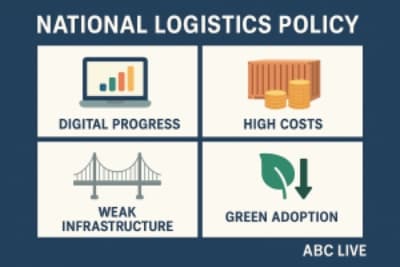
ABC Live conducted a performance audit of the National Logistics Policy, benchmarking India’s progress against global peers such as China, Singapore, the US, and Vietnam. The findings are mixed: while digital reforms are strong, infrastructure, cost reduction, and sustainability lag behind.
Why ABC Live is Publishing This Review Now
On September 17, 2022, Prime Minister Narendra Modi launched the NLP as a transformative framework. The government is marking its third anniversary with high-profile events.
ABC Live believes this is the right moment to move beyond official announcements and present a data-driven, global, and independent audit. Logistics costs currently consume 13–14% of India’s GDP, nearly double the global average, and directly weaken export competitiveness.
How This Report is Unique
Unlike standard coverage, this ABC Live review:
-
🔎 Uses a performance audit framework (inputs, outputs, outcomes, impact).
-
📊 Integrates hard data on costs, workforce, modal shares, and green adoption.
-
🌍 Benchmarks India against Singapore, the USA, the EU, China, and Vietnam.
-
⚠️ Identifies the execution gap, separating policy intent from ground reality.
-
👥 Highlights inclusion issues, from MSME digital divides to women’s participation.
Performance Audit of the National Logistics Policy (2022–2025)
The NLP was designed to:
-
Cut logistics costs to 8–9% of GDP.
-
Place India in the top 25 of the World Bank LPI by 2030.
-
Develop multimodal infrastructure under PM GatiShakti.
-
Push green logistics adoption.
-
Train a skilled workforce for the future.
Three years later, progress is visible in digital integration but weak in cost reduction, infrastructure rollout, and inclusivity.
Global Comparison: Where India Stands
| Country / Region | Logistics Cost (% of GDP) | LPI Rank (2023) | Rail Share (%) | Green Adoption | Takeaway |
|---|---|---|---|---|---|
| India | 13–14% | 38th | 27% | <10% EV adoption | Costs high, road-heavy, weak green push |
| USA | ~8% | 17th | 32% | Strong ESG compliance | Mature, multimodal balance |
| EU avg. | 7–8% | Germany 3rd, NL 5th | 18–25% | EU Green Deal mandates | High-quality infrastructure |
| Singapore | 6.8% | 1st | 35% | Mandatory green standards | Global hub, gold standard |
| China | ~8% | 19th | 47% | State-backed EV freight | Efficiency through scale |
| Vietnam | ~12% | 38th | 30% | Rapid digital adoption | Lean, fast-growing |
➡️ Insight: India is more expensive and less efficient than its peers. China and Vietnam, its direct competitors, are improving faster.
India vs. China: The Strategic Gap
| Metric | India (2025) | China (2025) | Takeaway |
|---|---|---|---|
| Logistics cost (% of GDP) | 13–14% | ~8% | India 50–75% costlier |
| Rail freight share | 27% | 47% | China’s model more efficient |
| LPI Rank (2023) | 38th | 19th | China 20 places ahead |
| Green adoption | <10% | Large-scale EV corridors | China scaling, India trial stage |
-
India’s inefficiency costs over $200 billion annually.
-
China’s rail-heavy model (47%) drives efficiency; India remains road-dependent.
-
China’s green transition is state-backed, while India’s is voluntary.
➡️ Verdict: Without accelerated reforms, China’s logistics advantage will continue to erode India’s competitiveness.
Chart 1: India vs China Logistics Costs (2025)
Alt-text: Performance audit chart comparing logistics costs: India 13.5% of GDP, China 8%.
Caption: India’s logistics costs remain nearly 75% higher than China’s in 2025.
Chart 2: India vs China Rail Freight Share (2025)
Alt-text: Performance audit chart comparing rail freight share: India 27%, China 47%.
Caption: China’s reliance on rail keeps costs low; India remains road-dependent.
Performance Audit: India’s Scorecard
| Objective | Target | Status 2025 | Audit Verdict |
|---|---|---|---|
| Cost reduction | 8–9% of GDP | 13–14% | ❌ Missed |
| LPI ranking | Top 25 by 2030 | 38th | ⚠️ Partial |
| Digital adoption | ULIP, Data Bank, E-Logs | 160+ crore transactions | ✅ Success |
| Infrastructure | 35 MMLPs | 4 in progress | ❌ Weak |
| Green logistics | TEMT, EVs, renewables | <10% adoption | ❌ Weak |
| Skills | 2.2 crore by 2030 | 65,000 trained | ❌ Severe gap |
| Inclusivity | Women’s workforce | 11% (global avg. 25–30%) | ❌ Weak |
Recommendations: Closing the Gap
-
Cut costs with sectoral incentives, fuel reforms, and tax breaks.
-
Accelerate infrastructure through viability gap funding for MMLPs.
-
Mandate green logistics with carbon-credit-linked incentives.
-
Support MSMEs via ULIP-lite and targeted training.
-
Expand skills in AI, blockchain, drones, and smart logistics.
-
Make inclusivity binding in logistics tenders.
-
Tie the central funds to State-level execution for accountability.
ABC Live Editor’s Note
At ABC Live, we cut through government press releases to provide independent, evidence-backed journalism. The NLP is bold in vision but weak in delivery.
This performance audit, built on data analysis, global benchmarking, and inclusion metrics, highlights a clear message: policy intent is not enough — execution will decide whether India can compete with China, Vietnam, and advanced economies by 2030.
✅ Final Verdict:
The National Logistics Policy has created momentum through digital reforms, but its execution gap remains stark. Without rapid progress in cost reduction, multimodal infrastructure, and green adoption, the 2030 targets will remain out of reach — while global competitors pull further ahead.