
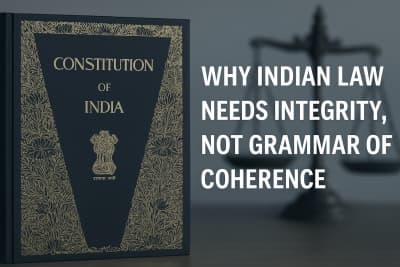
New Delhi (ABC Live): In a reflective essay published on The Proof of Guilt, Rajyavardhan Singh argues that Indian law is a “landscape without a lodestar,” lacking a jurisprudential grammar that unites law-making, adjudication, and enforcement.
He calls for a “grammar of coherence” built on culpability, proportionality, and due process—principles that, in his view, could restore conceptual order to Indian law.
This rejoinder recognises the innovation and intellectual ambition of Singh’s argument. However, it contends that India already has a coherent grammar: its constitutional jurisprudence. The real crisis lies not in legal theory but in institutional integrity and moral consistency.
I. The Innovativeness of Singh’s Argument
Rajyavardhan Singh’s essay stands out for several reasons.
First, his metaphor of “grammar” reframes coherence. It shifts the idea from a narrow doctrinal tool to a linguistic and structural philosophy. This transformation makes his argument both creative and accessible.
Second, through a comparative method, Singh draws from Hart and Sacks as well as Markus Dubber. By doing so, he brings global jurisprudence into India’s post-colonial context, which shows both intellectual range and courage.
Third, instead of stopping at critique, he proposes a constructive framework for law’s moral reasoning. Consequently, he invites readers to see coherence as a discipline of justification, not merely as order.
Finally, his work revives legal philosophy itself. At a time when most Indian legal writing focuses only on case law, Singh reclaims jurisprudence as a living and necessary project.
Therefore, even where one disagrees with his conclusions, his intervention deserves recognition for its creativity and depth.
II. Jurisprudence as India’s Existing Grammar
Nevertheless, Indian law already operates through an implicit grammar that blends positivism, natural law, and legal realism.
-
Positivism: The Constitution functions as the ultimate legal source.
-
Natural Law: Maneka Gandhi embodies substantive due process and moral reasoning.
-
Legal Realism: Context-based judicial interpretation, as seen in Puttaswamy and Navtej Johar, shows adaptability.
Together, these approaches create a jurisprudential triad that balances legality, morality, and justice. In other words, coherence already exists in practice—it simply needs fidelity in action.
III. The Constitution as Living Jurisprudence
The Constitution of India provides both structure and spirit. It is positivist in authority, moral in orientation, and interpretive in application.
The Preamble sets out the ethical grammar; Fundamental Rights define its syntax; and Judicial Review safeguards its meaning.
As Lon Fuller spoke of the “inner morality of law,” and Ronald Dworkin described law’s “integrity,” Indian constitutionalism reflects both ideas. Hence, coherence does not need to be invented—it only needs to be honoured.
IV. Pluralism and Coherence
Moreover, India’s legal pluralism—personal laws, regional customs, and state statutes—reflects democratic diversity rather than disorder.
This “jurisprudence of diversity” fits comfortably within Hart’s concept of open texture and the constitutional morality that promotes unity through difference.
Singh’s desire for uniform coherence, while idealistic, risks simplifying what is deliberately plural. True coherence in a diverse society must remain flexible, not rigid.
V. Doctrinal Coherence in Practice
| Field | Leading Cases | Theme | Principle |
|---|---|---|---|
| Constitutional Structure | Kesavananda Bharati (1973) | Natural-law limits | Basic Structure Doctrine |
| Fundamental Rights | Puttaswamy (2017), Shreya Singhal (2015) | Integrity of interpretation | Proportionality & Reasonableness |
| Criminal Process | Arnesh Kumar (2014), D.K. Basu (1997) | Due-process realism | Liberty & Accountability |
| Administrative Law | Maneka Gandhi (1978), E.P. Royappa (1974) | Fairness jurisprudence | Non-arbitrariness |
These cases demonstrate that doctrinal coherence already exists. They show how moral reasoning and procedural fairness continuously shape Indian law.
VI. The Real Crisis: Integrity, Not Absence of Grammar
The inconsistencies Singh observes—whether in bail, punishment, or arrest—arise from ethical failure rather than theoretical absence.
Often, courts yield to pressure, legislatures chase populism, and enforcement agencies act without restraint.
Therefore, what India needs is not a new “legal science,” but a jurisprudence of integrity. The grammar is already written in the Constitution; it only needs honest practice and moral courage.
VII. The Democratic Caution
If a new grammar were ever codified, an important question arises: who defines it?
Transferring interpretive authority from constitutional institutions to academic experts may replace democratic dialogue with technocratic rule.
Thus, coherence in a democracy must arise from reasoned disagreement, not imposed uniformity. Debate, not decree, is the true measure of a constitutional order.
Conclusion: Jurisprudence in Practice
Rajyavardhan Singh’s essay is a valuable and provocative contribution. It reignites the conversation on the moral foundations of Indian law.
Yet coherence is not missing—it is under-practised.
India’s legal system already contains the grammar Singh seeks. What it truly requires is integrity—the courage to live by the Constitution’s words and spirit.
Ultimately, integrity—not ideology—is the grammar Indian law must now master.
Editorial Note: Why ABC Live Is Publishing This
ABC Live publishes this rejoinder to recognise the originality of Rajyavardhan Singh’s essay and to extend the debate on whether India’s legal future depends on new theoretical design or renewed constitutional fidelity.
As the country transitions to the Bharatiya Nyaya Sanhita, Bharatiya Sakshya Adhiniyam, and Bharatiya Nagarik Suraksha Sanhita, the question is not what grammar to create, but how to uphold the one we already have.
References (Free Access)
- Rajyavardhan Singh, “Towards a Grammar of Coherence,” The Proof of Guilt blog (2025).
https://theproofofguilt.blogspot.com/2025/09/guest-post-extending-conversation-on.html - The Constitution of India (1950), Legislative Department, Government of India.
https://legislative.gov.in/constitution-of-india - Kesavananda Bharati v. State of Kerala (1973) 4 SCC 225 — Basic Structure Doctrine.
https://indiankanoon.org/doc/257876/ - Maneka Gandhi v. Union of India (1978) 1 SCC 248 — Substantive Due Process.
https://indiankanoon.org/doc/1766147/ - E.P. Royappa v. State of Tamil Nadu (1974) 4 SCC 3 — Equality as Fairness.
https://indiankanoon.org/doc/623254/ - K.S. Puttaswamy v. Union of India (2017) 10 SCC 1 — Right to Privacy.
https://indiankanoon.org/doc/127517806/ - Shreya Singhal v. Union of India (2015) 5 SCC 1 — Free Speech and Section 66A.
https://indiankanoon.org/doc/110813550/ - Arnesh Kumar v. State of Bihar (2014) 8 SCC 273 — Guidelines on Arrest.
https://indiankanoon.org/doc/59615260/ - D.K. Basu v. State of West Bengal (1997) 1 SCC 416 — Custodial Rights and Accountability.
https://indiankanoon.org/doc/501198/ - Ronald Dworkin, Law’s Empire (1986), Harvard University Press. (Open summary)
https://plato.stanford.edu/entries/law-interpretivist/ - Lon L. Fuller, The Morality of Law (1964), Yale University Press. (Open overview)
https://plato.stanford.edu/entries/legal-obligation/#FulMorLaw - Markus Dubber, “The New Legal Science,” University of Toronto Law Faculty Research Series (2018).
https://papers.ssrn.com/sol3/papers.cfm?abstract_id=3165621 - Hart & Sacks, The Legal Process: Basic Problems in the Making and Application of Law (1958) — Harvard Law School Manuscript.
https://cyber.harvard.edu/bridge/LawProcess/Hart-Sacks.htm
Also, Read