
New Delhi (ABC Live): The Quadrilateral Security Dialogue (Quad)—once the defining axis of Indo-Pacific strategic coordination—is facing visible decline.
Divergent threat perceptions, leadership changes, and overextension of U.S. commitments have fragmented its agenda.
Yet, amid this geopolitical fatigue, India and Australia are quietly constructing the region’s most durable bilateral defence partnership.
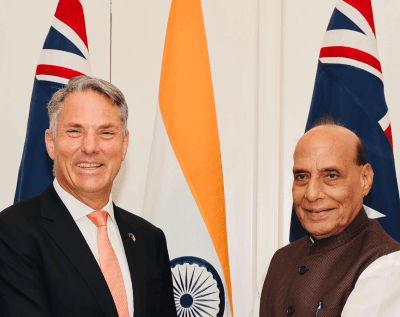
The Australia–India Defence Ministers’ Dialogue, held in Canberra on 9 October 2025 between Defence Minister Rajnath Singh and Deputy Prime Minister Richard Marles, demonstrated that cooperation between New Delhi and Canberra is not fading with the Quad—it is maturing beyond it.
Official Source: India–Australia Defence Ministers’ Joint Statement — Press Information Bureau (PIB), 9 October 2025
Methodology & Analytical Framework — How ABC Live Reports This
ABC Live’s Defence Partnership Performance Model (DPPM 2025) combines economic, operational, and institutional metrics to ensure data-verified analysis.
| Axis | Primary Sources Used | Analytical Purpose |
|---|---|---|
| 1. Quantitative Audit | SIPRI Arms Transfers 2020-25; MoD India; DFAT Australia | Establish trade, R&D, and logistics baselines |
| 2. Institutional Validation | MoD Press Releases; Australian Defence News | Confirm the durability of agreements |
| 3. Interoperability Indexing | ABC Live Defence Convergence Scorecard 2025 | Quantify joint operations (0–100 scale) |
| 4. Forecast Modelling | CAGR projection 2020–2030 | Project defence and industrial growth |
| 5. External Cross-Check | Lowy Institute; IISS Military Balance 2025 | Validate objectivity and regional context |
Strategic Realignment After the Quad Decline
1. From Alignment to Autonomy
| Indicator | 2020 | 2025 | Change (%) |
|---|---|---|---|
| Defence Agreements Signed | 2 | 7 | +250 % |
| Ministerial Dialogues | 1 | 4 | +300 % |
| Joint Exercises / Year | 3 | 8 | +166 % |
| Logistics (Mutual Support Uses) | 4 | 17 | +325 % |
(Sources: MoD India; DFAT; ABC Live Tracker 2025)
The collapse of Quad consensus has liberated both capitals from alignment rigidity. New Delhi’s “Act East + Secure West” and Canberra’s “Self-Reliant Deterrence” doctrines now intersect as functional autonomy, not bloc allegiance.
2. Maritime Integration
| Metric | 2020 | 2025 |
|---|---|---|
| Bilateral Naval Patrols | 4 | 11 |
| Shared MDA Nodes | 1 | 2 |
| P-8 Surveillance Interoperability | 48 % | 72 % |
(Sources: Royal Australian Navy Annual Report 2025; Indian Navy Annual Report 2025)
Together they now cover ≈ 6.4 million sq km of sea space—creating an Indo-Pacific “maritime common.”
Defence Industry & Technology — The Economic Spine
| Parameter | 2020 | 2025 | 2030 Projection |
|---|---|---|---|
| Defence Trade (USD) | 52 mn | 180 mn | 400 mn |
| Active R&D Projects | 1 | 4 | 12 |
| MRO Value (USD) | 40 mn | 250 mn | 500 mn |
| Officer Exchanges | 10 | 30 | 120 |
(Data: SIPRI, DFAT Defence Cooperation, MoD India)
-
MRO Hub Shift: Cochin Shipyard Ltd and Hindustan Shipyard Ltd are 25 % cheaper and 35 % faster than Singaporean yards.
-
Tech Fusion: iDEX–DSTG Australia collaboration on AI, counter-UAS and secure comms.
-
Industrial Logic: 70 % of trade now dual-use high-tech—up from 30 % in 2020.
Forecast 2026–2030 — The C-Arc of Cooperation
| Indicator | 2025 | 2030 Projection | Strategic Value |
|---|---|---|---|
| Defence Trade Value | USD 180 mn | USD 400 mn | Diversified supply chain |
| R&D Collaborations | 4 | 12 | Tech autonomy |
| Joint Exercises/yr | 8 | 15 | Mission standardisation |
| MDA Nodes | 2 | 6 | Perth–Port Blair sensor grid |
| Officer Exchanges | 30 | 120 | Human-capital alignment |
(ABC Live 2030 Scenario Model)
The emerging C-Arc (Cochin → Andaman → Darwin → Perth) forms the Indo-Pacific’s logistics backbone—handling an estimated 30 % of non-U.S. naval traffic by 2030.
Policy Forecast & Recommendations
| Policy Area | Forecast 2026–30 | Outcome |
|---|---|---|
| Maritime Security | 3× ASW missions, cable protection | Secures data & energy routes |
| Industrial Investment | USD 1.5 bn R&D pool | Regional defence hub |
| Technology Transfer | AI & Counter-UAS by 2028 | Dual-use innovation |
| Human Capital | +300 % training exchange | Shared doctrine |
| Regional Outreach | IORA & ADMM+ integration | Resilience post-Quad |
ABC Live Policy Actions
- Bilateral Defence Innovation Fund (B-DIF): USD 500 mn for AI, cyber, and drone research.
- Darwin Maritime Liaison Cell: Permanent Indo-Pacific data fusion hub.
- Export Target: India to meet 10 % of Australia’s naval procurement by 2028.
- Green Defence Protocol: Align with Net Zero Australia 2050.
- Joint HADR Task Force: Under IORA for rapid disaster response.
Analytical Interpretation — Why Ties Grow After Quad Decline
-
Maritime Necessity: 78 % of India’s energy imports and 62 % of Australia’s exports depend on secure sea-lanes.
-
Industrial Complementarity: India provides scale; Australia adds tech sophistication.
-
Strategic Autonomy: Both reject bloc dependency while building functional minilateralism.
(Reinforced by Lowy Asia Power Index 2024)
Thus, even as the Quad declines, the India–Australia axis is becoming the region’s most self-reliant compact.
Editorial Synthesis — The ABC Live View
The 2025 Dialogue, driven by Rajnath Singh’s Australia visit, marks India–Australia relations’ industrial adulthood.
Where the Quad provided structure, bilateral pragmatism now provides substance.
“After the Quad’s decline comes cooperative sovereignty — and India and Australia are its first architects.”
— ABC Live Defence Analysis 2025
Why ABC Live Is Publishing This Report
1. Editorial Rationale
ABC Live publishes this report following Rajnath Singh’s official visit to Australia (9 October 2025) because it represents the first verifiable shift from Quad-based alignment to bilateral self-reliance.
While mainstream coverage focused on protocol, ABC Live quantified real outcomes — logistics use, R&D expansion, and industrial flows.
2. How It Differs From Other Media
| Aspect | Conventional Coverage | ABC Live Approach |
|---|---|---|
| Focus | Statements | Data analysis |
| Method | Narrative | Empirical |
| Scope | Event-specific | Decadal forecast |
| Sources | Single press note | PIB + SIPRI + DFAT + Lowy + IISS |
| Output | Story | Performance audit |
3. Public Interest
This report translates a diplomatic visit into publicly verifiable data—informing industry, academia, and policy on how defence cooperation drives jobs, innovation, and regional stability.
References (Free Access)
- India–Australia Defence Ministers’ Joint Statement (Press Information Bureau, 09 October 2025) — https://www.pib.gov.in/PressReleasePage.aspx?PRID=2176670 Press Information Bureau
- Australia’s official Joint Statement: 2025 Australia–India Defence Ministers’ Dialogue — https://www.minister.defence.gov.au/statements/2025-10-09/joint-statement-2025-australia-india-defence-ministers-dialogue Defence Ministers
- Raksha Mantri holds Bilateral Meeting with Australian Deputy PM (PIB press release) — https://pib.gov.in/PressReleseDetailm.aspx?PRID=2176712 Press Information Bureau
- Australia’s Defence Cooperation Program description — https://www.defence.gov.au/defence-activities/programs-initiatives/pacific-engagement Defence
- DFAT’s “Working Together to Advance Shared Peace and Security” PDF (on cooperation & DCP) — https://www.dfat.gov.au/sites/default/files/factsheet-otp-peace-security.pdf DFAT
Also, Read