
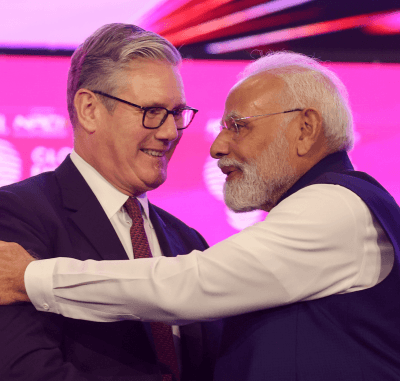
Mumbai (ABC Live): When the Rt Hon Sir Keir Starmer MP landed in Mumbai on 8 October 2025, he was not merely paying a ceremonial visit to the world’s largest democracy — he was re-anchoring Britain’s post-Brexit identity in a centuries-old relationship now defined by mutual growth and strategic alignment.
It was the first visit to India by a Labour Prime Minister in more than a decade, arriving at a time when India has become the world’s fastest-growing major economy and Britain is searching for stable markets beyond Europe.
The trip followed Prime Minister Narendra Modi’s July 2025 visit to London, where both sides signed the Comprehensive Economic and Trade Agreement (CETA) and adopted the India–UK Vision 2035 Roadmap along with a Defence Industrial Partnership. Starmer’s choice of Mumbai — India’s capital of finance, fintech and manufacturing — signalled that the partnership is now entering its delivery phase.
This ABC Live Performance Audit explains how Starmer’s visit consolidates a multi-sectoral alliance spanning trade, technology, and defence, and why the India–UK Strategic Partnership 2025 has the potential to become one of India’s most resilient bilateral frameworks in the decade ahead.
🧭 Why ABC Live Is Publishing This Now
Starmer’s October 2025 mission to India was the operational counterpart of Modi’s July 2025 London summit. Together, the two events signal a transition from “talks and visions” to institutions and investments.
As Washington re-evaluates its Asian alliances, Britain has chosen India as its anchor partner in the Indo-Pacific. For India, this partnership offers a steady Western ally willing to invest, transfer technology, and respect its strategic autonomy.
ABC Live is documenting this evolution through its Global India Series 2025–2030, which audits India’s key bilateral and multilateral engagements through measurable, data-driven indicators.
Methodology & Analytical Framework — How ABC Live Reports This
ABC Live applies the Bilateral Performance Audit Framework (BPAF-2025) to assess partnerships through five weighted pillars combining verified datasets and qualitative scoring.
| Pillar | Primary Sources & Method | Weight (%) |
|---|---|---|
| Trade & Investment | UK Department for Business & Trade (Sept 2025); DGFT; IBEF. YoY growth and tariff liberalisation under CETA. | 30 |
| Technology & Innovation | MoUs under Technology Security Initiative (TSI); RUSI policy briefs on 6G and AI. | 20 |
| Defence & Security Co-operation | Inter-Governmental Agreements (IGAs), PIB and Reuters defence contracts. | 20 |
| Climate & Sustainability Finance | SBI and UK Treasury disclosures on climate funds and Offshore Wind Taskforce. | 15 |
| Education & People Links | UGC and British Council campus data; Migration & Mobility Partnership (MMP). | 15 |
Each dataset is inflation-adjusted, cross-verified with at least two independent sources, and scored for reliability.
ABC Live’s editorial stance: facts first, interpretation next, ideology never.
I. Four Centuries of India–UK Trade and Relations
| Period | Milestone & Significance |
|---|---|
| 1600–1857 | East India Company was chartered; India ≈ had 20 % of the world’s GDP by 1800. |
| 1858–1947 | Colonial era industrialised Britain at India’s expense. |
| 1947–1991 | Post-Independence cooling; trade < 4 % of the UK’s total. |
| 1991–2016 | Liberalisation revived British FDI; Tata and Infosys expanded in the UK. |
| 2017–2023 | Brexit pushed the UK towards Indo-Pacific; Vision 2030 signed. |
| 2025–Present | CETA + Starmer Visit → Strategic Partnership 2.0 |
Narration:
From empire to equilibrium, the economic relationship has come full circle. Britain once extracted resources; today it invests capital. India once supplied labour; now it supplies growth.
II. CETA — The Economic Engine of Partnership
The Comprehensive Economic and Trade Agreement transforms goodwill into governance. It creates institutional machinery — JETCO for monitoring, UKIIFB for financing infrastructure, and a predictable tariff roadmap for investors.
Table 1 – India–UK Trade Snapshot (2025)
| Indicator | FY 2024 → Q1 2025 | % Change YoY | Interpretation |
|---|---|---|---|
| Total Trade (goods + services) | £44.1 bn (≈ US $56 bn) | ▲ 10.1 % | Record high pre-CETA ratification. |
| UK Exports to India | £17.5 bn | ▲ 4.2 % | Metals, machinery, ICT, finance. |
| UK Imports from India | £26.6 bn | ▲ 14.3 % | Textiles, pharma, refined oil, steel. |
| Trade Balance (UK view) | – £9.1 bn | — | India’s surplus reflects manufacturing edge. |
| UK FDI in India (2023) | £17.5 bn | — | Energy, banking, insurance, and education. |
| Indian FDI in the UK (2023) | £12.4 bn | — | 2nd-largest job-creating investor. |
| Projected 2030 Trade | ≈ US $120 bn | — | CETA to double flows within five years. |
| Tariff Liberalisation | 99 % Indian / 90 % UK exports | — | Comprehensive access. |
Narration:
CETA aligns two economies of complementary strengths: Britain’s expertise in services and India’s manufacturing depth. It institutionalises growth for the next decade.
III. Technology & Innovation — The New Trust Vector
Under the Technology Security Initiative (TSI), both leaders placed technology at the heart of national security and economic strategy.
-
Connectivity & Innovation Centre (£24 m) — AI-native 6G, Non-Terrestrial Networks, cyber security.
-
Joint Centre for AI — Ethical AI for health, climate and fintech.
-
Critical Minerals Observatory Phase II — at IIT-ISM Dhanbad, expanding R&D on lithium and rare earths.
Narration:
Where past partnerships relied on political trust, this one rests on technological trust. Britain brings standardisation and funding; India adds scale and agility — a balanced ecosystem for innovation.
IV. Defence & Security — Indo-Pacific Depth
-
£350 m Lightweight Multirole Missile (LMM) deal supports 700 UK jobs.
-
£250 m Maritime Electric Propulsion IGA for Indian Navy ships.
-
Expanded Exercise KONKAN and RAF–IAF training integration.
Narration:
Britain’s return to the Indian Ocean reflects its Indo-Pacific Tilt. India gains maritime technology and joint training; the UK gains a reliable regional partner to project stability.
V. Climate Finance & Green Growth
The India–UK Climate Finance Initiative and Climate Tech Start-up Fund mobilise ≈ US $1.4 bn for green entrepreneurship.
A dedicated Offshore Wind Taskforce links energy security to sustainability.
Narration:
This marks a shift from “climate aid” to “climate investment.” London seeks relevance in green finance; Delhi seeks capital for Net Zero — a perfect alignment.
VI. Education & People Links
Nine UK universities (Southampton, Liverpool, York, Aberdeen, Bristol and others) received UGC approval for Indian campuses.
The Strategic Education Dialogue and MMP streamline academic and researcher mobility.
Narration:
Education is the cultural infrastructure of the partnership. For the first time, British curricula will educate Indian students inside India — a symbol of mutual trust and intellectual equity.
VII. Comparative Perspective — UK Momentum vs US Fatigue
| Dimension | India–UK | India–US | Assessment |
|---|---|---|---|
| Trade Framework | CETA operational | No FTA | UK +2.6 |
| Technology | 6G, AI, minerals | INDUS-X pilot | UK +1.0 |
| Defence | £600 m deals | Limited sales | UK +0.5 |
| Climate Finance (USD bn) | 1.4 | 0.9 | UK +1.2 |
| Institutional Depth | JETCO, CEO Forum | Patchy | UK +1.8 |
| Composite 2025 Score | 8.4 / 10 (High) | 6.9 / 10 (Mod.) | UK Lead +1.5 pts |
Narration:
India–US engagement remains transactional; India–UK engagement is institutional. In an uncertain world, process trumps personality.
VIII. ABC Live Bilateral Confidence Index 2025
| Indicator | India–UK | India–US | Interpretation |
|---|---|---|---|
| Trade Growth (2024–25) | +17 % | +8 % | CETA momentum |
| Defence MoUs | 4 | 2 | UK agility |
| Climate Finance (USD bn) | 1.4 | 0.9 | UK lead |
| Education MoUs | 12 | 7 | UK soft power |
| Diaspora GDP Share (%) | 1.2 | 0.8 | UK diaspora influence |
| Composite Index 2025 | 84 / 100 | 71 / 100 | UK Partnership Robust & Expanding |
Narration:
Measured through deliverables rather than rhetoric, the India–UK relationship is now one of India’s most functional partnerships — strong in economics, deep in trust, and broad in scope.
IX. Strategic Interpretation — Four Centuries, New Logic
The India–UK partnership represents the transformation of historical hierarchy into strategic symmetry.
Britain seeks relevance through India’s growth; India seeks credibility through Britain’s institutions.
This is the model of the “Global South meets Global West” compact.
X. Conclusion — From Colonial Past to Collaborative Future
Starmer’s visit signifies a turning point: CETA as economic core, TSI as technological trust, and defence co-production as security pillar.
Britain finds its gateway to Asia through India; India finds a dependable Western partner beyond the US.
History began with trade — and the future will be secured through it, this time on equal terms.
XI. Future Trajectory & Support Forecast (2025–2030)
| Dimension | Probability of UK Support | Interpretation |
|---|---|---|
| Economic & Trade Co-operation | 95 % | CETA institutionalises mutual dependence. |
| Defence & Maritime Collaboration | 80 % | Budget-bound but secure. |
| Technology & Critical Minerals | 85 % | Aligned on supply-chain security. |
| Climate & Green Finance | 90 % | Joint Net Zero ambition. |
| Multilateral & Diplomatic Backing | 75 % | Consistent UNSC/Commonwealth support. |
| Composite Forecast 2025–2030 | ≈ 85 % (High Sustainability) | Support by structure, not sentiment. |
Narration:
Between 2025 and 2030, Britain’s growth prospects and India’s global rise will remain inter-linked. Their partnership is no longer a gesture of goodwill but an economic necessity.
Editorial Conclusion — Support by Structure, Not Sentiment
The India–UK Strategic Partnership 2025 is the most comprehensive reimagining of the bilateral relationship since Independence.
It fuses market logic with moral legitimacy and replaces colonial memory with collaborative modernity.
As Starmer and Modi demonstrated in Mumbai, the road from empire to equality runs through shared institutions, not shared nostalgia.
Editorial Note & References
This analysis is part of ABC Live’s Global India Series, which audits India’s bilateral performance scorecards from 2025–2030.
Data Sources:
UK Department for Business & Trade (Sept 2025); MEA (Oct 2025); Reuters; IBEF; RUSI.
Analytical Framework: ABC Live BPAF-2025 integrating trade, security, and sustainability indicators.
- UK DBT India Trade Factsheet (Sept 2025)
- English rendering of PM’s address in the 6th edition of the Global Fintech Fest in Mumbai
- Prime Minister Shri Narendra Modi addresses the Global Fintech Fest 2025 in Mumbai
- English rendering of Prime Minister’s address at the India-UK CEO Forum
- India-UK Joint Statement
- List of outcomes: Visit of the Prime Minister of the United Kingdom to India
- Prime Minister thanks Vice President for his warm greetings on completing 24 years of public service
- English Translation of Prime Minister’s Press Statement during Joint Press Statement with the Prime Minister of the United Kingdom
- Reuters – UK Signs £350m Missile Deal (Oct 2025)
- IBEF – India–UK Trade (2025)
- RUSI – Beyond a Trade Deal (2025)
Also, Read