
Judicial Quality & Equity Series 2025
A Joint Report by ABC Live × Association for Judicial Reforms (India) Trust (AJRI)
Reforming India’s Courts through Data, Dignity & Constitutional Accountability.
The Forgotten Foundation of India’s Justice System
India’s judiciary is admired worldwide for its independence.
Yet, the everyday face of justice—the District and Subordinate Courts—still struggles for equal recognition.
These courts decide nearly nine out of every ten cases in the country.
However, their judges work under tight administrative control from the High Courts, with limited autonomy and fewer resources.
Because of this imbalance, the very system meant to protect equality operates unequally within itself.
The High Courts enjoy constitutional freedom, whereas District Judges function as if they were part of a civil service.
To build an equitable judiciary in India, we must treat all judges—trial or constitutional—with the same dignity and accountability.
This ABC Live × AJRI report uses data, case law, and reform analysis to show how a balanced relationship between the Supreme Court, High Courts, and District Courts can restore trust, speed up justice, and improve quality across the system.
Why ABC Live and AJRI Are Publishing This Report?
This study forms part of the Judicial Quality & Equity Series 2025, produced jointly by ABC Live and the Association for Judicial Reforms (India) Trust (AJRI).
The collaboration was inspired by the Supreme Court’s ruling in Rejanish K.V. v. K. Deepa (2025 INSC 1208), which reaffirmed that District Judges are constitutional officers under Article 233.
Nevertheless, their working conditions still mirror a subordinate service.
Therefore, this report aims to:
- Present factual NJDG data showing that subordinate courts handle about 90 % of all cases;
- Explain how the current hierarchy erodes morale and consistency.
- Introduce a Judicial Performance Point System (JPPS) to evaluate judges fairly; and
- Recommend reforms that merge efficiency with independence.
Together, ABC Live and AJRI believe that a truly equitable judiciary will arise when data replaces opinion and mentorship replaces control.
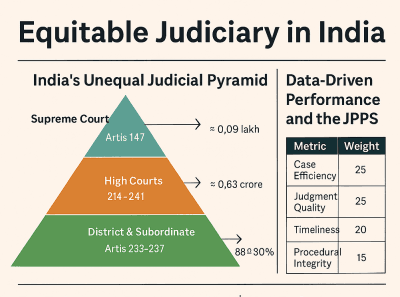
India’s Unequal Judicial Pyramid
| Judicial Tier | Constitutional Basis | Pending Cases (Aug 2025) | Share of Total | Status |
|---|---|---|---|---|
| Supreme Court | Arts. 124–147 | ≈ 0.09 lakh | < 0.1 % | Apex Constitutional Court |
| High Courts (25) | Arts. 214–231 | ≈ 0.63 crore | 9–10 % | Constitutional Courts |
| District & Subordinate Courts | Arts. 233–237 | ≈ 4.7 crore | 88–90 % | Administratively Subordinate |
Sources: NJDG Dashboard | DoJ India
Narration:
The numbers tell a clear story.
Although the District Courts handle almost all litigation, their institutional voice remains weak.
Because authority is concentrated upward, accountability feels one-sided.
Hence, reforming the power-to-workload ratio is essential for achieving an equitable judiciary in India.
The Strained Relationship Between Higher and Subordinate Courts
When Article 235 granted High Courts “control” over the subordinate judiciary, the intention was supervision—not dominance.
Over the decades, however, this control expanded into personnel management, covering postings, transfers, and even vigilance.
As a result, District Judges now operate under constant administrative pressure.
Furthermore, the fear of poor inspection reports discourages independent reasoning.
Instead of fostering courage, the system rewards conformity.
Therefore, the link between the High Courts and District Courts needs re-imagining—as a partnership built on data and mentorship, not command.
🟣 Bal Mukund Shah v. State of Bihar, AIR 2000 SC 1296, reminds that “control must nurture independence, not diminish it.”
From Inspection to Mentorship
| Aspect | Current Approach | Reform Approach |
|---|---|---|
| Inspection Visits | Sudden or annual checks | Scheduled mentoring reviews |
| Focus | Quantity of disposals | Quality of reasoning |
| Feedback | Confidential remarks | Transparent learning metrics |
| Power | Hierarchical | Collaborative |
Narration:
Inspections, though intended to ensure discipline, have become symbolic of mistrust.
By contrast, a mentorship model can convert oversight into guidance.
When experienced judges share analytical feedback rather than confidential criticism, younger judges grow more confident.
Consequently, the entire system gains quality without sacrificing accountability.
Re-balancing Control under Article 235
| Judicial Level | Function | Nature of Power | Needed Reform |
|---|---|---|---|
| Chief Justice of the High Court | Policy & discipline | Final authority | Act as a protector of independence |
| Administrative Judge | HR & vigilance | Decisional | Separate disciplinary and career matters |
| Inspecting Judge | Field oversight | Recommendatory | Convert to Mentoring Judge |
| District & Sessions Judge | District head | Executive lead | Grant constitutional parity |
| Subordinate Judiciary | Civil & Magistrate Courts | Under 233–237 | Protect from micromanagement |
Narration:
Currently, authority flows vertically while accountability flows only upward.
As a result, the trial judiciary feels supervised but unsupported.
To correct this, control should evolve into coordination.
Once mentoring replaces micromanagement, the judiciary can act as a single constitutional community rather than a divided hierarchy.
Data-Driven Performance and the JPPS
| Metric | Weight (%) | Purpose |
|---|---|---|
| Case Efficiency | 25 | Measures throughput without pressure for haste |
| Judgment Quality | 25 | Rewards reasoned decisions |
| Timeliness | 20 | Tracks the average case duration |
| Procedural Integrity | 15 | Discourages adjournment abuse |
| Public Confidence | 15 | Captures trust and ethics |
Narration:
The Judicial Performance Point System uses measurable indicators instead of subjective opinions.
It values both speed and substance.
Because data drives evaluation, every judge gains clarity on expectations, and citizens gain trust in results.
Thus, quality and transparency become allies, not opposites.
Key Reform Blueprint
| Reform Axis | Action Step | Outcome |
|---|---|---|
| Judicial Status Act | Grant constitutional status to District Judges | Dignity with responsibility |
| Mentorship Model | Replace inspections with guided learning | Improved judgment quality |
| Standardized Evaluation | Implement JPPS nationwide | Comparable fair assessment |
| Data Transparency | Publish NJDG performance dashboards | Public accountability |
| Shared Governance | Include District Judges in judicial policy bodies | Inclusive decision-making |
Narration:
These steps create a bridge between constitutional ideals and courtroom realities.
If adopted, they will reduce hierarchy, raise morale, and make justice delivery faster and more consistent.
Editorial Perspective
India’s judiciary cannot preach equality while practising inequality within.
When District Judges receive the same constitutional dignity as those above them, justice will become both faster and fairer.
Moreover, performance will improve naturally once evaluation is open, objective, and based on data.
Equity within the judiciary is not only a reform—it is a restoration of the Constitution’s original promise.
About the Co-Publishers
ABC Live
India’s first performance-audit-based research platform combining law, data, and governance analysis to advance institutional transparency.
🔗 https://www.abclive.in
Association for Judicial Reforms (India) Trust (AJRI)
“Transparency and Efficiency in the Administration of Justice”
A public-interest trust advocating for transparent, data-driven judicial reforms in India through research and policy representation since 2016.
🔗 https://a4jrindia.blogspot.com
References (Free Access)
- Constitution of India, Articles 124–147, 214–237, and 235 (available at https://legislative.gov.in)
- National Judicial Data Grid (NJDG), Government of India — Caseload, pendency, and disposal statistics (https://njdg.ecourts.gov.in)
- Supreme Court of India Judgments Database — official repository of judgments (https://main.sci.gov.in/judgments)
- Department of Justice, Government of India — Judicial statistics and eCourts Mission Mode Project (https://doj.gov.in)
- Law Commission of India, 230th Report (2009) — Reform in the Judicial Administration (https://lawcommissionofindia.nic.in/reports.htm)
- All India Judges’ Association v. Union of India, (1992) 1 SCC 119 — on parity of dignity and independence.
- Bal Mukund Shah v. State of Bihar, AIR 2000 SC 1296 — on limits of High Court “control.”
- Shetty Commission Report (1999) — Judicial Pay and Conditions of Service.
- Supreme Court Data Grid (SCDG) — Case statistics of the Supreme Court (https://scdg.sci.gov.in)
- Association for Judicial Reforms (India) Trust (AJRI) Blog — advocacy and policy submissions (https://a4jrindia.blogspot.com)
- ABC Live Research Portal — Judicial Quality and Equity Series 2025 (https://www.abclive.in)