
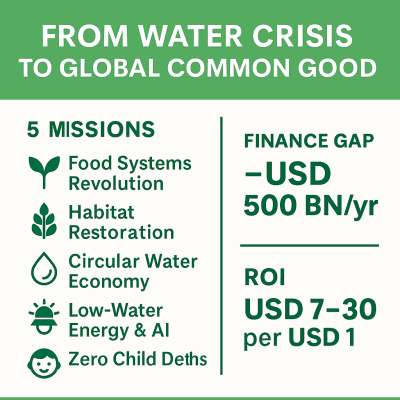
New Delhi (ABC Live): For centuries, water has been viewed as a local utility — managed through rivers, basins, and tariffs. The 2024 report “The Economics of Water: Valuing the Hydrological Cycle as a Global Common Good”, chaired by Tharman Shanmugaratnam, Ngozi Okonjo-Iweala, Mariana Mazzucato, and Johan Rockström, transforms that logic.
It proposes that the hydrological cycle itself — including rainfall, soil moisture, evapotranspiration, and glaciers — should be governed as a global common good, just as climate and biodiversity are.
This is a conceptual revolution. But does the economics match the ambition? And can the world afford not to act?
Methodology & Analytical Framework — How ABC Live Reports This
ABC Live applies its Performance Audit Model, designed to test large-scale international reports for Conceptual Innovation, Policy Feasibility, Economic Evidence, Data Integrity, and Justice Orientation.
| Audit Lens | Focus | Primary Source |
|---|---|---|
| Conceptual Rigor | Originality & integration of climate–water–biodiversity frameworks | GCEW Ch. 1–4 |
| Economic Evidence | Data credibility, ROI, and global investment arithmetic | GCEW Ch. 8–9 |
| Governance Feasibility | Institutional & treaty realism | GCEW Ch. 10 |
| Finance Mechanisms | Public/private finance design & subsidy re-allocation | GCEW Ch. 8 |
| Equity & Justice | Access, intergenerational equity, and inclusion | GCEW Preface + Ch. 11 |
Each dimension is scored on a 10-point scale using ABC Live’s Composite Quality Scorecard.
Conceptual Breakthrough — The Global Water Compact
The report’s greatest achievement lies in reframing water as the invisible connective tissue of all planetary systems. It introduces a dual-lens view of blue water (rivers, lakes, aquifers) and green water (soil moisture and evapotranspiration).
This systemic framing aligns with the Planetary Boundaries model, treating hydrological balance as a biophysical limit. The Commission calls for a Global Water Pact, elevating water to the same diplomatic footing as the Paris Agreement.
Yet, the report stops short of outlining a phased legal roadmap — how national sovereignty, river-basin rights, and atmospheric moisture governance would converge.
ABC Live recommends a tiered approach: basin compacts → regional water-justice charters → a UN-backed pact by 2035.
Data & Empirical Evidence — What the Numbers Show
The GCEW brings rarely unified global data:
- Green Water Dependence: 80% of cropland and over 50% of world’s food rely on rainfed systems, not irrigation.
- Water Storage Decline: Rapid losses in NW India, NE China, and Southern Europe threaten to cut global cereal output by 23%, risking 8–15% GDP losses by 2050 in major economies.
- Circular Economy Potential: Approximately 320 billion m³/year wastewater could be reused (around 8% of global withdrawals).
- 40% of urban water is lost to leakage — equivalent to US $39 billion annually.
- Treating this lost water emits 11.9 billion kg of CO₂ each year.
- Only 11% of domestic and industrial wastewater is currently reused.
ABC Live analysis:
At ₹20/m³ average cost, halving non-revenue water (NRW) in a large Indian city saves around ₹1,000 crore over 10 years — and cuts urban CO₂ emissions.
This is the most direct and financeable climate–water intervention available.
The Five Missions — Ambition with Uneven Metrics
| Mission | Global Target | ABC Live Commentary |
|---|---|---|
| 1. Food Systems Revolution | –33% irrigation water + higher yields; regenerative agriculture 15→50% cropland by 2050; 30% plant-based protein by 2050 | Strong alignment with SDG 2; needs income parity modelling for farmers and transition credit mechanisms. |
| 2. Habitat Restoration (Green Water) | Restore 30% degraded ecosystems and conserve 30% forests & wetlands by 2030 | Ecologically sound; requires spatial prioritisation and water budget valuation. |
| 3. Circular Water Economy | Halve leakage; 50% reuse; resource recovery from wastewater | Quantified and finance-ready; the core of a credible urban mission. |
| 4. Low-Water Energy and AI | Reduce water intensity in energy and data centres | Needs global benchmarks for cooling and mining footprints. |
| 5. Zero Child Deaths by 2030 | Universal safe water and sanitation access | Undercosted but aligns with UNICEF metrics and SDG 6. |
Financing the Transition — From Gaps to Just Partnerships
The Commission quantifies an annual USD 500 billion gap to meet SDG 6 in low-income countries.
It notes:
-
Only 9% of emerging-market water finance comes from private sources; in WSS, it is 1.7%.
-
Many governments still under-invest and operate reactively, leading to neglected assets and service leakage.
ABC Live comparison:
Global harmful agricultural subsidies amount to US $553 billion per year and water utility subsidies about US $300 billion per year, of which only 6% reach the poorest 20%.
Redirecting even 20% could fill the SDG gap and fund Just Water Partnerships — blended finance models similar to JETPs but anchored in equity.
Governance, Data & Institutional Design
The GCEW advocates a Global Water Data Infrastructure to track green and blue water flows, but integration with existing systems like AQUASTAT, GRACE, and SDG 6 portals is undefined.
ABC Live recommends developing a Water Disclosure Index aligned with ISSB and TCFD standards while embedding Indigenous data sovereignty protocols.
Decentralisation is another strength: the report notes that 25–70% of urban residents rely on informal service providers and highlights San Francisco’s building-scale reuse, which reduced potable demand by 40%.
This supports ABC Live’s call for hybrid utility ecosystems, where state utilities collaborate with off-grid actors through credit-linked tariffs and lifeline blocks.
Justice & Equity — Making Water System Justice Actionable
The report’s moral compass — Water System Justice — frames water as a right intertwined with human dignity, ecosystem stability, and intergenerational equity.
But the numbers reveal persistent inequality:
-
2.2 billion people still lack safe drinking water.
-
3.4 billion lack safe sanitation.
-
Blanket subsidies and low tariffs often hurt the poor by limiting service expansion.
ABC Live recommends universal lifeline water blocks and direct benefit transfers to protect vulnerable users while discouraging waste — a model already tested successfully in South Africa and the Philippines.
Comparative Performance Audit Scorecard
| Dimension | Score | Interpretation |
|---|---|---|
| Conceptual Innovation | 9/10 | Paradigm-defining shift in hydro-economics |
| Policy Feasibility | 6/10 | Needs phased roadmap and treaty sequencing |
| Economic Modelling | 5/10 | Normative vision without costed plans |
| Finance Architecture | 6/10 | Sound vision; weak risk structuring |
| Governance Blueprint | 6/10 | Global Pact undefined; data integration thin |
| Equity & Justice | 7/10 | Strong ethics; lacks binding mechanisms |
| Data & Transparency | 6/10 | Needs alignment with ISSB and SDG frameworks |
| Composite Quality Score | 6.4 / 10 (Moderate–High) | Intellectually brilliant but operationally immature |
Policy Math & Economic Rationale
- Leakage Reduction Payback: A 5% NRW cut in a 1 billion m³ system saves 50 million m³ — equivalent to about ₹1,000 crore in opex avoided over a decade.
- Forest Restoration ROI: ₹1,000 crore investment yields ₹7,000–₹30,000 crore equivalent in benefits from flood control, soil stability, and tourism.
- Climate Leverage: Cutting 11.9 billion kg CO₂ annually through NRW reduction equals approximately 30 million tonnes of CO₂ mitigation, comparable to a medium-sized country’s annual emissions reduction.
These metrics convert the Commission’s qualitative vision into quantifiable financial and carbon outcomes.
Why ABC Live Is Publishing This Report Now
By 2025, water will define geopolitics — from India’s Indus and Teesta basins to the Sahel and the American West. Yet, there is still no Paris Agreement for water.
ABC Live publishes this audit to:
- Translate the GCEW’s vision into actionable metrics for governments and DFIs.
- Highlight the economic and carbon ROI in leakage reduction and green-water restoration.
- Support India and the Global South in advancing toward a UN Water Compact by 2035.
This performance audit is part of ABC Live’s ongoing editorial series linking climate, finance, and justice through data-driven policy reviews.
Conclusion — From Ethics to Execution
The Economics of Water stands as one of the century’s most important environmental reports. It redefines economics through ecology and justice.
ABC Live finds its vision morally compelling and scientifically sound — yet institutionally incomplete.
The next challenge is execution: pricing water justly, repurposing harmful subsidies, and embedding justice in every drop.
References (Free Access)
- Global Commission on the Economics of Water (2024). The Economics of Water: Valuing the Hydrological Cycle as a Global Common Good. OECD & Government of the Netherlands
- OECD (2015). Principles on Water Governance. https://www.oecd.org/water/principles-on-water-governance.htm
- UN-Water (2024). SDG 6 Synthesis Report. https://www.unwater.org/sdg6-synthesis-report
- Dasgupta, P. (2021). The Economics of Biodiversity: The Dasgupta Review. HM Treasury, UK.
- Stern, N. (2006). The Economics of Climate Change: The Stern Review. Cambridge University Press.
Also, Read