
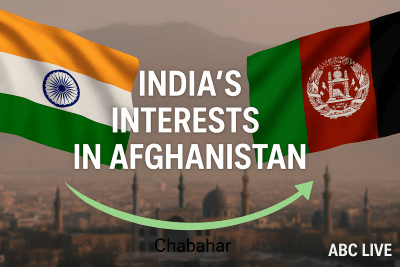
New Delhi (ABC Live): In October 2025, a quiet yet historic moment unfolded in New Delhi. For the first time since the Taliban regained power, Afghan Foreign Minister Amir Khan Muttaqi visited India.
His meetings with senior Indian officials, including External Affairs Minister S. Jaishankar, signalled a cautious reopening of dialogue.
Soon afterwards, India announced plans to restore a full embassy in Kabul.
For India, Afghanistan is more than a neighbour; it is a strategic corridor that connects security, trade, and diplomacy.
Moreover, it links South Asia with Central Asia’s energy and mineral wealth.
However, the Taliban’s return has reshaped every calculation.
India must now balance moral restraint with strategic necessity.
Therefore, this ABC Live report explains why New Delhi chose engagement over isolation.
It shows how India intends to protect its interests while supporting regional stability and humanitarian legitimacy.
Consequently, it offers a data-driven roadmap for policymakers seeking clarity in a complex environment.
When the Taliban captured Kabul in 2021, India faced one of its hardest foreign-policy tests.
However, by 2025, New Delhi had adopted a steadier and more pragmatic approach.
The visit of Amir Khan Muttaqi in October 2025 confirmed that shift.
It demonstrated that India would now engage directly, yet conditionally, with the Taliban.
India’s decision to reopen its embassy, therefore, marks a policy recalibration rather than recognition.
It ensures access to ground intelligence, humanitarian cooperation, and regional dialogue.
In addition, it reflects India’s acceptance that stability in Afghanistan cannot be achieved from a distance.
Furthermore, Afghanistan remains crucial to India’s energy and trade ambitions.
It connects South Asia to Eurasia’s resources and transit routes.
As a result, India’s engagement blends security vigilance, economic access, and diplomatic balance.
Guiding Doctrine: Engage to protect India’s interests — not to legitimise the Taliban regime.
1. Security and Counter-Terrorism Interests
1.1 Preventing Terror Sanctuaries
India’s foremost objective is to ensure that Afghan soil never again shelters extremist groups.
During the 1990s, Jaish-e-Mohammad, Lashkar-e-Taiba, and IS-Khorasan planned attacks from there.
Therefore, dialogue now serves a defensive purpose: it helps secure verifiable guarantees against renewed militancy.
Moreover, engagement keeps communication open, reducing the chance of miscalculation.
1.2 Maintaining Intelligence Reach
Re-establishing India’s mission in Kabul provides continuous on-ground visibility.
Consequently, Indian agencies can track border activity, monitor Chinese contractors, and coordinate faster with Central Asian partners.
In addition, direct contact improves crisis-response capacity and early-warning systems.
Thus, India strengthens prevention rather than reaction.
1.3 Encouraging Regional Deradicalisation
Although the Taliban’s ideology remains rigid, its desire for trade and legitimacy has introduced a degree of restraint.
Hence, consistent engagement encourages moderation through economic dependence.
Furthermore, a stable Afghanistan reduces the ideological export of extremism into South Asia.
In the end, dialogue becomes an indirect but effective counter-radicalisation tool.
2. Economic and Connectivity Interests
2.1 Gateway to Central Asia
Afghanistan functions as India’s gateway to energy-rich Central Asia.
Through it passes the TAPI gas pipeline and CASA-1000 power grid, both vital for regional energy security.
Moreover, Afghanistan’s mineral reserves—worth about US $1 trillion—contain lithium, copper, and rare earths essential to India’s green transition.
Therefore, India’s economic engagement directly supports its energy diversification goals.
2.2 Chabahar Port and INSTC
India’s investment in Iran’s Chabahar Port and the International North–South Transport Corridor (INSTC) offers a route that bypasses Pakistan.
As a result, goods can move from Mumbai to Kandahar and onward to Tashkent with fewer disruptions.
Furthermore, a peaceful Afghanistan would transform this corridor into a key Eurasian trade spine.
Thus, regional stability and India’s connectivity strategy are inseparable.
2.3 Trade as a Stabilising Instrument
During 2024–25, bilateral trade reached nearly US $1 billion.
India exported medicines and machinery; Afghanistan shipped saffron, dry fruits, and talc.
Most shipments used the Air Freight Corridor 2.0 and Chabahar route, which reduces dependence on Pakistani transit.
Consequently, trade now supports both livelihoods and diplomacy.
3. Geopolitical and Strategic Interests
3.1 Balancing Pakistan
Pakistan’s leverage in Kabul has weakened due to TTP violence and border clashes.
Hence, India views engagement as a means to limit Pakistan’s monopoly and restore regional balance.
Moreover, this policy prevents strategic encirclement and ensures independent access to Central Asia.
3.2 Countering China’s Expansion
China seeks to fold Afghanistan into the Belt and Road Initiative.
However, its model often creates debt and dependency.
In contrast, India offers development without dominance—providing aid, education, and connectivity.
Therefore, India positions itself as a constructive alternative in the region.
3.3 Working with Russia, Iran and Central Asia
Through the Moscow Format, SCO, and BRICS Plus, India coordinates with regional powers that share three priorities:
– no foreign bases,
– no terror export, and
– inclusive growth.
Furthermore, these multilateral forums strengthen India’s diplomatic autonomy.
3.4 Managing the U.S. Factor
When Donald Trump suggested “retaking Bagram” in 2025, regional anxiety spiked.
Nevertheless, India reaffirmed its “no-bases, all-aid” policy.
Consequently, it maintained credibility with both Washington and Eurasian partners.
Such a balance ensures strategic flexibility in a polarised world.
4. Humanitarian and People-Centric Interests
4.1 Legacy of Goodwill
Between 2002 and 2021, India invested more than US $3 billion in Afghan development.
Projects like the Salma Dam, Parliament Building, and rural clinics built durable goodwill.
Moreover, they continue to serve communities regardless of who governs Kabul.
Hence, India’s reputation rests on deeds, not declarations.
4.2 Women and Education
Despite Taliban restrictions, India sustains scholarships and digital-learning programs.
In addition, medical visas and maternal-health initiatives continue under UN partnerships.
Therefore, India keeps its moral voice alive while remaining practical.
4.3 Humanitarian Aid as Soft Power
Food aid and vaccines move through Chabahar Port and WFP channels.
Consequently, India helps stabilise livelihoods and reinforces trust.
Furthermore, these deliveries comply with sanctions rules, preserving legitimacy.
Each consignment strengthens India’s image as a responsible neighbour.
5. October 2025: The Diplomatic Turning Point
From 9–10 October 2025, Amir Khan Muttaqi’s Delhi visit became a milestone in India–Afghanistan relations.
Talks covered counter-terror cooperation, trade, and humanitarian issues.
Afterwards, India confirmed the upgrade of its Kabul mission to a full embassy.
Although the visit began with a controversy over women journalists, India’s firm response restored balance and transparency.
As a result, the engagement ended on a note of cautious optimism.
This visit confirmed that:
- India can engage without recognising the Taliban.
- Dialogue can deter threats.
- Regional legitimacy increasingly runs through New Delhi, not Islamabad.
6. Risk Assessment and Mitigation
| Risk | Chance | Impact | Mitigation |
|---|---|---|---|
| Taliban ignores CT pledges | Medium | High | Use conditional aid + visa restrictions |
| Human-rights backlash | High | Medium | Deliver aid via UN; amplify women’s programs |
| Border tension with Pakistan | Medium | High | Expand Chabahar and Air Corridor backups |
| U.S. re-basing attempt | Low | High | Reinforce “no-bases” consensus |
| Taliban infighting | Low | Medium | Maintain evacuation and continuity plans |
7. 2030 Scenarios
| Scenario | Probability | Outcome for India |
|---|---|---|
| Stable Taliban rule | 60 % | Maintain engagement; trade > US $1.5 bn |
| Moderate coalition government | 25 % | Broaden cooperation; consider partial recognition |
| Renewed civil conflict | 15 % | Prioritise humanitarian support and border security |
In every scenario, flexibility and evidence-based diplomacy remain essential.
8. Policy Takeaways
- Security First: Engage only with verifiable CT assurances.
- Trade as Leverage: Boost Air Freight and Chabahar capacity.
- Regional Dialogue: Use SCO and Moscow Format for crisis coordination.
- Humanitarian Continuity: Protect education and health initiatives.
- Adaptive Engagement: Scale relations up or down as situations change.
9. Why ABC Live Is Publishing This Report Now
ABC Live releases this analysis as India re-enters Afghanistan’s strategic arena.
The Muttaqi visit, the embassy reopening, and the regional stance against Bagram militarisation together mark a decisive moment.
Therefore, it is vital to measure how these developments affect India’s long-term interests.
Unlike headline-driven stories, this report translates events into verifiable outcomes.
Consequently, it helps readers understand how India converts vulnerability into influence through disciplined diplomacy.
10. How This Report Is Unique
| Aspect | ABC Live Method | Typical Coverage |
|---|---|---|
| Evidence Base | MEA data + COMTRADE + field sources | Opinion columns |
| Framework | Five dimensions – Security, Economy, Geo-strategy, Humanitarian, Depth | Single-issue focus |
| Performance Audit | Tracks CT benchmarks and trade flows | No quantifiable metrics |
| Forecasting | 2030 probability model | Event-centric analysis |
| Editorial Integrity | “Data before debate” ethic | Ideological tilt or donor bias |
Editorial Note
“At ABC Live, we audit policy through data, not declarations.
Our aim is to show how diplomacy performs in practice — where it succeeds and where it must adapt.”
This Afghanistan study is part of ABC Live’s Strategic Performance Audit Series, linking real data with national interest.
Conclusion
Afghanistan remains India’s continental test case.
Engagement with the Taliban is not endorsement; rather, it is a strategic adjustment to a changing region.
Therefore, India must continue balancing principle with pragmatism.
If done effectively, it will stand as a stabiliser in an uncertain neighbourhood.
India’s formula for the next decade: Engage without endorsing. Trade without depending. Influence through legitimacy, not force.
Reference (free access)
References
- “Afghanistan’s Taliban foreign minister visits India to build closer ties.” Reuters, Oct 9, 2025.
https://www.reuters.com/world/asia-pacific/afghanistans-taliban-foreign-minister-visits-india-build-closer-ties-2025-10-09/ - “India to reopen its embassy in Kabul, says Foreign Minister.” Reuters, Oct 10, 2025.
https://www.reuters.com/world/india/india-reopen-its-embassy-kabul-indian-foreign-minister-says-2025-10-10/ - “Afghanistan’s neighbours signal opposition to U.S. retaking Bagram base.” Reuters, Oct 8, 2025.
https://www.reuters.com/business/aerospace-defense/afghanistans-neighbors-signal-opposition-us-retaking-bagram-base-2025-10-08/ - “India and WFP sign agreement on wheat donation to people of Afghanistan.” WFP press release.
https://www.wfp.org/news/india-and-wfp-sign-agreement-fifth-tranche-wheat-donation-people-afghanistan - “Afghanistan–India trade over $1 billion in 2024–25 fiscal: Taliban.” Ariana News / KabulNow.
https://www.ariananews.af/afghanistan-india-bilateral-trade-over-1-billion-in-2024-25-fiscal/ - “India’s exports to Afghanistan.” Trading Economics.
https://tradingeconomics.com/india/exports/afghanistan - “India’s imports from Afghanistan.” Trading Economics.
https://tradingeconomics.com/india/imports/afghanistan - “No deliberate exclusion: Taliban foreign minister holds another presser, women journalists present.” Times of India.
https://timesofindia.indiatimes.com/india/no-deliberate-exclusion-taliban-foreign-minister-amir-khan-muttaqi-holds-another-presser-women-journalists-present/articleshow/124498291.cms - “Taliban minister Amir Muttaqi’s Taj Mahal visit called off, no reason known.” Hindustan Times.
https://www.hindustantimes.com/india-news/taliban-minister-amir-muttaqi-taj-mahal-visit-called-off-no-reason-known-yet-101760250620104.html - “Afghanistan Economic Monitor, July 2024.” World Bank document.
https://thedocs.worldbank.org/en/doc/0d1d30979ec71aaefff18558ad7c56c9-0310012024/original/Afghanistan-Economic-Monitor-July-2024.pdf
Also, Read