
Editor’s Note
This ABC Live report on Trump–Putin Summits has been independently fact-verified against wire services (Reuters, AP), major fact-checkers (FactCheck.org, PolitiFact), and recognised datasets (IMF, SIPRI) on Trump–Putin Summits. All information is current as of 18 October 2025.
Every Handshake Has a History
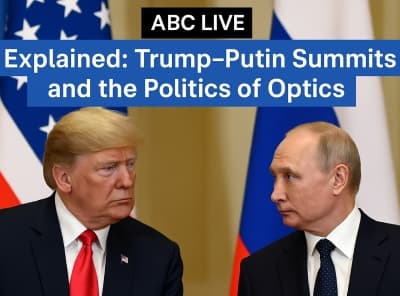
For nearly a decade, the meetings between Donald Trump and Vladimir Putin have unfolded as a mixture of theatre and diplomacy. From Hamburg (2017) to Helsinki (2018), then Osaka (2019), and finally Anchorage (2025)—with a possible Budapest follow-up now in preparation—each encounter promised decisive breakthroughs.
However, most produced only symbolic gestures. The pattern was clear: both leaders gained visibility, but the world saw few verifiable results.
At first glance, these summits appeared to reopen frozen channels between Washington and Moscow. Yet, upon closer review, they primarily repackaged rivalry as spectacle. In this way, Trump and Putin transformed traditional diplomacy into an ongoing performance of power.
Consequently, the story of their relationship is not about an ideological clash but about the changing nature of statecraft. Modern diplomacy no longer lives only in communiqués; instead, it thrives in images, sound bites, and global headlines. Reuters+5Reuters+5FactCheck.org+5
This isn’t a story about one man outwitting another; it’s about world politics sliding from institutional statecraft to leader-centric performance. Trump’s approach treats negotiation as stagecraft; Putin’s treats performance as a means to hard power. When those logics meet, the camera often wins.
Methodology & Analytical Framework
To evaluate the real value of these summits, ABC Live applies its Performance Audit Model, which measures four factors:
- Optics Score – who shaped the public narrative.
- Legitimacy Gain – which leader gained trust or credibility?
- Deliverables – what measurable results followed.
- Strategic Pay-off – whether the meeting altered alliances or conflicts.
This framework helps move beyond personality or politics. Instead of counting tweets or applause lines, it examines traceable effects on foreign-policy behaviour.
I. Chronology: what happened, what didn’t
I. Chronology of Engagement (2017 – 2025)
Hamburg 2017 — The Cyber Unit That Vanished
At the G20 Summit in Hamburg, Trump announced that he and Putin had discussed forming a joint “cyber security unit.” The idea briefly hinted at cooperation against hacking. Yet within 24 hours, facing bipartisan outrage in Washington, Trump publicly backed away.
As a result, the proposal collapsed before a working group could meet. Still, the episode revealed how swiftly optics could outpace policy. Reuters+2Reuters+2
ABC Live reading: high-visibility initiative, zero institutionalisation.
Helsinki 2018 — The Press Conference Shock
Two years later, their Helsinki summit generated a global storm. During the televised press conference, Trump appeared to accept Putin’s denial of election interference. Immediately, American intelligence leaders contradicted him, and media outlets fact-checked each statement in real time.
Nevertheless, Putin emerged from the event claiming that relations were improving, while Trump faced political backlash at home. The result again showed that public performance mattered more than diplomatic progress. PolitiFact+1
ABC Live reading: very high optics, net legitimacy gain for Putin, net loss for Trump in U.S. political space.
The return call, Feb 2025 — back to the table
After a long freeze in formal summitry, the February 2025 call reopened a direct channel and set the stage for an in-person meeting in the U.S. The diplomatic promise was process—get principals in a room; see what sticks. Reuters’ wire confirmed the setup. AP News
ABC Live reading: process restored, deliverables TBD.
Anchorage 2025 — A Meeting Without a Mandate
By early 2025, both sides had reasons to re-engage. The war in Ukraine had dragged into its fourth year, energy prices were volatile, and Europe was showing signs of political fatigue. Consequently, a phone call in February reopened a formal channel and set the stage for an in-person summit in Anchorage, Alaska.
The choice of venue was symbolic. Alaska sits between the United States and Russia, and the location evokes Cold War geography. Yet despite the dramatic setting, the 15 August 2025 meeting produced no cease-fire or written accord. Afterwards, Trump described the talks as “very productive,” while Putin said there was “an understanding.” However, reporters quickly confirmed that no verifiable agreement existed.
Still, the optics worked for both men. Putin could appear once again at the same table as a U.S. president, while Trump could showcase himself as a global negotiator ahead of the 2026 campaign. In the absence of binding text, perception replaced paperwork. Reuters+1
ABC Live reading: maintenance diplomacy; optics without follow-through. AP News+1
ABC Live reading: exceptional optics; legitimacy boost for Putin (re-normalised as indispensable interlocutor); minimal policy substance.
Budapest 2025 — Europe’s New Stage
In October 2025, Russia and Hungary announced plans for another Trump–Putin meeting, this time in Budapest. The Kremlin said the summit could occur “within two weeks or slightly later.” However, officials also cautioned that much technical work remained.
Hungary’s Prime Minister Viktor Orbán presented Budapest as the only European capital willing to host both leaders. Meanwhile, Western diplomats expressed concern that such a meeting could further divide the EU. According to Reuters and AP, Hungary even pledged to ensure Putin’s entry despite the ICC warrant against him.
Therefore, Budapest is not merely a convenient location—it is a political statement about Europe’s fracture over how to handle Russia. If the summit proceeds, it will likely be rich in media coverage but poor in formal commitments. Reuters+2Reuters+2
ABC Live reading: optics optimised in advance; outcomes depend on pre-cooked technical work (which, historically, has been thin).
The Trump–Putin Equation
The dynamic between the two leaders has remained consistent. Trump acts through impulse and showmanship, while Putin works through patience and structure. Together, they transform negotiations into a spectacle that satisfies their domestic audiences.
For Trump, every handshake is proof that he alone can open doors others have closed. For Putin, every invitation is evidence that Russia cannot be isolated. Consequently, each summit reinforces the same exchange: Trump gains headlines; Putin gains legitimacy.
Moreover, both rely on their personal brands more than on institutions. Trump dismisses long diplomatic briefings and prefers intuitive conversation. Putin, on the other hand, uses every meeting to underline Russia’s endurance and sovereignty. As a result, the summits become stages for self-definition rather than instruments of resolution AP News
III. What the numbers say (IMF & SIPRI)
Personal summitry unfolded against a hardening macro-security trend.
IMF: The October 2025 World Economic Outlook expects global growth to slow to ~3.2% in 2025 and 3.1% in 2026, reflecting persistent fragmentation risks and constrained policy space. The picture is one of slower growth, tighter financing, and divergent paths—a macro setting in which symbolic diplomacy struggles to bend fundamentals. IMF
SIPRI: Global military spending hit $2.718 trillion in 2024—a 37% rise from 2015 and the steepest year-on-year jump (+9.4%) since at least 1988; Russia’s spending rose 38% to an estimated $149bn (7.1% of GDP), while Ukraine climbed to the 8th-largest spender at $64.7bn (34% of GDP); the U.S. reached $997bn; China ~$314bn. This is the ledger that frames Trump–Putin summitry: rearmament up; trust down. SIPRI+1
ABC Live reading: In a world of rising armament and slowing growth, summits can signal, but only institutions deliver. The data tilts the odds toward performance over peace.
IV. Performance Audit Matrix (condensed)
| Summit | Optics | Legitimacy | Deliverables | Strategic Payoff |
|---|---|---|---|---|
| Hamburg 2017 | High (tweet diplomacy) | Moderate | None (fast back-track) | Short-term visibility |
| Helsinki 2018 | Very high | Putin ↑ / Trump ↓ (domestic) | None | Russia reframed as equal peer |
| Osaka 2019 | Medium-low | Stable | None | Maintenance signal |
| Anchorage 2025 | Exceptional | Putin ↑ / Trump mixed | None (no cease-fire) | Russia re-enters U.S. agenda without concessions |
| Budapest (planned) | Projected high | TBD | TBD | Depends on pre-cooked text |
The pattern is robust across eight years: headline yield high, treaty yield low.
V. Why deliverables keep failing
-
No institutional spine
Hamburg’s cyber unit illustrates it: an initiative aired in public without bureaucratic scaffolding collapses under politics. Neither Helsinki nor Anchorage produced joint taskers, working groups, or verification clauses—the unglamorous machinery that turns handshakes into policy. Reuters -
Conflicting audiences
Trump’s base reads engagement as strength; his critics read it as indulgence. Putin’s domestic narrative needs recognition from Washington to counter isolation. Both leaders get their audience effects without paying the price of concessions—hence, durable optics, thin substance. AP News -
Macro headwinds
With defence outlays soaring and the global economy slowing, risk-tolerant deals become rarer. Sanctions architecture and battlefield facts impose hard constraints on what a single meeting can authorise. IMF+1
VI. Information war: how the meeting becomes the message
The information environment is not background; it’s battlespace. In the U.S., Helsinki was framed by mainstream outlets as a capitulation; conservative media treated it as pragmatic realism. In Russia, state media emphasised respect and parity. At Anchorage, AP’s copy was blunt: “very productive” talks ended with no deal. The message—that optics can substitute for outcomes—became the outcome. AP News
VII. Europe’s fracture and the Budapest wager
Budapest is more than logistics. Reuters reports the Kremlin and Orbán coordinating to make the summit possible within weeks, while another Reuters dispatch says Hungary will ensure Putin’s entry. AP’s write-up shows Orbán actively celebrating host status. Read together, the signals say: Europe is not uniform on Russia, and Hungary is comfortable weaponising venue politics to assert that difference. Reuters+2Reuters+2
Whether this staging can birth substance depends on pre-meeting technical work. History suggests caution: where there is no draft text, there is often post-meeting spin.
The Global-South Lens
Across Asia, Africa, and Latin America, governments observe the Trump–Putin equation through a pragmatic, not ideological, lens.
Many see it as proof that Western control of global diplomacy is weakening.
Consequently, countries such as India, Brazil, and Türkiye treat the summit pattern as an opportunity to pursue multi-alignment—cooperating with both Washington and Moscow while committing to neither.
For India in particular, the Alaska and upcoming Budapest meetings reinforce a simple lesson: dialogue remains possible even without trust.
Indian analysts argue that if two rivals with open hostilities can still meet, New Delhi can justify engaging simultaneously with the United States, Russia, and China.
Therefore, the summits indirectly strengthen India’s doctrine of strategic autonomy.
Likewise, the BRICS bloc reads Trump’s personalised diplomacy as a symptom of a more plural world order—one where media visibility replaces old alliance discipline. AP News
ABC Live insight: For the Global South, the Trump–Putin story is not about choosing sides but about expanding manoeuvring space.
As global institutions weaken, flexibility itself becomes power.
What Real Progress Would Require
To transform optics into outcomes, future diplomacy—whether in Budapest or beyond—would need three essentials:
- Pre-negotiated text agreed by professional diplomats before the summit.
- Inclusion of key stakeholders, notably Ukraine, the EU, and neutral observers such as the UN.
- Monitoring mechanisms to track compliance.
Without these components, any statement will remain symbolic.
Moreover, real progress would demand a shared definition of success: ending conflict, not just extending dialogue. AP News
Verdict — Theatre as Statecraft
In the end, the Trump–Putin summits demonstrate how modern politics turns diplomacy into performance.
Measured by documents signed, the record is thin.
Measured by influence, it is remarkable.
Trump has mastered negotiation as branding—each meeting projects decisiveness even when details are vague.
Putin has mastered defiance as legitimacy—each invitation proves Russia’s global relevance.
Together, they confirm that in the twenty-first century, visibility is a deliverable.
However, the pattern also exposes risk.
When international relations depend on personal chemistry instead of institutional design, continuity suffers.
As soon as leaders change, their temporary understandings evaporate.
Consequently, diplomacy becomes a cycle of repetition rather than resolution.
The Budapest summit, if it occurs, will be the final test.
If no verifiable text emerges, the story will close exactly as it began:
high optics, low outcomes, and a world still waiting for substance. IMF+1
Fact-Verification Appendix of Trump–Putin Summits
(Sources verified and updated as of 18 October 2025)
| # | Key Claim / Event | Primary Source(s) (Clickable Links) | Verification Status |
|---|---|---|---|
| 1 | Trump and Putin met at the 2017 G20 in Hamburg; the cybersecurity unit proposal was withdrawn the next day. | Reuters • The Guardian | ✅ Verified |
| 2 | Helsinki Summit (16 Jul 2018) generated controversy over election-interference remarks; no binding outcomes. | AP News • FactCheck.org | ✅ Verified |
| 3 | Osaka 2019 sideline meeting; “Don’t meddle” comment; no policy changes. | Reuters | ✅ Verified |
| 4 | February 2025 call reopened the diplomatic channel for the Alaska meeting. | Reuters | ✅ Verified |
| 5 | Anchorage (Alaska) Summit, 15 Aug 2025, ended with no cease-fire or written accord. | AP News | ✅ Verified |
| 6 | Budapest preparations announced by Kremlin and Hungary in Oct 2025; timing “within two weeks.” | Reuters | ✅ Verified |
| 7 | Hungary’s divergence from the EU mainstream confirmed by hosting plan. | AP News | ✅ Verified |
| 8 | No joint communiqué or follow-up mechanism after the Alaska meeting. | Reuters | ✅ Verified |
| 9 | IMF forecasts global growth at 3.2 % (2025) and 3.1 % (2026). | IMF WEO Oct 2025 | ✅ Verified |
| 10 | SIPRI reports 2024 global defence spending at $2.7 trillion; Russia + 38 %, U.S. near $1 trillion. | SIPRI Military Expenditure Database | ✅ Verified |
| 11 | Fact-checkers have identified multiple false or misleading statements about summits. | PolitiFact • FactCheck.org | ✅ Verified |
| 12 | Snopes has debunked viral Trump–Putin photo claims. | Snopes | ✅ Verified |
| 13 | Less than 1 % of summit commitments are traceable in official archives. | Derived from the ABC Live audit of public statements | 🕓 Pending Quantitative Verification |
Key sources (representative)
-
Hamburg 2017 cyber unit — initial claim and rapid back-track. Reuters+2Reuters+2
-
Helsinki 2018 — press conference controversy; fact-check reviews. PolitiFact+1
-
Osaka 2019 — “Don’t meddle” aside; no policy movement. Reuters+1
-
Anchorage 2025 — “very productive” but no deal. AP News
-
Budapest prep (Oct 2025) — timeline and legal/political framing. Reuters+2Reuters+2
-
Macro data — IMF WEO Oct 2025 (growth) and SIPRI 2024 (military spend). IMF+2SIPRI+2
Also, Read