
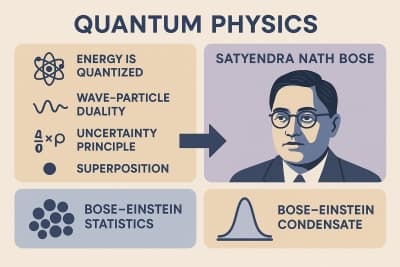
New Delhi (ABC Live): In 1924, Satyendra Nath Bose challenged classical physics with a paper so radical that Einstein himself translated and published it. Together they predicted a new state of matter — the Bose–Einstein Condensate. That equation gave birth to modern quantum theory, the foundation of lasers, semiconductors, and quantum computers.
Decades later, Dr. A. P. J. Abdul Kalam turned such imagination into infrastructure — missiles, satellites, and digital dreams. Bose expanded human understanding; Kalam expanded India’s capabilities.
Uniting them forms the soul of Quantum Bharat 2047 — a scientific and civilizational mission to make India a knowledge powerhouse.
India’s Quantum Opportunity: Data and Direction
The Moment in Numbers
| Metric | 2024–25 Value | 2030 Projection | Source |
|---|---|---|---|
| NQM Budget | ₹ 6,003.65 crore | — | DST [1] |
| Start-ups Founded (2023–25) | > 40 | 150 + | DST [2] |
| Quantum Computing Market | US $ 68.7 M (2024) | US $ 231.8 M (2030) | Grand View Research [3] |
| CAGR | ≈ 22.9 % | — | Grand View Research [3] |
| India’s Global Rank (Quantum Start-ups) | 6th | Top 5 Target | Times of India [4] |
Interpretation
India possesses intellectual capital and institutional infrastructure, but lags in hardware production and funding speed. The National Quantum Mission’s first-phase grants are a strong start; the next step is coordination, commercialization, and consistency.
By 2031, India can transition from research follower to rule-maker if it adopts Bose’s clarity and Kalam’s execution.
The Bose Principle for Policy Design
| Bose’s Concept | Policy Application |
|---|---|
| Indistinguishability | Shared testbeds & open datasets for universal access |
| Collective Coherence | Academia–Industry–Startup consortia with common KPIs |
| Quantized Energy | Outcome-linked funding cycles |
| Statistical Elegance | Public dashboards for patents and grants |
Bose proved that cooperation produces order in nature. India’s policy must mirror that coherence.
Strategic Framework for Quantum Leadership
Bose Center for Quantum Excellence (BCQE)
National hub integrating IISc, IITs, ISRO & DRDO; governed by PM-STIAC; divisions in Computing, Communication, Sensing & Materials.
Goal: convert research into prototypes to exports.
National Quantum Grid (NQG)
2,000 km quantum-secure network connecting Delhi–Bengaluru–Hyderabad–Mumbai–Gandhinagar by 2028 with ISRO QKD satellite links and C-DOT fiber nodes [5][6].
Make in Quantum India (MIQI)
Domestic production of cryogenics, lasers, and quantum chips at SCL Chandigarh; target 50 % import substitution by 2030.
Talent and Education
-
100 National Bose Fellowships (PhD).
-
Bose–Kalam Young Scholars Network (1,000 students).
-
Quantum Curriculum 2.0 in 25 universities by 2026.
-
500 Young Bose Clubs linking physics and AI.
The Bose–Kalam Quantum Bharat Call
“You are the generation that will finish Bose’s equation and realize Kalam’s dream.”
| Initiative | Description | Goal |
|---|---|---|
| Bose–Kalam Fellowships | Lab internships for UG/PG students | 1,000 per year |
| Quantum Bharat Lectures | Campus talks nationwide | 1 lakh students |
| Innovation Challenge | Algorithm hackathons | 100 prototypes |
| Science Week (1–8 Jan) | Bose birthday & Kalam tribute | Annual event |
This movement makes science aspirational again — a patriotic act of creation.
Policy Recommendations
- ₹ 1,000 crore Bose–Kalam Innovation Fund for deep-tech start-ups.
- Bose Digital Archive (open manuscripts & letters).
- Quantum Bharat Dashboard for real-time transparency.
- Quantum-Ready India Stack (PQC for UPI & Aadhaar).
- Bose–Einstein Global Framework (Germany-Japan-US collaboration).
- BRICS Quantum Standards Cell at GIFT City.
Milestones & Metrics
| Indicator | 2025 | 2031 Target |
|---|---|---|
| Research Papers | ≈ 250 | 1,000 + |
| Start-ups | 53 | 150 + |
| Hardware Made in India | < 10 % | > 50 % |
| Quantum-Safe Systems | Pilot | Nationwide |
| Students Trained | 5,000 | 1 lakh |
| Patents | < 100 | 1,500 + |
Why Bose Still Matters
Bose reminds us that humility and rigour create lasting impact. His work embodied cooperation between mind and matter. In a world driven by speed, his discipline teaches depth. Kalam extended that ethic to national service. Together, they show India how to balance faith in reason with faith in self.
Why ABC Live Is Publishing This Report Now
1. Centenary of Bose’s Quantum Revolution
2024–25 marks 100 years since Bose’s paper with Einstein. At the same moment, India’s National Quantum Mission has entered its implementation phase. ABC Live publishes this whitepaper now to honour a century of Indian scientific thought and spark a fresh policy conversation.
2. India’s Strategic Window
With global rivals commercializing quantum hardware, India’s QKD trials and quantum-grid projects represent a rare leap-frog opportunity. Documenting these developments today ensures future accountability and policy continuity.
3. Bose and Kalam — A Unifying Legacy
Twenty years after Kalam’s Vision 2020, this report bridges his applied mission with Bose’s pure science, creating a national philosophy of innovation that is both ethical and ambitious.
4. Policy Timeliness
DST, MeitY and DRDO are synchronising their quantum funding. ABC Live publishes now to evaluate readiness and highlight what India must do to move from plan to performance.
Why This Report Is Unique
- Science + Statecraft: Connects physics with governance and economics.
- Legacy to Policy: Applies Bose’s collective-coherence principle to institutional design.
- Data-Driven: Uses verified sources — DST, PIB, TEC, Grand View Research.
- Youth Focus: Launches a national student mobilization plan.
- Global South Lens: Frames India as a standard-setter for equitable quantum growth.
- Aligned with ABC Live’s Mission: Connecting policy to people through data.
Conclusion
Reimagining Bose is not nostalgia; it is a blueprint for scientific sovereignty. By uniting Bose’s intellect and Kalam’s vision, India can define a new era of technological ethics and global leadership.
“From Bose’s Equations to Kalam’s Vision — India Leads the Quantum Age.”
Verified References
- DST India – National Quantum Mission (2023)
- DST – Call for Proposals (2025)
- Grand View Research – India Quantum Computing Market Outlook
- Times of India – India’s Quantum Investment Rankings (2025)
- PIB – C-DOT QKD Demo (2025)
- TEC – Third International Quantum Conclave (2024)
- ICSI Journal – Start-Ups and India’s National Quantum Mission (2025)
Also, Read