
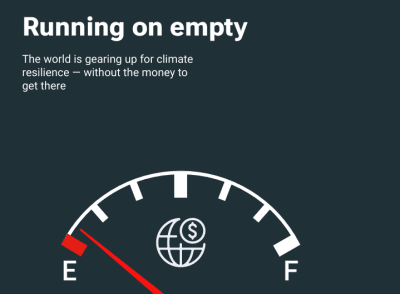
New Delhi (ABC Live): The UNEP Adaptation Gap Report 2025: “Running on Empty” is more than an annual publication—it is a benchmark for judging how the world responds to the climate crisis. This report, produced under the United Nations Framework Convention on Climate Change (UNFCCC), combines scientific accuracy, fiscal analysis, and institutional credibility to assess how prepared nations are for climate adaptation.
Institutional and Political Credibility
The report’s strength begins with its origin. It comes directly from the United Nations Environment Programme (UNEP), the UN’s leading environmental authority. Because of this, it carries global recognition and legitimacy. The 2025 edition feeds into COP 30 in Belém, Brazil, aligning with the Baku to Belém Roadmap to 1.3T, a plan to mobilize $1.3 trillion annually for climate adaptation in developing nations by 2035.
Furthermore, UNEP developed this report with respected partners such as the Stockholm Environment Institute (SEI), IISD, LSE Grantham Institute, UNEP-CCC, and Climate Policy Initiative (CPI). Funding from Irish Aid, Horizon Europe, IDRC Canada, and the Zurich Climate Resilience Alliance adds to its credibility. These diverse partnerships reduce bias and ensure a balanced, evidence-based perspective.
Scientific and Methodological Strength
The Adaptation Gap Report follows IPCC-aligned methods to define and measure adaptation, resilience, and vulnerability. It relies on:
-
National Adaptation Plans (NAPs)
-
Nationally Determined Contributions (NDCs)
-
Biennial Transparency Reports (BTRs)
-
Climate finance data from OECD and multilateral banks
By converting all figures to constant 2023 prices, the report accurately shows that developing countries will need between US $310–365 billion per year by 2035. However, adaptation finance reached only US$26 billion in 2023, revealing a serious shortfall.
The report does not hide these realities—it highlights them clearly, using transparent assumptions and verifiable data. This transparency makes the analysis more reliable and easier to interpret for policymakers.
Independent Review and Transparency
AGR 2025 stands out because of its open peer-review system. Over 40 independent experts from the Asian Development Bank, OECD, GEF, and UNDP reviewed its findings. Authors from leading global research institutions contributed chapters, which ensures a diversity of views and expertise.
UNEP also clarifies that the views expressed are those of the authors, not of UNEP itself. This separation safeguards academic independence and prevents political influence. As a result, the report’s conclusions feel balanced, realistic, and grounded in evidence rather than advocacy.
Economic Insights and Analytical Depth
The 2025 edition digs deeper into the economics of adaptation. It shows how non-concessional loans now exceed concessional loans, especially in middle-income countries, creating what UNEP calls the “adaptation debt trap.” It also projects that by 2035, inflation-adjusted needs could rise to $440–520 billion per year, far above the $300 billion NCQG goal.
Moreover, it distinguishes between concessional loans, grants, and debt-based instruments—offering policymakers a full picture of global adaptation finance. This honesty and precision make the report a trusted fiscal compass for climate negotiators.
Comparison with Other Global Assessments
Unlike the IPCC’s Working Group II reports, which focus on scientific impacts, AGR 2025 merges science, economics, and governance. It transforms adaptation research into financial accountability metrics, turning climate resilience into measurable, fundable goals.
This bridging role—between pure science and applied finance—makes AGR 2025 uniquely valuable. It complements the IPCC rather than competing with it.
Limitations and Acknowledged Uncertainties
No assessment is flawless, and AGR 2025 acknowledges its limits. It notes that:
-
Some countries have not yet submitted updated BTRs.
-
Private-sector adaptation finance remains under-reported.
-
Certain donor datasets might exaggerate adaptation spending.
By openly stating these gaps, UNEP strengthens rather than weakens the report’s credibility. Transparency about uncertainty shows intellectual honesty, which is essential for trust.
Policy Relevance and Global Impact
The Adaptation Gap Report directly shapes international negotiations. Its findings influence:
-
The New Collective Quantified Goal (NCQG) on climate finance,
-
Global Goal on Adaptation indicators, and
-
Finance Ministerial Dialogues on loss and damage.
Previous editions have already been cited in more than 1,500 research and policy papers, proving its academic and diplomatic reach. Governments, development banks, and think tanks routinely use AGR findings as the baseline for national adaptation planning.
Worthiness Scorecard
| Category | Evaluation | Notes |
|---|---|---|
| Institutional legitimacy | ⭐⭐⭐⭐⭐ | UNEP report under the UNFCCC framework |
| Scientific accuracy | ⭐⭐⭐⭐⭐ | IPCC-aligned definitions and methods |
| Economic transparency | ⭐⭐⭐⭐ | Real-term estimates and fiscal modelling |
| Peer review | ⭐⭐⭐⭐⭐ | 40+ international experts |
| Policy integration | ⭐⭐⭐⭐⭐ | Key input to COP30 and NCQG goals |
| Disclosure and openness | ⭐⭐⭐⭐ | Clear about data gaps and limitations |
Conclusion: A Benchmark for Adaptation Accountability
The UNFCCC Adaptation Gap Report 2025 deserves recognition as a scientifically credible, institutionally sound, and policy-relevant document. It combines UN-level legitimacy with independent scholarship, balancing transparency and precision.
Its worthiness comes from four key strengths:
- Scientific legitimacy through IPCC-based definitions
- Institutional authority under the UNEP-UNFCCC system
- Methodological clarity in measuring costs and finance
- Ethical transparency about uncertainties and authorship
In the global climate governance landscape, AGR 2025 stands as a moral and empirical benchmark—a reminder that adaptation without financing is only a promise. Its message is simple yet urgent: the world is gearing up for climate resilience, but without the money, it will never get there.
Read the Complete report. Click here