
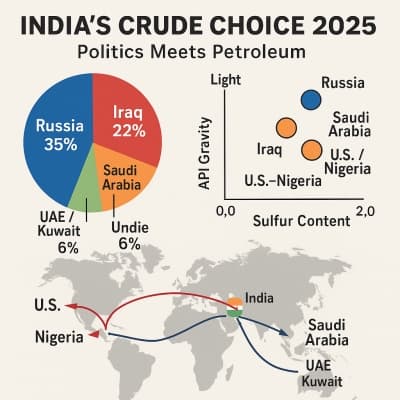
New Delhi (ABC Live): India’s Crude Choice: In today’s world, oil is not only fuel — it is a source of strategic power.
Every tanker leaving the Persian Gulf, the Black Sea, or the U.S. coast carries more than crude; it also carries political intent, economic leverage, and diplomatic pressure.
For India, this connection between energy and power is both vital and complex.
Its fast-growing economy, expanding at 6–7 per cent each year, requires vast energy supplies. Moreover, because the country imports nearly 85 per cent of its crude oil, spending about US $180 billion annually, energy prices strongly influence inflation, trade balance, and currency stability.
After Russia invaded Ukraine in 2022, global oil routes changed dramatically. While Western countries imposed sanctions and a price cap on Moscow, India and China continued to purchase discounted Russian barrels. Consequently, India gained new diplomatic leverage, becoming a bridge between Washington, Moscow, and the Gulf.
However, behind this political manoeuvring lies a practical truth: Indian refineries are engineered for medium-to-heavy sour crude, not the lighter grades favoured in the West. Therefore, technical design, not political alignment, continues to guide India’s choices.
In short, India’s crude policy is pro-economy, pro-margin, and pro-security rather than pro-any bloc.
How India’s Refineries Work
India’s refining network — 255 million tonnes a year (≈ 5.1 million b/d) — is the fourth largest in the world.
It was deliberately built for flexibility; however, most facilities are optimised for heavier, cheaper grades.
| Type | PSU Refineries (IOCL, BPCL, HPCL) | Private Refineries (RIL Jamnagar, Nayara Vadinar) |
|---|---|---|
| Nelson Complexity Index | 5 – 8 | 11 – 15 |
| Crude Preference | Light – Medium | Medium – Heavy |
| Output Focus | Domestic fuels | Exports + Domestic |
➡ Therefore, the system naturally favours medium-to-heavy sour crude rather than light-sweet oil.
India’s Crude Supply (2024–25)
| Country | Share of Imports | Typical Grade | Quality | Comment |
|---|---|---|---|---|
| Russia | 30 – 35 % | Urals | Medium-Sour | Large discounts post-sanctions |
| Iraq | 20 – 23 % | Basrah Medium/Heavy | Sour | Stable long-term contracts |
| Saudi Arabia | 16 – 18 % | Arab Light/Medium | Sour | Core Gulf partner & OPEC anchor |
| UAE & Kuwait | 8 – 10 % | Upper Zakum / Kuwait Export | Medium-Sour | Reliable suppliers |
| U.S. / Nigeria | 5 – 7 % | WTI Midland / Bonny Light | Light-Sweet | Used mainly for blending |
(Source: PPAC 2025 Crude Import Bulletin)
Why Sour Crude Makes Sense in India’s Crude Choice
| Factor | Benefit |
|---|---|
| Lower Price | Sour oil costs US $4 – 10 less per barrel than Brent. |
| Better Margins | Complex plants profit by upgrading low-grade oil into BS-VI fuel. |
| Higher Diesel Yield | Heavy crude produces more distillates, India’s export strength. |
| Blending Flexibility | Light-sweet oil helps meet clean-fuel standards. |
| Supply Security | Multiple sources reduce political and logistical risk. |
As a result, sour crude remains the logical, profitable choice for India’s refining sector.
The Role of U.S. Crude: Cleaner but Costlier
U.S. exports — mainly WTI Midland and Eagle Ford Light — offer high quality but come at a price.
Advantages
-
Ultra-low sulfur (< 0.3 %) supports BS-VI fuel standards.
-
Improves gasoline and jet-fuel octane ratings.
-
Strengthens U.S.–India energy partnership.
Drawbacks
-
Long voyage (35–40 days vs 5 from the Gulf) raises freight costs.
-
Landed price ≈ US $81/bbl vs Urals US $68 and Basrah US $73.
-
Excess light feed can lower profit margins.
Therefore, U.S. crude is best used as a 5–10 per cent blend to enhance fuel quality without hurting economics.
Comparative Snapshot
| Attribute | U.S. WTI Midland | Iraqi Basrah Medium | Russian Urals |
|---|---|---|---|
| API Gravity (°) | 40 | 31 | 32 |
| Sulfur (%) | 0.25 | 2.1 | 1.3 |
| Landed Cost (2025) | ≈ US$81/bbl | ≈ US$73/bbl | ≈ US$68/bbl |
| Voyage Time | 35–40 days | 5–6 days | 10–12 days |
(Data Sources: IEA Oil Market Report 2025, Argus Media, Reuters Energy)
Politics Meets Petroleum
Because energy shapes foreign relations, India follows a policy of strategic multi-alignment.
-
Middle East: Term contracts ensure a steady supply; meanwhile, joint ventures secure investments.
-
Russia: Discounted barrels since 2022 help contain domestic fuel prices.
-
United States: Expanding exports and clean-energy ties deepen strategic cooperation.
-
OPEC+: Production cuts directly affect India’s import bill and inflation.
Therefore, India buys from every side without taking sides, turning its refining capacity into a tool of balanced diplomacy.
Policy and Transition Outlook
India’s refining policy is shifting alongside its climate commitments.
Furthermore, BS-VI norms continue to support sour-crude hydrotreating capacity, while Strategic Petroleum Reserves filled with Basrah and Arab Light provide energy resilience.
In addition, refineries are preparing for a low-carbon future by investing in bio-oil blending, hydrogen co-processing, and carbon capture technologies.
Key Takeaways
- India’s refineries are optimised for medium-to-heavy sour crude.
- U.S. light oil improves clean-fuel quality and diplomatic balance.
- Russian and Gulf supplies remain the cornerstone of price stability.
- Refinery modernisation and green transition must progress together.
Conclusion: Economics Over Politics
Ultimately, India’s crude policy is an exercise in pragmatism over posturing.
By transforming low-cost sour oil into high-grade BS-VI fuels and exporting surpluses, India turns import dependence into a strategic strength. Meanwhile, blending light U.S. crude enhances flexibility and environmental performance.
Economics decide what India buys; diplomacy decides how it arrives.
Verified References
Government of India Sources
- Petroleum Planning & Analysis Cell (PPAC) — Import & Export of Crude Oil and Petroleum Products
- PPAC — Installed Refinery Capacity (as on 1 April 2025)
- PPAC — Monthly Report on Crude Oil Production and Imports (May 2024 Web Version PDF)
- PPAC — India’s Oil & Gas Ready Reckoner FY 2025-26 (H1)
- PPAC — International Price of Crude (Oil Indian Basket)https://ppac.gov.in/download.php?file=rep_studies%2F174https://ppac.gov.in/download.php?file=rep_studies%7829499_Final_202405_Monthly_Report_WebVersion.pdf
- Press Information Bureau (PIB) — BS-VI Fuel Quality Standards (10 ppm Sulphur)
- Indian Oil Corporation (IOCL) — BS-VI Fuel Media Brief (PDF)
- International Council on Clean Transportation (ICCT) — India BS-VI Fuel Policy Updahttps://www.pib.gov.in/Pressreleaseshare.aspx?PRID=1844628&utm_source=chatgpt.comte (PDF)
- Indian Strategic Petroleum Reserves Ltd (ISPRL) — About Us and Capacity Details (5.03 MMT)
International Agencies & Energy Reports
10. International Energy Agency (IEA) — Oil Market Report — September 2025
11. IEA — Oil Market Report — October 2025
12. OPEC — Monthly Oil Market Report — September 2025 (PDF)
13. OPEC — Monthly Oil Market Report Archive Hub
14. U.S. Energy Information Administration (EIA) — U.S. Crude Exports to India (Monthly Series)
15. EIA — Spot Prices: Brent and WTI (Reference Series)
Market & Media Sources
16. Reuters — Russian Oil Discounts Widen as Indian, Chinese Refiners Cut Purchases (6 Nov 2025)
17. Reuters — Urals Sells at Narrowest Discounts Since 2022 (6 Jun 2025)
18. Reuters — India’s Russian Oil Imports to Rise in September 2025 (28 Aug 2025)
19. Reuters — U.S. Crude Exports to India Hit 2-Year High (6 Mar 2025)
20. Argus Media — WTI Midland Methodology and Benchmark Specification
21. ExxonMobil — WTI Light Crude Assay (API & Sulphur Data, PDF)
Also, Read
Explained: How India Can Secure Its Energy Future (2025–2070)
Explained: Why India Should Face Trump Tariffs with Tech Depth