
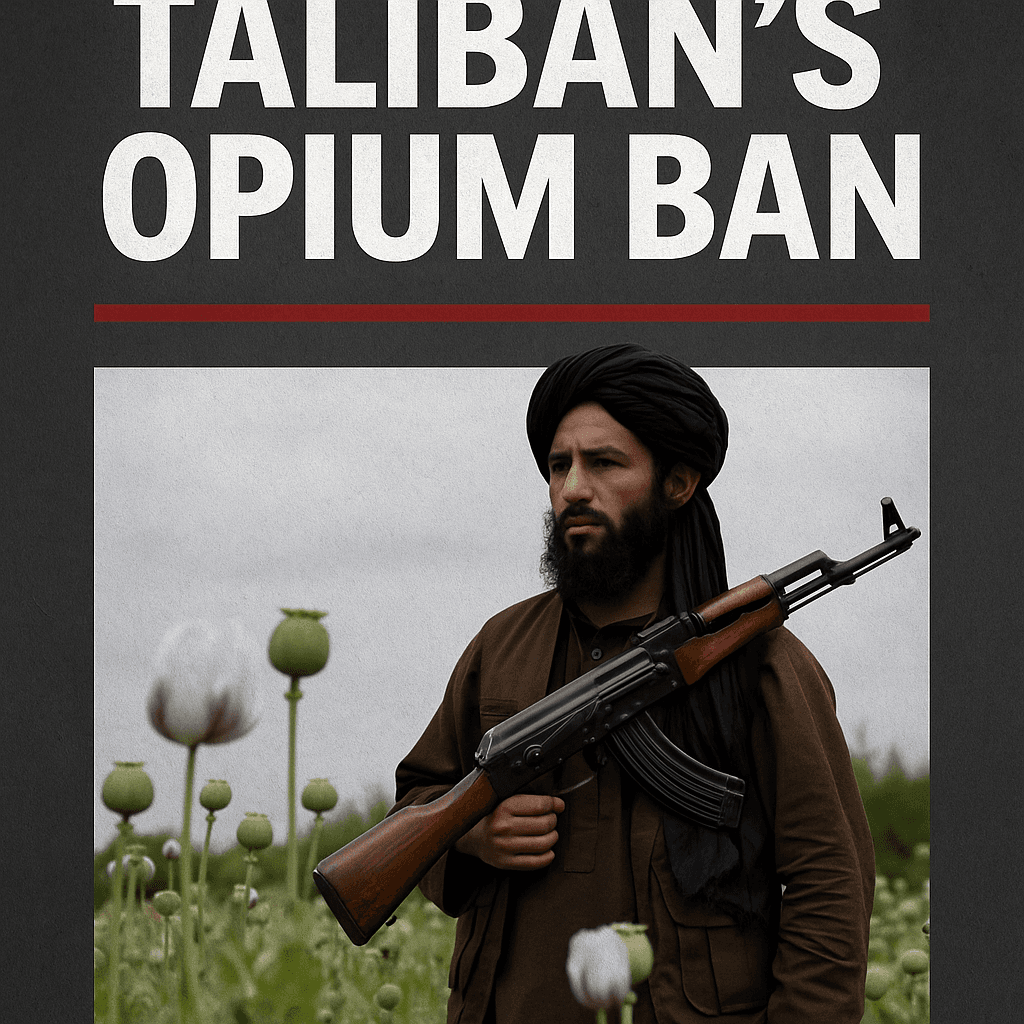
New Delhi (ABC Live: For over two decades, Afghanistan’s opium fields fed both families and fighters. They provided quick cash for farmers and steady revenue for warlords. Moreover, they linked isolated valleys to global crime networks that stretched from Karachi and Tehran to Moscow and London.
When the Taliban returned to Kabul in 2021, this drug economy became both an asset and a liability. On one hand, it offered the new rulers vital income. On the other, it branded the country a narco-state and blocked diplomatic recognition. Consequently, the Taliban needed a dramatic policy that could prove moral discipline while also showing administrative strength.
In April 2022, Supreme Leader Mullah Hibatullah Akhundzada announced a nationwide ban on all narcotics. The move appeared religious, yet it was also political and strategic. It aimed to demonstrate obedience to Islamic law, restore global credibility, and re-establish central control. Within two years, poppy acreage collapsed by 95 percent, heroin routes shifted, and Afghanistan’s economic structure began to change. Thus, a single religious decree became the cornerstone of a new political order.
Why the Taliban Banned Poppy Cultivation
a Religious and Moral Reasoning
The Taliban portrayed narcotics as haram under Sharia. Therefore, implementing the ban reaffirmed their identity as protectors of faith and guardians of Islamic morality. It also united conservative clerics behind the regime’s spiritual legitimacy.
b Search for Political Recognition
At the same time, the decision carried a clear diplomatic goal. By enforcing a difficult nationwide reform, the Taliban hoped to convince foreign governments that they could govern responsibly and should, therefore, be engaged economically.
c Drive for Economic Control
Before 2022, opium profits empowered provincial powerbrokers. However, after the ban, these independent networks lost income, allowing Kabul to recentralize taxation and authority. Consequently, the state regained both fiscal and territorial control.
Geopolitical Motives and Regional Calculations
| Factor | Taliban Goal | Expected Outcome |
|---|---|---|
| Global image | Demonstrate responsible rule | Build case for recognition |
| Regional ties | Satisfy Iran, China, Central Asia | Expand trade and energy links |
| Sovereignty | Remove Western pretexts for intervention | Reinforce control narrative |
| Negotiation tool | Use drug control in talks | Gain leverage for aid |
| Alignment | Join SCO and Eurasian partners | Reduce Western dependence |
Because the Taliban understood the symbolic power of restraint, the ban also became a foreign-policy instrument. Through it, the regime could reposition itself as a disciplined, regionally responsible government instead of a global outcast.
The Scale of Collapse
| Indicator | Before Ban (2021) | After Ban (2025 est.) | Change |
|---|---|---|---|
| Area under poppy | ≈ 233 000 ha | 10 200 ha | − 95 % |
| Global share of opium | > 80 % | < 15 % | − 82 % |
| Farm-gate price | US $ 120 / kg | US $ 400 – 500 / kg | ↑ > 300 % |
The outcome was immediate. Production collapsed almost overnight, while scarcity drove prices to record highs. As a result, farmers suffered, yet traffickers with stored opium temporarily benefited.
Changing Geography of Cultivation
| Region | 2021 Status | 2025 Status | Notes |
|---|---|---|---|
| Helmand & Kandahar | Opium heartland | Declared poppy-free | Tight Taliban control |
| Farah & Nimroz | Border corridors | Sharp decline | Routes restricted |
| Badakhshan (Northeast) | Peripheral grower | Residual hub | Weak enforcement |
Gradually, cultivation retreated to the northeast, where terrain and local autonomy still limit enforcement. Consequently, production now survives only in small, isolated pockets.
Rural Shock and Economic Dependence
| Factor | Effect (2024–25) |
|---|---|
| Farmland left fallow | ≈ 40 % (drought + ban) |
| Household income | Down 30 – 50 % |
| Informal debt | Rapid growth |
| Alternative crops | Low profit and weak markets |
Because legal crops yield little cash, many families now rely on Taliban-controlled credit and food aid. Consequently, economic survival and political obedience have become inseparable.
New Trends in Trafficking
As old stockpiles run out, smugglers seek fresh routes through Iran and Central Asia. Furthermore, methamphetamine derived from ephedra plants is rising fast, showing how Afghanistan’s illicit economy adapts even under pressure.
Impact on Terror Financing
| Group / Actor | Previous Income Source | Post-Ban Impact |
|---|---|---|
| IS-Khorasan (IS-KP) | Smuggling taxes & extortion | Funding fell ≈ 60 % |
| Local militias | Opium levies & protection fees | Revenue collapsed |
| Cross-border cartels | Heroin exports | Networks fragmented |
| Foreign extremists | Money laundering via drug cash | Liquidity reduced |
Therefore, the ban has weakened rival insurgent groups while reinforcing Taliban dominance. At the same time, it has forced terrorist organisations to search for smaller, riskier funding methods.
Global Ripple Effects
As expected, heroin shortages pushed European and Asian prices to new highs. Moreover, purity levels climbed because fewer actors control supply. Although Western agencies welcomed the temporary decline in output, they now warn that synthetic-drug production could soon replace opium profits.
How the Ban Strengthens Taliban Governance
-
Centralised taxation: provincial revenue now flows through Kabul.
-
Expanded security presence: eradication drives created new checkpoints and local offices.
-
Co-opted elites: former traffickers were absorbed into bureaucracy.
-
Diplomatic bargaining: counter-narcotics progress used to secure aid promises.
-
Policy execution: visible enforcement showcases national control.
Because of these steps, the Taliban turned an economic ban into a demonstration of administrative reach.
How the Ban Reduces Future Rebellion
- Cuts funding for insurgents. Without opium taxes, rebellion lacks financial fuel.
- Increases surveillance. Eradication networks allow early detection of dissent.
- Co-opts commanders. Former warlords now rely on state patronage.
- Creates economic dependency. Villagers depend on Taliban rations and loans.
- Limits foreign support. Neighbours prefer calm over conflict.
- Frames defiance as sin. Religious rhetoric suppresses opposition.
- Weakens recruitment. No money means fewer fighters.
Altogether, the ban functions as a non-military counter-insurgency plan—one that combines ideology, coercion, and poverty management to prevent rebellion.
Afghanistan’s Next Decade
Going forward, the country faces a paradox. On one hand, the Taliban have achieved their strongest grip on power since 2001. On the other hand, rural poverty and shrinking employment could ignite social tension later. Unless credible development arrives soon, synthetic drugs or illegal mining may replace poppy income. Nevertheless, in the short term, the Taliban’s command over territory, taxation, and ideology appears unchallenged.
Why ABC Live Is Publishing This Report Now
The UN’s 2025 data marks a decisive moment in Afghanistan’s transformation. Therefore, ABC Live presents this report to show how faith, economics, and geopolitics have converged to rebuild a war-torn state through control rather than growth. By analysing both policy outcomes and human costs, this feature helps readers understand how one decree changed Afghanistan’s trajectory.
Verified References
-
UNODC — Afghanistan Opium Survey 2025 (Preliminary Findings) → https://www.unodc.org
-
World Bank — Afghanistan Economic Monitor 2025 → https://www.worldbank.org/en/country/afghanistan
-
Global Initiative Against Transnational Organized Crime (2024) — Crime & Conflict Nexus in Afghanistan
-
UN Security Council Monitoring Team Report (2025)
-
BBC / Reuters / Al Jazeera Field Reports — Nov 2025