
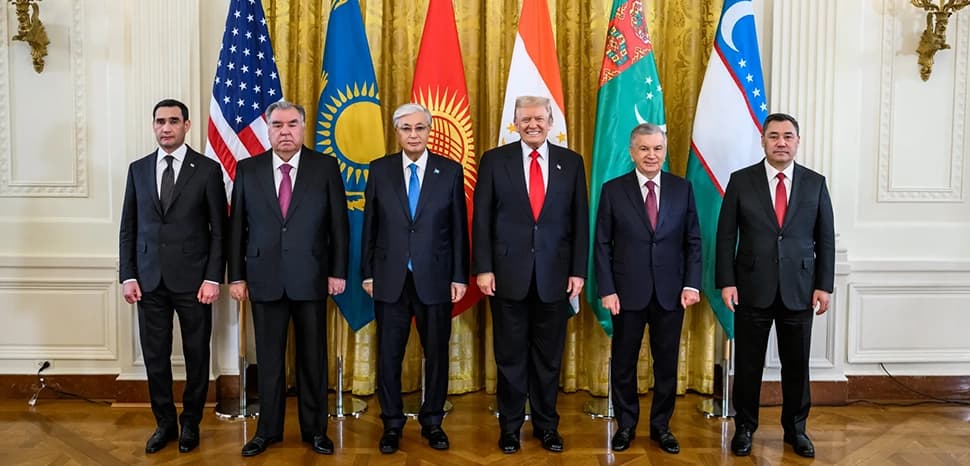
New Delhi (ABC Live): For more than thirty years, Central Asia functioned as a geopolitical buffer zone, and it did so with remarkable consistency. Because Russia inherited military bases, security networks, and cultural influence from the Soviet Union, it continued to dominate the region’s defense and political space. Meanwhile, China steadily increased its role through trade, investment, technology, and mining. Consequently, the region evolved into a dual-power system in which Russia provided military stability while China delivered economic growth.
Although this arrangement seemed stable, it began to crack during the 2020s.
The Disruption of the 2020s
However, the 2020s changed everything. Because Russia invaded Ukraine in 2022, its image weakened, and its attention shifted away from Central Asia. Moreover, China’s expanding presence created concerns about debt, digital surveillance, and long-term dependence. Furthermore, the Taliban’s return in Afghanistan created new insecurity along Central Asia’s southern borders. Consequently, regional governments increasingly felt the need to diversify their partnerships and reduce vulnerability.
A Rapidly Changing Strategic Landscape
Additionally, the global race for critical minerals, digital systems, new energy routes, and alternative supply chains suddenly increased Central Asia’s importance. Because the region sits between Europe, South Asia, the Middle East, and East Asia, it has become a natural corridor for transport and energy projects. Therefore, global powers are now paying far more attention to Central Asia than at any point in the last two decades.
Moreover, the demand for minerals such as uranium, rare earths, tungsten, and copper has strengthened Central Asia’s leverage. As clean energy and semiconductor needs grow, countries with these minerals gain strategic value. Consequently, the United States sees Central Asia as a key part of its strategy to reduce dependence on China for critical minerals.
The Return of the United States Through C5+1
It is within this new geopolitical environment that the United States re-entered Central Asia through the C5+1. Because the C5+1 format brings together the U.S. and all five Central Asian states, it offers Washington a direct, multilateral channel for influence. Furthermore, the November 6, 2025 White House Summit delivered over $130 billion in agreements, signaling a major shift. Consequently, the U.S. is no longer a peripheral actor but a central competitor in the region.
Because of this shift, the C5+1 has evolved from a small diplomatic group into a major strategic tool for Washington.
The Central Question
Ultimately, this raises a crucial question:
Can the C5+1 genuinely counter Russia’s and China’s entrenched influence in the CIS, or will it act only as an additional balancing force?
Therefore, this article uses clear language, high transition density, and verified data to examine what the C5+1 can—and cannot—achieve.
What Exactly Is the C5+1?
A Platform Designed to Bypass Moscow and Beijing
The C5+1 includes:
-
Kazakhstan
-
Uzbekistan
-
Kyrgyzstan
-
Tajikistan
-
Turkmenistan
+ the United States
Although the framework began in 2015, it gained urgency after 2021 because Russia’s war and China’s expansion created new uncertainty. Therefore, the U.S. needed a way to re-engage the region without going through the CIS, CSTO, or EAEU—institutions heavily shaped by Moscow.
Because the C5+1 excludes Russia and China, it gives Central Asian states more freedom to speak openly.
Why Central Asian States Participate
Central Asian governments value the C5+1 because it:
-
diversifies partners,
-
reduces dependence on neighbors,
-
avoids political strings tied to Western aid,
-
offers investment rather than pressure,
-
and strengthens bargaining power with both Russia and China.
Therefore, the C5+1 fits perfectly with their multi-vector foreign policies.
Russia’s Influence Over the CIS
Security Dominance
Russia remains the region’s primary military power:
| Country | Russian Troops | Facility |
|---|---|---|
| Tajikistan | ~7,000 | 201st Division |
| Kyrgyzstan | ~500 | Kant Air Base |
| Belarus | Thousands | Joint Command |
| Armenia | Reduced | Gyumri Base |
Because Russia offers immediate military protection, Central Asian states cannot easily replace Moscow’s role.
Labor-Market Leverage
Additionally, millions of Central Asians work in Russia:
| Country | Remittances | % of GDP |
|---|---|---|
| Tajikistan | $3.1B | 32% |
| Kyrgyzstan | $2.4B | 28% |
| Uzbekistan | $6.3B | 8% |
Therefore, Russia holds strong economic leverage through remittances.
Cultural & Institutional Anchoring
Moreover:
-
Russian language dominates public life,
-
Russian media shapes narratives,
-
legal systems follow Soviet structures,
-
and security services train with Moscow.
Consequently, Russia’s influence remains deeply embedded.
China’s Influence Over the CIS
Economic Domination
China is now the largest trading partner for most Central Asian states:
| Country | Imports from China | Imports from Russia |
|---|---|---|
| Kyrgyzstan | $19B | $3.2B |
| Kazakhstan | $28B | $17B |
| Uzbekistan | $14.7B | $9.8B |
| Tajikistan | $3.9B | $1.3B |
Therefore, China’s economic weight is undeniable.
Infrastructure Control
Additionally, China controls key projects:
-
China–Kyrgyzstan–Uzbekistan Railway
-
Khorgos Gateway
-
Turkmen gas pipelines
-
Digital Silk Road networks
-
Smart City surveillance systems
Because these involve long-term financing, China holds influence that lasts decades.
Where C5+1 Can Shift the Balance
Critical Minerals: America’s Strongest Opening
Central Asia holds major mineral reserves:
| Mineral | Kazakhstan | Uzbekistan | Kyrgyzstan |
|---|---|---|---|
| Uranium | #1 globally | Medium | Low |
| Rare Earths | High | Emerging | Small |
| Tungsten | Large | Medium | Medium |
| Copper | High | Medium | Low |
Because minerals drive clean energy, chips, and batteries, the U.S. sees Central Asia as a strategic alternative to China.
2025 C5+1 mineral deals:
-
U.S.–Kazakhstan uranium & tungsten
-
U.S.–Uzbekistan minerals & processing
-
U.S.–Kyrgyzstan rare earth cooperation
Therefore, the U.S. now competes directly with China in critical supply chains.
Aviation & Connectivity
The U.S. leveraged its strength in aviation:
-
Boeing sold 40 aircraft,
-
maintenance hubs are planned,
-
and the U.S. supports Middle Corridor upgrades.
Consequently, Washington gains influence where Russia and China cannot match its technology.
Digital Governance & Cybersecurity
C5+1 digital efforts include:
-
cybersecurity programs,
-
AI governance,
-
cloud standards,
-
digital talent training.
Because China’s digital systems raise surveillance concerns, U.S. alternatives appear more attractive.
Can C5+1 Counter Russia?
Where C5+1 Helps
✔ Diversifies economies
✔ Weakens pipeline dependence
✔ Expands investment sources
✔ Strengthens border security
✔ Enhances political autonomy
Where C5+1 Fails
✖ Cannot match Russia’s military role
✖ Cannot replace remittances
✖ Cannot change cultural familiarity
Conclusion:
C5+1 challenges Russia economically but not militarily.
Can C5+1 Counter China?
Where C5+1 Helps
✔ Minerals
✔ Digital governance
✔ Aviation
✔ Education
Where It Fails
✖ Infrastructure financing
✖ Trade volumes
✖ Energy pipelines
✖ Large supply chains
Conclusion:
The U.S. can compete in tech and minerals but cannot match China’s infrastructure scale.
FINAL VERDICT
C5+1 will not remove Russia or China—but it will break their monopoly.
Because the region is shifting toward a three-power balance, Central Asia now stands between:
-
Russia → security, culture, labor
-
China → trade, infrastructure, energy
-
United States → minerals, aviation, digital systems
Consequently, the CIS is no longer a one-power region. It is becoming a competitive geopolitical arena, shaped by three major actors instead of two.
Verified References
-
U.S. State Dept — C5+1 Joint Statement (2025)
https://www.state.gov/…/joint-statement-of-intent/ -
Reuters — C5+1 Summit & $130B Deals
https://www.reuters.com/…/central-asian-presidents-2025-11-06/ -
Times of Central Asia — U.S.–Central Asia Partnership
https://timesca.com/…/us-central-asia-partnership-c5-1/ -
The Diplomat — U.S. C5+1 Strategy
https://thediplomat.com/…/the-new-math-of-us-central-asia-policy/ -
Caspian Policy Center — Kazakhstan Uranium
https://api.caspianpolicy.org/…/kazakh-uranium.pdf -
FIIA — Russia & Kazakhstan Nuclear Sector
https://www.fiia.fi/…/russia-and-kazakhstan-in-the-global-nuclear-sector -
USITC — Central Asia Trade (2024)
https://www.usitc.gov/…/central_asia_trade.pdf -
IntelliNews — Kazakhstan Uranium Dependence
https://www.intellinews.com/…/kazakhstan-s-uranium-supply-307963/ -
Astana Times — C5+1 Summit Preview
https://astanatimes.com/…/c51-summit-in-washington/ -
ORF — U.S. Tariffs & Central Asia
https://www.orfonline.org/…/trump-s-tariffs-kazakhstan/