
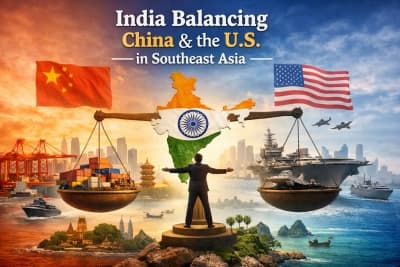
New Delhi (ABC Live): Southeast Asia is no longer a passive theatre where great powers project influence at will. Instead, it has become an active arena where power is tested through infrastructure choices, supply-chain shifts, digital systems, and crisis response. As a result, the region’s capitals are no longer asking who is strongest. Rather, they are asking who is useful, reliable, and non-coercive.
In other words, power today is judged less by declarations and more by delivery.
How the Old Strategic Order Began to Thin
For decades, the United States filled this role by default. Its naval dominance, alliance system, and post–Cold War standing provided Southeast Asian states with a strategic umbrella under which they could trade freely and hedge cautiously. Over time, however, that umbrella has thinned.
Today, U.S. power appears episodic and election-sensitive. Moreover, it relies heavily on signalling while investing little in long-term economic grounding. Washington still deters escalation; nevertheless, it no longer shapes the region’s future in daily economic terms.
As a consequence, American influence now feels strong in moments of crisis but weaker in shaping routine growth and supply chains.
How China Filled the Gap—Step by Step
Meanwhile, China exploited this gap patiently rather than loudly. Instead of demanding loyalty or formal treaties, Beijing built facts on the ground—ports that move exports, railways that link industrial zones, power grids that steady growth, data centres that host information flows, and platforms that handle daily commerce.
Taken together, these assets create path dependence. Once embedded, they quietly limit strategic choice. In effect, China does not force Southeast Asian states to choose sides. Instead, it makes other choices costly.
Why the Region Still Resists Dependence
Yet Southeast Asia is not surrendering to China either. Ongoing wars and grey-zone conflicts—from Myanmar’s civil war to constant pressure in the South China Sea—have reinforced a simple lesson: over-dependence on any single power is risky.
China is close, powerful, and vital to growth. At the same time, it can be coercive when challenged. By contrast, the United States remains militarily strong but increasingly unreliable in sustaining long-term economic focus.
It is within this tension that India’s strategic relevance emerges.
Where India Enters the Equation
As ABC Live has previously explained in India and China All Set to Lead New World Order, the global system is shifting toward a dual-axis reality, where power flows less from ideology and more from economic scale, patience, and reach.
👉 https://abclive.in/2025/06/21/india-and-china-all-set-to-lead-new-world-order/
India does not enter Southeast Asia as a hegemon or as a stand-in for American power. It lacks China’s capital scale and Washington’s alliance depth. However, it possesses something increasingly rare in a conflict-prone region: strategic acceptability.
India is large but non-imperial, close but not intrusive, and influential yet restrained. Crucially, it does not demand alignment or export ideology. Therefore, as U.S. influence recedes from agenda-setting to episodic action—and as China’s reach creates quiet unease—Southeast Asia looks for balance without confrontation.
Southeast Asia’s Wars: Why Power Works Differently Here
Any strategy for Southeast Asia must begin with one reality: the region is already living with war, just not in conventional form.
Myanmar’s Civil War (2021–Present)
Myanmar’s post-coup collapse has produced a multi-front civil war involving the military junta, resistance forces, and ethnic militias. As a result, India–ASEAN land connectivity has weakened, Thai border regions have destabilised, and insecurity has spread along China’s southwest frontier.
China manages this chaotic transaction by engaging all sides to protect border stability and infrastructure. Meanwhile, the United States relies largely on sanctions and diplomacy, with limited leverage. India, by contrast, is geographically exposed but underpowered. The lesson is clear: in Southeast Asia, influence belongs to those who can operate amid fragmentation, not those who wait for resolution.
South China Sea: A Permanent Grey-Zone Conflict
The South China Sea is not a future flashpoint; rather, it is an ongoing, low-intensity confrontation. Water-cannoning, ramming incidents, island militarisation, and constant naval shadowing have normalised coercion without escalation. The United States provides deterrent patrols. China provides proximity and persistence. Consequently, ASEAN states live with pressure while seeking partners who can help without forcing binary choices.
Internal Conflicts and Frozen Borders
From Thailand’s southern insurgency to dormant Thailand–Cambodia border disputes, Southeast Asia remains deeply sensitive to sovereignty, nationalism, and internal stability. Accordingly, foreign powers that politicise domestic order face instinctive resistance. Here, non-interference is not ideology—it is survival logic.
Why China Is Winning Structurally
China’s advantage in Southeast Asia is not military dominance. Instead, it is system-building.
Beijing finances and constructs infrastructure, anchors industrial corridors, embeds digital platforms, and ties growth to Chinese markets. Once these systems take root, influence no longer requires diplomacy. It becomes automatic.
China does not ask Southeast Asian states to “choose.”
Instead, it makes choices economically expensive.
Why the United States Is No Longer Decisive
The United States remains the region’s strongest military actor. However, military power alone no longer determines outcomes.
Washington exited major trade frameworks, invests little in public infrastructure, and relies heavily on values-based messaging without economic depth. Consequently, U.S. influence has become crisis-centric rather than structural—strong during escalation, weak in everyday governance.
Southeast Asia does not reject America.
Rather, it no longer depends on it.
Where India Can Balance China—Realistically
1) Trusted Digital Infrastructure
As ASEAN states worry about over-dependence on Chinese digital ecosystems, India can offer open-standard digital public infrastructure, fintech rails, cybersecurity cooperation, and data-governance support. These systems are quiet, practical, and deeply sticky.
2) Health, Pharma, and Human Security
India’s strength in generics, vaccines, and health logistics builds dependence without coercion—a decisive advantage in post-pandemic Southeast Asia.
3) Maritime Security Without Militarisation
India’s naval presence is stabilising rather than provocative. Training, humanitarian assistance, and maritime domain awareness make India useful without escalating confrontation.
4) Industrial Complements, Not Mega-Projects
India should avoid competing with China on mega-rails and ports. Instead, its edge lies in EV software, battery-management systems, semiconductor design services, agri-tech, and logistics—plugging into ASEAN supply chains rather than replacing them.
Country-Wise Reality Checks
🇹🇭 Thailand: Strategic Ambiguity Anchored in Economics
| Dimension | China | United States | India |
|---|---|---|---|
| Trade partner rank | #1 | #3–4 | #10+ |
| Infrastructure role | Rail, EEC, EV, digital | Minimal | Limited |
| Military ties | Limited, growing | Strong (Major Non-NATO Ally) | Low |
| Elite alignment | High (Sino-Thai capital) | Institutional | Cultural |
| Strategic posture | Economic anchor | Security ritual | Option widener |
Reading: Thailand maintains U.S. military insurance while allowing China to shape the future economy. India’s role is to widen options—precisely what Bangkok wants.
Vietnam: Strategic Resistance with Controlled Hedging
| Dimension | China | United States | India |
|---|---|---|---|
| Historical relations | Adversarial | Improving | Friendly |
| South China Sea | Direct conflict | Security partner | Diplomatic & naval |
| Trade dependence | High but wary | Growing | Moderate |
| Defence cooperation | Minimal | Expanding | Strong & trusted |
| Strategic role | Threat | Balancer | Preferred hedge |
Reading: Vietnam resists China but avoids U.S. over-dependence. India fits the gap as a trusted hedge without alliance pressure.
Indonesia: ASEAN’s Balancer with Untapped India Potential
| Dimension | China | United States | India |
|---|---|---|---|
| Trade & investment | High (nickel, EVs) | Moderate | Low |
| Maritime disputes | Natuna tensions | Diplomatic backing | Strategic interest |
| ASEAN leadership | Neutral | External | Natural partner |
| Infrastructure | Chinese-led | Limited | Minimal |
| Alignment instinct | Non-aligned | Secondary | Under-engaged |
Reading: Indonesia resists dominance by design. China supplies capital; the U.S. supplies balance. India remains underrepresented—yet the logic for partnership is strong.
Philippines: Frontline State Seeking Diversification
| Dimension | China | United States | India |
|---|---|---|---|
| South China Sea | Primary threat | Security guarantor | Diplomatic supporter |
| Military presence | Coercive | Expanded bases | Limited |
| Economic leverage | Moderate | Limited | Low |
| Strategic dependence | Unwanted | High | Complementary |
| Desired role | Minimise | Rely on | Diversify with |
Reading: Manila relies on U.S. deterrence but seeks diversification. India offers defence options and political backing without escalation.
The Strategic Ceiling—and the Opportunity
India cannot out-invest China.
India cannot replace U.S. deterrence.
However, India can do something neither can: reduce Southeast Asia’s dependence on any single power. In a region shaped by internal wars, grey-zone conflict, and sovereignty anxiety, that role matters more than dominance.
ABC Live Takeaway
Alliances or speeches will not decide Southeast Asia’s future.
Instead, it will be decided by who helps the region function amid conflict.
-
China offers order through systems.
-
The United States offers security without permanence.
-
India can offer stability without domination.
India will not set the tempo in Southeast Asia.
However, if it acts decisively, it can ensure that no one else sets it alone—not by becoming a hegemon, but by becoming indispensable.
Verified References (Exact Links)
-
ABC Live – India and China All Set to Lead New World Order
https://abclive.in/2025/06/21/india-and-china-all-set-to-lead-new-world-order/ -
China-ASEAN Trade and Investment Relations – China Briefing
https://www.china-briefing.com/news/china-asean-trade-and-investment-relations/ -
China–ASEAN Upgrade of Free Trade Area (FTA 3.0) – Reuters
https://www.reuters.com/markets/emerging/china-asean-complete-negotiations-free-trade-area-30-2025-05-21/ -
Economics Is Security: Building U.S. Strategy in Southeast Asia – Brookings
https://www.brookings.edu/articles/economics-is-security-building-us-strategy-in-southeast-asia/ -
Resetting India–ASEAN Trade – Observer Research Foundation
https://www.orfonline.org/expert-speak/resetting-india-asean-trade-in-2025/ -
ASEAN–India Trade & Cooperation – Ministry of Commerce, India
https://www.commerce.gov.in/about-us/divisions/foreign-trade-territorial-division/foreign-trade-asean/