
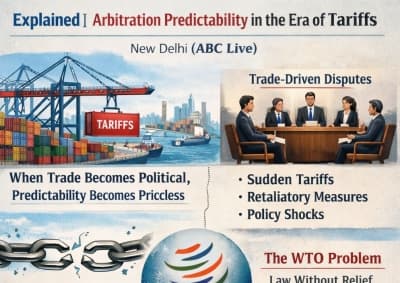
New Delhi (ABC Live): In recent years, tariffs have once again become a central tool of economic policy. As a result, the risk structure of global trade has changed at its core. Earlier, commerce largely followed cost, efficiency, and shared multilateral rules. Now, however, it is shaped by unilateral duties, retaliation, industrial policy, and strategic protection.
Because of this shift, disputes are no longer rare or accidental. Instead, they are built into the system itself.
When Trade Becomes Political, Predictability Becomes Priceless
Today, tariffs do far more than raise prices. They break supply chains, force contract renegotiation, disturb pricing formulas, and weaken long-term business planning. At the same time, tariff regimes now change with elections, geopolitics, and policy priorities. Consequently, many disputes arise not from broken promises but from sudden policy shocks.
Therefore, the key issue for businesses is no longer whether arbitration is neutral in theory. Rather, it is whether arbitration remains predictable in practice when trade rules move faster than contracts.
1. Why Tariffs Have Changed Arbitration Risk
In the current tariff-driven environment, arbitration is often triggered by:
-
sudden new import or export duties,
-
retaliatory tariff increases,
-
safeguard and anti-dumping measures,
-
local-content and industrial-policy rules, and
-
Customs reclassification of goods.
As a consequence, these actions directly affect:
-
price-adjustment clauses,
-
force-majeure and hardship provisions,
-
long-term supply and offtake contracts,
-
EPC and infrastructure projects, and
-
energy and commodity pricing formulas.
In short, arbitration is now required to manage policy-led commercial disruption, not just clear cases of contractual breach.
2. Why Tariffs Increase Arbitration Uncertainty
Tariff-linked disputes tend to expose weak points in arbitration systems.
A. Expanding Public-Policy Review
When disputes touch customs revenue, domestic industry, or trade protection, courts are more willing to invoke public policy. As a result, awards face a higher risk at the enforcement stage. Over time, this weakens predictability.
In fact, ABC Live has earlier explained how enforcement-stage uncertainty often becomes decisive, even after a well-reasoned award. As detailed in Explained: Why Arbitration Award Enforcement Matters More Than the Award Itself, the real risk often lies not in the hearing room, but in courtrooms that follow
👉 https://abclive.in/2025/11/27/arbitration-award-enforcement/
B. Inconsistent Legal Characterisation
The same tariff action may be viewed very differently across jurisdictions. For instance, one court may treat it as a normal business risk, while another may see it as a sovereign action. Likewise, some tribunals accept tariff hikes as force majeure, while others classify them as expected regulatory change. Because of this, outcomes vary sharply from seat to seat.
C. Politically Sensitive Enforcement
Tariff disputes often involve state-owned firms and strategic sectors such as steel, energy, semiconductors, and agriculture. Therefore, enforcement can quickly become political. In such cases, only proven enforcement corridors offer real certainty.
3. The WTO Gap: Law Without Commercial Relief
The tariff era has also exposed the limits of the World Trade Organisation. Because appellate review is paralysed and timelines are long, WTO dispute settlement has lost practical value for private businesses.
Moreover, WTO remedies operate only between states. They do not reopen contracts or compensate private losses. As retaliation replaces adjudication, arbitration has stepped in to fill the gap.
At the same time, this enforcement gap is not limited to trade law alone. As ABC Live recently analysed in Explained: How the Protection of Interests in Aircraft Objects Act, 2025 Fixes India’s Enforcement Credibility Gap, global commerce increasingly depends on domestic legal systems to give effect to international commitments
👉 https://abclive.in/2025/12/27/protection-of-interests-in-aircraft-objects-act-2025/
Put simply:
-
The WTO asks whether a tariff is legal.
-
Arbitration decides who bears the economic cost of that tariff.
For businesses, the second answer matters far more.
4. Where Tariff Disputes Actually Go
Market behaviour shows a clear trend. First, tariff-exposed contracts increasingly avoid domestic seats. Second, parties prefer jurisdictions where courts show restraint in economic-policy disputes. Third, neutral hubs outperform national courts.
This explains the steady preference for institutions such as the Singapore International Arbitration Centre (official site: https://www.siac.org.sg) and the Dubai International Arbitration Centre (official site: https://www.diac.ae), even when neither party has a local connection.
Thus, tariffs have intensified forum migration, not reduced reliance on arbitration.
5. What Predictable Arbitration Requires Today
Earlier models of arbitration assumed stable regulation. Today, that assumption no longer holds. Predictability must be built deliberately.
a. Clear Risk Allocation
Systems must clearly separate ordinary regulatory change from rare policy shocks. Otherwise, outcomes will continue to diverge.
b. Narrow Public-Policy Use
Courts should treat tariffs as background context, not as a reason to block awards. If public policy dominates, trust in arbitration erodes.
c. Speed for Policy Shocks
Tariff disputes often need quick decisions on price and supply. Accordingly, reliable systems offer interim relief and fast-track procedures to prevent wider damage.
6. Cost and Time Pressure
Tariffs raise dispute exposure by:
-
complicating damage calculations,
-
triggering parallel regulatory action, and
-
spreading enforcement battles across borders.
Because of this, businesses now value cost certainty more than low cost. In practice, many accept higher fees if this reduces surprise and speeds up closure.
7. India–US and India–EU Stress Points
In India–US trade, safeguard duties and counter-tariffs often lead to change-in-law disputes. Here, enforcement risk rises when courts blend trade policy with public policy.
Meanwhile, India–EU trade faces pressure from carbon border measures and trade remedies. These disputes often run on two tracks at once, regulatory and arbitral. As a result, delay risk grows and interim relief becomes critical.
In both corridors, neutral seats perform better than domestic forums.
8. IMEA Corridor and the GIFT City Opportunity
The India–Middle East–Africa corridor is tariff-exposed, capital-heavy, and state-linked. For this reason, arbitration predictability becomes essential.
Against this backdrop, the Gandhinagar International Mediation & Arbitration Centre, operating from GIFT City, can position itself as a tariff-resilient hub by embedding:
-
sector-specific rules for trade-linked contracts,
-
clear force-majeure and hardship standards,
-
fast-track paths for policy shocks,
-
compliance-aware case handling, and
-
enforcement-focused seat design.
In the end, outcomes—not promises—will define success.
Conclusion | Arbitration’s Real Test in the Tariff Era
In a tariff-driven world, arbitration is judged not only by neutrality but by its ability to deliver predictable results under policy stress.
Tariffs have turned arbitration into a shock absorber for global trade. Therefore, systems that fail to manage public-policy pressure, enforcement risk, and cost swings will slowly lose relevance.
Predictable arbitration now depends on disciplined rules, restrained courts, clear risk sharing, and fast, enforceable decisions. Fragmentation is here to stay. Arbitration will survive it—but only where predictability is designed, not assumed.
ABC Live Editorial Note
Tariffs reward certainty. Arbitration systems that treat predictability as core economic infrastructure will attract trade-exposed disputes. Those that do not will quietly fade from global contracts.