Independent Research-Based Journalism
AboutEditorial PolicyCorrectionsContact
ABC Live
www.abclive.in
A Research Based Journalism
Search
ABC ResearchIndiaLegalInvestigationGeopoliticsBusinessEnvironmentAgricultureHealth
Geopolitics

Explained: Can the Kra Canal Break U.S. Control of the Malacca Strait?

This ABC Live explainer analyses how Thailand’s Kra Canal or Landbridge choice could weaken U.S. leverage over the Malacca Strait and shift power dynamics across the Indo-Pacific.

Dinesh Singh Rawat
Dinesh Singh Rawat5 months ago
Kra Canal
Kra Canal

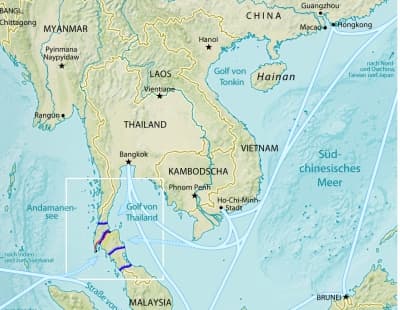
New Delhi (ABC Live): At the centre of today’s Indo-Pacific power shift lies a quiet but consequential choice in southern Thailand. The Isthmus of Kra—a narrow land corridor between the Andaman Sea and the Gulf of Thailand—has resurfaced as a strategic fault line. For centuries, it promised a shortcut. Now, it threatens to reshape how power, trade, and deterrence work across Asia.

The Malacca Strait: Where Trade Becomes Leverage

Roughly one-third of global maritime trade and a dominant share of East Asia’s energy imports pass through the Strait of Malacca. Because of this concentration, Malacca is more than a shipping lane. It is leverage. While no state legally controls it, the United States and its partners shape outcomes through naval presence, surveillance, and alliances. As a result, China’s trade lifelines remain exposed to disruption—a vulnerability Beijing openly calls the “Malacca Dilemma.”

Kra Canal or Landbridge: Break or Bend the System?

Thailand’s choice now sits at the centre of this dilemma. A Kra Canal would cut a new sea route, allowing ships to bypass Malacca altogether. In contrast, a Southern Landbridge would move cargo across land while keeping existing sea lanes intact. Therefore, the question is not about speed alone. It is about whether chokepoint power is broken outright or softened quietly.

Why India Is Directly Affected

This decision also holds significant importance for India. India’s Andaman & Nicobar Islands sit astride the sea lanes China must cross to enter the Indian Ocean. Consequently, Malacca acts as a silent buffer for New Delhi. If that buffer weakens, India’s strategic calculus changes.

What This Explainer Answers

This report examines whether the Kra Canal truly challenges U.S. leverage, whether the landbridge achieves the same goal without escalation, and how Thailand’s choice repositions India in the Indo-Pacific balance of power.

In southern Thailand lies the Isthmus of Kra, a narrow stretch of land between the Andaman Sea and the Gulf of Thailand. At first glance, it seems ordinary. However, in geopolitical terms, it is one of the most sensitive locations in the Indo-Pacific.

Today, Thailand faces a decisive choice. It can either build the long-discussed Kra Canal or develop a modern landbridge linking two ports by rail and road. Importantly, this decision is not just about trade efficiency. Instead, it raises a deeper question:

Will either option weaken U.S. leverage over the Strait of Malacca, and how will that reposition Thailand and India in the regional balance of power?

Why the Strait of Malacca Still Matters

To understand the Kra debate, it is essential to understand Malacca first.

The Strait of Malacca runs between Malaysia, Singapore, and Indonesia. At its narrowest point, it is only 2.7 kilometres wide. Yet, despite this, it carries one of the largest volumes of trade in the world.

Key Data

  • About 33% of global maritime trade passes through Malacca every year

  • Nearly 40% of global seaborne oil trade uses this route

  • China sends:

    • 73–75% of its crude oil imports

    • 65–70% of its LNG imports

    • Roughly 60% of its container trade

  • Japan depends on Malacca for around 90% of its energy imports

  • Daily traffic averages 250–300 vessels

Interpretation

Because so much energy and trade flows through one narrow waterway, Malacca acts as strategic leverage, not just infrastructure. Although no country legally controls it, the United States shapes outcomes through naval power, surveillance, and strong ties with Singapore and other littoral states.

As a result, Malacca gives Washington crisis-time leverage, particularly over China. This exposure is what Beijing calls the “Malacca Dilemma.”

Why the Isthmus of Kra Is So Important

The Isthmus of Kra lies fully inside Thailand and forms the shortest land distance between the Indian Ocean and the Pacific.

Geographic Facts

  • Narrowest usable corridor: about 90–100 km

  • Entirely under Thai sovereignty

  • No disputed international waters

Interpretation

Because the corridor is short, stable, and sovereign, Kra is the only realistic place where Malacca can be bypassed or diluted at scale. Therefore, any infrastructure decision here has regional consequences.

Option One: The Kra Canal — Direct Substitution

Project Data

  • Length: ~100 km

  • Depth: ~25 metres (suitable for VLCC and LNG carriers)

  • Estimated cost: USD 25–30 billion

  • Distance saved: 1,000–1,200 nautical miles

  • Time saved: 4–6 days per voyage

  • Projected traffic: 80,000–100,000 ships per year

  • Estimated annual revenue: USD 2–4 billion

Strategic Interpretation

Even a 20–30% diversion of China-bound oil and LNG would:

  • Reduce U.S. crisis leverage

  • Weaken Singapore’s chokepoint role

  • Shorten China–Middle East energy routes

In simple terms, the Kra Canal is not a backup route. Instead, it is a substitute. Consequently, it would directly weaken U.S. maritime leverage by breaking Malacca’s role as a single point of pressure.

Impact on Thailand

  • Fiscal exposure equals around 6–7% of Thailand’s GDP

  • Southern provinces, already fragile, would be physically divided

  • The canal would attract external pressure over security and access

Therefore, while the canal raises Thailand’s global importance, it also turns the country into a geopolitical frontline.

Option Two: The Southern Landbridge — Redundancy Without Rupture

Project Data

  • Corridor length: ~90 km

  • Ports: Ranong (Andaman Sea) and Chumphon (Gulf of Thailand)

  • Estimated cost: USD 27–28 billion

  • Ship-rail-ship transfer time: 24–36 hours

  • Initial capacity: 10–20 million TEU per year

Strategic Interpretation

Ships still pass through Malacca. Therefore, U.S. naval leverage remains intact. At the same time, China gains faster logistics, lower congestion risk, and more resilience in peacetime.

Put differently, the landbridge offers redundancy, not replacement.

The Quiet Power Layer

Moreover, the landbridge relies on digital systems such as port software, logistics platforms, and customs data. Over time, control of data flows and scheduling can shape trade without military escalation.

How This Choice Repositions India

Any decision at Kra also reshapes the strategic environment for India.

Why Malacca Matters to India

India does not depend on Malacca for energy survival. Instead, it gains strategic advantage from it.

Key Data

  • ~60% of China’s trade and ~75% of its oil imports pass through Malacca

  • India’s Andaman & Nicobar Command is located about 500 km west of the strait

  • Over 40% of global seaborne trade enters the Indian Ocean through Malacca, Sunda, and Lombok combined

Interpretation

Malacca acts as a natural pressure point for India. It allows monitoring and deterrence without direct confrontation. In effect, it is India’s silent strategic buffer.

Kra Canal Scenario (India)

  • China enters the Indian Ocean without Malacca

  • Chinese naval presence in the Bay of Bengal becomes routine

  • The strategic value of the Andaman & Nicobar Islands is diluted

  • India faces higher surveillance costs and shorter reaction times

Therefore, the Kra Canal would be a clear strategic setback for India.

Landbridge Scenario (India)

  • Malacca remains relevant

  • Chinese access to the Indian Ocean stays visible and indirect

  • India’s existing posture remains sufficient

Thus, the landbridge is manageable for India, even if not ideal.

For wider context, see ABC Live Internal Link:
🔗 https://abclive.in/2025/12/26/india-in-southeast-asia/

Kra Canal vs Landbridge: At a Glance

Issue Kra Canal Landbridge
Bypasses Malacca Yes No
Weakens U.S. leverage Directly Indirectly
Impact on Thailand’s neutrality Severe Limited
Impact on India’s leverage Negative Largely preserved
Risk of military escalation High Low
ASEAN stability Disrupted Preserved

In short, canals change naval geography, while landbridges change cost, speed, and resilience.

How ABC Live Verified This Report

This explainer is based on verified public data and cross-checked sources, including:

  • International Energy Agency (IEA) — energy flows and import dependence
    https://www.iea.org

  • UNCTAD — global maritime trade and chokepoint data
    https://unctad.org/topic/transport-and-trade-logistics

  • U.S. Energy Information Administration (EIA) — Malacca chokepoint analysis
    https://www.eia.gov/international/analysis/regions-of-interest/Strait_of_Malacca

  • Japan METI — energy import statistics
    https://www.meti.go.jp/english/

  • Indian Ministry of Defence — public information on Andaman & Nicobar Command
    https://mod.gov.in

  • Thailand Ministry of Transport / NESDC — landbridge and port planning documents
    https://www.mot.go.th
    https://www.nesdc.go.th

All key figures were checked against at least two independent sources. Scenario outcomes are clearly marked as analytical projections.

About ABC Live

ABC Live is an independent, research-driven digital publication covering geopolitics, infrastructure, law, technology, and strategic governance. We separate verified facts from editorial interpretation and avoid anonymous or sponsored narratives.

📧 research@abclive.in
🌐 https://abclive.in

Final Editorial Takeaway

The choice between the Kra Canal and the Southern Landbridge is not just about ships and ports. It is about how geography turns into power.

For China, the canal promises relief from vulnerability.
For the United States, it poses a threat to leverage.
For India, it weakens a natural stabiliser.

But for Thailand, the conclusion is clear:

The Kra Canal makes Thailand a geopolitical frontline.
The Landbridge keeps Thailand a balancer—relevant, investable, and sovereign.

In a fragmented Indo-Pacific, how Thailand uses the Isthmus of Kra will shape the balance between oceans for decades to come.

Share

Related Stories

Environment

A Critical Review of India’s Green Push Under Modi

in about 4 hours
India’s Green Push Under Modi
Geopolitics

Explained: Trump’s Iran War Powers Dilemma

about 9 hours ago
Trump’s Iran War Powers Dilemma
Legal

Critical Analysis of CCI’s Delhi Super-Specialty Hospital Orders

about 20 hours ago
CCI’s Delhi Super-Specialty Hospital Judgments
ABC Live
www.abclive.in
A Research Based Journalism

ABC Live — A Research-Based Journalism platform delivering law, policy, governance, environment, geopolitics, and public-interest analysis.

Trust

About ABC Live
Editorial Policy
Corrections Policy
Contact ABC Live

Desks

ABC ResearchIndiaLegalInvestigationGeopoliticsBusiness
© ABC Live — A Research Based Journalism