
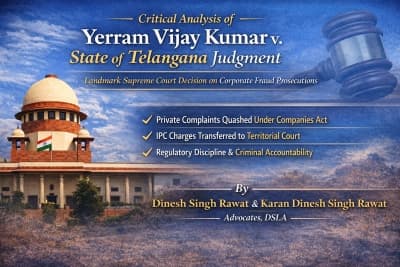
New Delhi (ABC Live): In its 9 January 2026 judgment, the Supreme Court tightened the legal boundary between corporate-regulatory enforcement and private criminal complaints. The Court held that a Special Court cannot take cognizance of alleged offences under Sections 448 and 451 of the Companies Act, 2013, on a private complaint when the alleged wrongdoing is functionally “fraud-linked” and therefore triggers the Section 212(6) cognizance bar. At the same time, the Court allowed the IPC offences to continue, but transferred them to the proper territorial criminal court once the Companies Act counts were completed.
Why this case matters for corporate litigation
Corporate control disputes often spill into criminal courts. As a result, parties sometimes file “fraud” complaints to gain leverage in parallel NCLT and civil proceedings. This judgment interrupts that pattern. It forces complainants to use the statutory fraud pathway first, while still keeping the door open for real criminal allegations under the IPC.
The core holding in plain terms
Section 448 cannot be prosecuted as a “stand-alone” crime
Section 448 defines false statements. However, it does not prescribe its own punishment. Instead, it says the person “shall be liable under Section 447.” Therefore, Section 448 draws its punitive force from Section 447. Because of that linkage, the Court treated Section 448 as an “offence covered under Section 447” for Section 212(6).
Section 212(6) is a jurisdictional gatekeeper
Section 212(6) restricts cognizance of Section 447-linked offences. The Special Court may take cognizance only on a written complaint by the SFIO Director or an authorised Central Government officer. The Court rejected attempts to bypass that safeguard by drafting the complaint under Section 448 while keeping Section 447 out.
3721620242026-01-09-645655
What the Supreme Court quashed and what it kept
Outcome table
| Category | Sections | Status after the Supreme Court |
|---|---|---|
| Companies Act | 448, 451 | Quashed |
| IPC | 420, 406, 426, 468, 470, 471, 120B (etc.) | Continues |
The Court quashed the Companies Act counts because the complaint did not satisfy the Section 212(6) precondition. Yet it refused to end the IPC case merely because civil and NCLT proceedings were pending.
Why the IPC case survives even when the Companies Act counts fail
Civil disputes can coexist with criminal allegations. Therefore, the Court held that parallel civil suits and an NCLT petition do not, by themselves, erase alleged cheating or forgery. However, once the Companies Act charges were gone, the Special Court’s ability to try IPC offences under Section 436(2) also fell away. As a result, the Court directed transfer to the competent territorial court (within four weeks).
The High Court’s key mistake
The Supreme Court noted that the High Court did not consider its own earlier decision on the same legal point. That omission matters because coordinate benches should maintain consistency. If a bench disagrees, it should refer the matter to a larger bench. The Supreme Court treated this as a serious lapse in judicial discipline.
Practical implications for companies, directors, and litigators
1) Fraud allegations must follow the Companies Act route
If a complainant alleges conduct that attracts Section 447 punishment, they must use the SFIO / Central Government authorised complaint route. Alternatively, they can invoke the NCLT mechanism under Section 213 to trigger an investigation.
2) Drafting tricks will not cure jurisdiction
If the punishment flows through Section 447, the cognizance bar applies. Courts will look at substance, not labels.
3) IPC exposure remains real
Even when the Companies Act counts fail, the IPC case may still proceed if the complaint discloses basic ingredients of offences such as forgery, cheating, or conspiracy.
ABC Live context
This “process-first” approach aligns with the Court’s broader insistence on using the correct statutory channel in complex regulatory disputes. Readers may also see ABC Live’s internal analysis here: https://abclive.in/2026/01/07/adani-power-ltd-v-union-of-india-2026/
Conclusion
The Supreme Court’s message is direct: corporate fraud prosecution is not a private shortcut. The law demands institutional screening before criminal courts take cognizance of fraud-linked offences under the Companies Act. Still, the Court did not weaken criminal accountability. Instead, it preserved IPC prosecution and corrected the forum by shifting the matter to the territorial criminal court.
The Judgment Analysis
By Dinesh Singh Law Associates | For ABC Live