
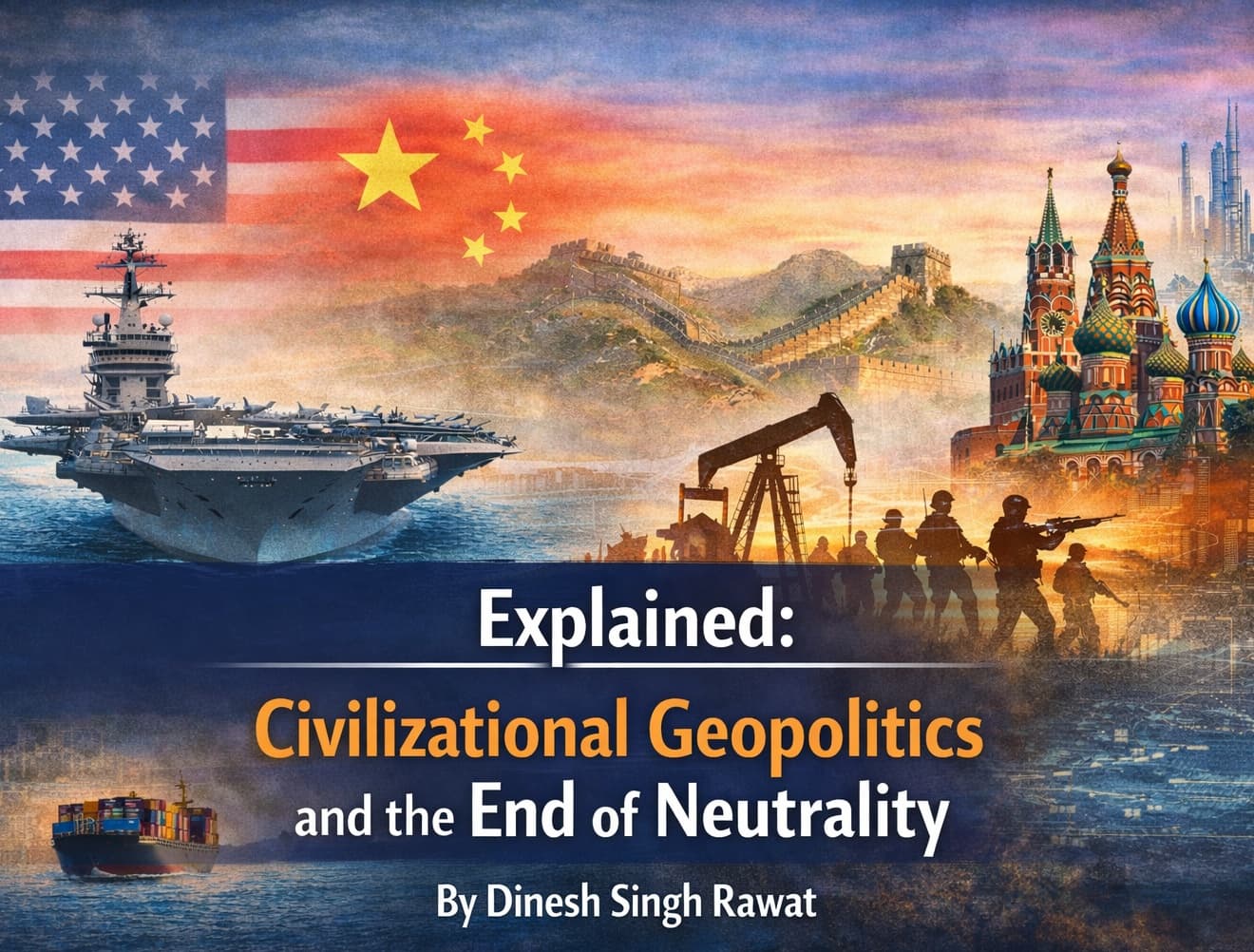
New Delhi (ABC Live): In 2026, the global system reflects a deep and lasting change in how power works. Importantly, this change is not temporary. Rather, it is not driven by one leader, one war, or one crisis. Instead, it reflects long-term shifts that have built up steadily over time.
While the nation-state still exists as the legal unit of authority, it no longer holds power on its own. Instead, power is now located within civilizational systems. In practice, these systems connect states through energy flows, trade routes, data networks, finance, technology, and security ties. As a result, leverage increasingly sits above individual governments.
Crucially, this break cannot be repaired in the post-Trump era. Rather, it is rooted in material facts. Specifically, energy self-sufficiency, tight supply chains, technology bottlenecks, uneven population growth, and weaker public support for global leadership have reshaped how states behave. Consequently, these forces influence policy regardless of who governs.
Because of this, geopolitics no longer runs mainly on rules or norms. Instead, it now runs on leverage. In other words, control over energy, data, money, transport, and security access has become more decisive than treaties or institutions.
1. What Is Civilizational Geopolitics?
At its core, civilizational geopolitics works through three connected layers.
First, the identity layer includes culture, history, religion, and shared stories.
Second, the decision layer includes governments and states.
Third, and most importantly, the power layer includes energy, data, finance, infrastructure, and military force.
Although identity still shapes public support and states still make formal decisions, the power layer now decides outcomes. Therefore, while sovereignty still exists on paper, real freedom increasingly depends on who controls key assets at the civilizational level.
2. Why the System Shifted (With Data)
First: Energy Risk Has Fallen
To begin with, the United States now produces about 13 million barrels of oil per day, making it the world’s largest producer. Meanwhile, global oil demand is growing slowly, and spare supply exists.
As a result, wars and crises no longer cause long-lasting oil shocks. Consequently, major powers can take tougher actions with less economic pain.
Second: Interdependence Has Become a Weapon
At the same time, global connection now creates pressure rather than safety. For example, about 95% of global internet traffic flows through subsea cables. Similarly, China controls 60–70% of rare-earth processing, which is vital for technology and defense.
Because supply chains are so narrow, dependence itself has become a weakness. Therefore, instead of calming conflict, interdependence now raises risk.
Third: Domestic Politics Limit Commitments
Meanwhile, voters in many countries oppose endless foreign duties. At the same time, government budgets are under strain.
As a result, security support is no longer automatic. Instead, it has become conditional and renegotiated.
Table 1: Structural Power by Civilization (2026)
| Civilization | Global GDP Share | Military Spend Share | Energy Position | Population Trend |
|---|---|---|---|---|
| Atlantic System | ~42% | ~45% | Energy secure | Aging |
| Sinic System | ~18% | ~14% | Importer | Aging |
| Eurasian–Russian | ~3–4% | ~5–6% | Exporter | Shrinking |
| Indic System | ~8% | ~4% | Importer | Fast growth |
| Islamic System | ~9–10% | ~6% | ~48% of oil | Very young |
| African System | ~4% | ~2% | Resource rich | Fastest growth |
Therefore, power does not come from GDP alone. Instead, energy control, population trends, and military strength increasingly define influence.
3. The Major Civilizational Systems
Atlantic System (US and Core Allies)
To begin with, the Atlantic system still holds unmatched military and financial strength. However, its key feature today is conditional support.
Assets
-
Dollar-based finance (85–90% of FX trades)
-
Strong navies
-
Advanced weapons
-
Wide alliance network
Leverage
-
Sanctions
-
Security protection
-
Market access
For example, NATO members are now judged on defense spending levels. Consequently, allies remain partners; however, protection now comes with clear conditions.
Sinic System (China-Centered)
By contrast, China turns dependence into influence.
Assets
-
About 30% of global manufacturing
-
Control of rare-earth processing
-
Strong role in ports and rail
Leverage
-
Supply-chain pressure
-
Trade access
-
Technology standards
For instance, Chinese firms help fund or run more than 100 ports worldwide. Thus, China gains power quietly by shaping reliance rather than provoking conflict.
Eurasian–Russian System
Meanwhile, Russia favors control and endurance over growth.
Assets
-
Large land depth
-
Nuclear weapons
-
Major gas and oil reserves
Leverage
-
Energy cut-offs
-
Military pressure
-
Willingness to absorb losses
Notably, defense spending remains near 6–7% of GDP. As a result, Russia trades efficiency for staying power.
Indic System (India-Centered)
Similarly, India acts as a civilizational swing power. Its leverage comes less from formal alliances and more from its ability to absorb shocks, rebuild capacity, and convert long historical identity into strategic resilience. This recurring pattern of disruption followed by recovery has been described as that of a “phoenix civilization,” reflecting how India repeatedly reconstructs institutional strength and re-enters the global system with renewed autonomy (a dynamic examined in greater depth here: https://abclive.in/2025/09/23/explained-how-india-became-a-phoenix-civilization/).
Assets
-
World’s largest population
-
Key sea routes
-
Growing technology and industry
Leverage
-
Multi-alignment
-
Market size
-
Diplomatic balance
For example, about 95% of India’s trade moves by sea. Therefore, India’s autonomy in 2026 depends on remaining a flexible deal-maker rather than becoming a dependent actor.
Islamic System (Muslim World)
In contrast to unified blocs, this system is central but divided.
Assets
-
Nearly half of global oil reserves
-
Major sea chokepoints
-
Large labor flows
-
Financial hubs
Leverage
-
Energy supply
-
Transit control
-
Security deals
For instance, around 20% of global LNG exports come from this region, while most states depend on outside security. Consequently, high importance combined with weak unity creates high risk.
African System
Likewise, Africa has become the main future battleground for leverage.
Assets
-
30–40% of key minerals
-
Young and fast-growing population
-
Strategic geography
Leverage
-
Resource access
-
Base hosting
-
Infrastructure contracts
Notably, more than half of African states host foreign troops or private forces. Accordingly, control is often traded through contracts rather than borders.
Europe and the Balkans
Meanwhile, Europe is re-arming quickly. Defense spending is rising fast, and over 90% of digital traffic relies on subsea cables.
By contrast, the Balkans remain only partly integrated. As a result, Europe is catching up late, while the Balkans stay open to pressure.
4. How the System Works in Practice
Across all regions, the same rules apply. First, infrastructure is strategic. Second, security has a price. Third, neutrality without strength fails. Fourth, division invites pressure. Finally, markets no longer stop conflict.
5. Roles in the Current System
| Role | Meaning | Examples |
|---|---|---|
| Dealmakers | Set terms | US, China |
| Dependents | Protected at a cost | Many African & Middle East states |
| Gray zones | Absorb pressure | Balkans, conflict areas |
How the Analysis Is Verified
The claims and figures in this report are based on open-source, cross-checked public data. Wherever possible, multiple independent sources are used to confirm trends and reduce reliance on any single dataset.
Verification follows three principles: triangulation, recency, and consistency.
Economic and Energy Data
-
International Monetary Fund (GDP, macro trends): https://www.imf.org/en/Data
-
International Energy Agency (oil, gas, LNG): https://www.iea.org/data-and-statistics
-
U.S. Energy Information Administration: https://www.eia.gov
Military Spending and Security Capacity
-
Stockholm International Peace Research Institute (SIPRI): https://www.sipri.org/databases/milex
-
NATO public defense expenditure data: https://www.nato.int/cps/en/natohq/topics_49198.htm
Trade, Supply Chains, and Manufacturing
-
World Trade Organization: https://www.wto.org/english/res_e/statis_e/statis_e.htm
-
World Bank data portal: https://data.worldbank.org
Technology, Data, and Infrastructure
-
TeleGeography (subsea cables): https://www.telegeography.com
-
OECD digital economy datasets: https://www.oecd.org/digital/
Demographics
-
United Nations Population Division: https://www.un.org/development/desa/pd
Case-based civilizational analysis is supplemented with internal analytical references, including the India-focused study cited above, to illustrate how civilizational recovery and resilience translate into strategic autonomy.
Methodologically, no single data point determines conclusions. Instead, trends are assessed over time, and political claims are weighed against material capability. Accordingly, the report prioritizes structure over events and capacity over rhetoric.
Conclusion: The New Normal
Ultimately, civilizational geopolitics in 2026 is real, structural, and already in force. It did not start with one leader, and it will not end with one election. Instead, power now follows control of energy, trade, data, and security.
There is no neutral ground left.
No one stands neutral anymore—only dealmakers, dependents, or the displaced.
Accordingly, this condition should be treated as the baseline reality of the international system, not an exception.