
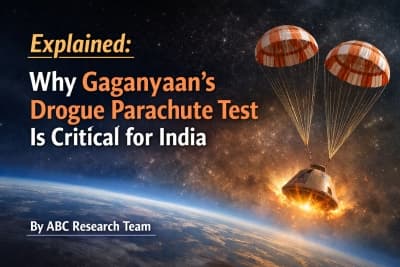
New Delhi (ABC Live): India has successfully carried out the qualification-level load test of the Drogue Parachute for the Gaganyaan programme at the Rail Track Rocket Sledge (RTRS) facility of the Defence Research and Development Organisation (DRDO) at the Terminal Ballistics Research Laboratory (TBRL), Chandigarh.
The RTRS is a specialised dynamic test facility used widely for high-speed aerodynamic and ballistic evaluations.
At first glance, the event may seem highly technical. In reality, it represents one of the most important safety validations in India’s first crewed space mission. The drogue parachute is the first mechanical recovery system that activates after atmospheric re-entry. As a result, its reliability directly decides whether astronauts can return safely.
What Is the Drogue Parachute and Why Does It Matter
The drogue parachute is a high-strength ribbon parachute that deploys shortly after the Crew Module enters the atmosphere.
It performs three key functions:
- First, it stabilises capsule orientation
- Second, it reduces speed to controllable levels
- Third, it enables the correct extraction of the main parachutes
If this stage fails, every later stage is placed at risk.
Gaganyaan Crew Module Descent Architecture
| Phase | System Activated | Function |
|---|---|---|
| Re-entry | Heat Shield | Thermal protection |
| Early Descent | Drogue Parachute | Stabilisation & initial slowing |
| Mid Descent | Pilot Parachutes | Extract main chutes |
| Final Descent | Main Parachutes | Major speed reduction |
| Terminal Phase | Landing Attenuation | Safe splashdown |
Therefore, the drogue parachute acts as the gateway to safe recovery.
What the Qualification-Level Load Test Proved
Qualification testing deliberately exposes the parachute to loads higher than those expected in actual flight.
Indicative Test Envelope
| Parameter | Qualification Condition | Operational Need |
|---|---|---|
| Tensile load | Above design load | Design load |
| Deployment regime | Extreme dynamic | Supersonic |
| Structural response | No tear or seam failure | Mandatory |
| Inflation symmetry | Stable and uniform | Mandatory |
In simple terms, survival under overload confirms strong safety margins.
Human-Rating Certification Logic
| Stage | Objective |
|---|---|
| Design validation | Check calculations |
| Development testing | Check prototype |
| Qualification testing | Certify final design |
| Acceptance testing | Clear flight units |
Thus, this test marks the move from development to certified hardware.
Multi-Agency Execution
The test was carried out with close coordination among:
- Vikram Sarabhai Space Centre (ISRO)
- Aerial Delivery Research and Development Establishment (ADRDE)
- Teams from Terminal Ballistics Research Laboratory
Together, these institutions form the backbone of India’s crew safety effort.
Risk Profile: If Drogue Parachute Fails
| Failure Mode | Impact |
|---|---|
| No deployment | Capsule tumbles |
| Partial inflation | Main chutes may not extract |
| Structural tear | High-speed impact |
| Asymmetric inflation | Capsule spins |
Simply put, human spaceflight allows no margin for such failures.
Global Comparison: Parachute Qualification in Crewed Missions
| Programme | Country | Certification Approach |
|---|---|---|
| Apollo | USA | Ground sled + overload tests |
| Orion | USA | Qualification-level overload |
| Soyuz | Russia | High-load dynamic tests |
| Shenzhou | China | Multi-stage overload tests |
| Gaganyaan | India | RTRS overload qualification |
Consequently, India now follows the same safety philosophy as leading space powers.
Indigenous Capability Advancement
| Area | Earlier Status | Current Status |
|---|---|---|
| Ribbon parachute design | Limited | Indigenous |
| Stitching & seams | Partial | Certified |
| Overload testing | Limited | Indigenous |
| Human-rating ecosystem | Nascent | Advancing |
Moreover, the success supports the Atmanirbhar Bharat vision highlighted by Rajnath Singh and Samir V Kamat.
Conclusion
The successful qualification-level load test of the Gaganyaan drogue parachute is not symbolic. Instead, it is a life-certification milestone.
It confirms that India can independently design, test, and certify systems that protect astronauts’ lives.
In human spaceflight, launch attracts attention. However, recovery decides survival.
Therefore, this milestone moves India decisively closer to a fully indigenous, human-rated space mission.
ABC Live Editor’s Note
The number of launches often judges human spaceflight. However, history shows that the highest number of mission failures happens during descent and recovery. Therefore, the qualification-level load test of the Gaganyaan drogue parachute is not a routine trial. Instead, it is a life-certification event.
This report explains what was tested, why overload qualification matters, how India’s method compares globally, and what this milestone reveals about India’s human-rating capability.
Primary Source (PIB):
https://www.pib.gov.in/PressReleasePage.aspx?PRID=2230224®=3&lang=1
ABC Live Backgrounder:
https://abclive.in/2025/10/08/drdo-irsa-1-0-india-sdr-architecture/