
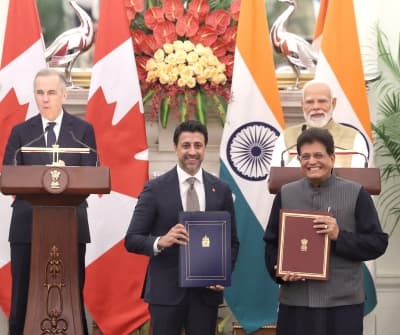
New Deli (ABC Live): India–Canada CEPA: On 2 March 2026, India and Canada signed the Terms of Reference (ToR) to begin negotiations for a Comprehensive Economic Partnership Agreement (CEPA). The document was signed by Piyush Goyal and Maninder Sidhu, in the presence of Narendra Modi and Mark Carney at Hyderabad House.
🔗 Official PIB Release:
https://www.pib.gov.in/PressReleasePage.aspx?PRID=2234674®=3&lang=1
At the ceremony, leaders announced an ambitious target of USD 50 billion in bilateral trade by 2030. However, while the political signal was strong, the ToR itself only sets the framework for talks. Therefore, the real question is whether CEPA can realistically achieve that scale of expansion.
Why ABC Live Is Publishing This Report on India–Canada CEPA
ABC Live is publishing this report because the India–Canada CEPA, following the signing of the Terms of Reference, represents more than a diplomatic event—it signals a strategic economic shift that must be evaluated against data, feasibility, institutional depth, and long-term impact. With bilateral trade currently at USD 8.66 billion and a target of USD 50 billion by 2030, the gap between ambition and arithmetic demands scrutiny. Moreover, since CEPA fits within India’s broader FTA expansion strategy involving the EU, UK, GCC, EFTA, and Indo-Pacific partners, it is essential to assess whether this agreement can realistically expand services trade, strengthen investment flows, and reduce the bilateral trust deficit. Therefore, ABC Live examines the policy substance, structural risks, and institutional design behind the announcement to provide readers with analysis—not just event coverage.
Deep Context: CEPA Within India’s Trade Strategy
Over the past few years, India has shifted its trade strategy. Earlier, it moved cautiously on FTAs. Now, however, it actively pursues targeted agreements that align with supply chains, energy security, and services growth.
For instance, India signed the India–UAE CEPA, which quickly boosted trade through logistics strength. Similarly, it concluded the India–EFTA TEPA, which emphasised long-term investment commitments. Meanwhile, negotiations with the EU and the UK have focused heavily on regulatory alignment and access to services.
ABC Live has examined this transformation in detail:
- India–EU FTA
https://abclive.in/2026/01/28/india-eu-fta/ - India’s New Trade Doctrine: GCC & Israel FTAs
https://abclive.in/2026/02/25/indias-new-trade-doctrine-gcc-israel-ftas/ - India–GCC FTA
https://abclive.in/2026/02/06/india-gcc-fta/ - India–New Zealand FTA
https://abclive.in/2025/12/22/india-new-zealand-free-trade-agreement/ - India–UK Strategic Partnership
https://abclive.in/2025/10/11/india-uk-strategic-partnership/ - India–EFTA TEPA
https://abclive.in/2025/10/02/india-efta-tepa/ - India–UAE CEPA
https://abclive.in/2025/10/01/india-uae-cepa/ - India–Saudi Arabia Bilateral Trade
https://abclive.in/2025/10/16/india-saudi-arabia-bilateral-trade/ - India–Brazil–Mercosur Deal
https://abclive.in/2025/10/17/explained-how-india-brazil-mercosur-deal-offsets-u-s-export-loss/
Therefore, Canada’s CEPA must be viewed within this wider diversification effort rather than as a standalone initiative.
Trade Arithmetic: Ambition Meets Reality
Currently, bilateral trade stands at USD 8.66 billion (FY 2024–25).
Trade Breakdown
| Indicator | USD Billion |
|---|---|
| Total Trade | 8.66 |
| India Exports | 4.22 |
| India Imports | 4.44 |
To reach USD 50 billion by 2030, trade must expand nearly six times within five years. Consequently, annual growth would need to exceed 40 percent.
Scenario Modelling
| Annual Growth | Estimated 2030 Trade |
|---|---|
| 10% | ~14 billion |
| 20% | ~22 billion |
| 30% | ~32 billion |
| 40%+ | ~50 billion |
Clearly, moderate growth will not suffice. Therefore, tariff cuts alone cannot deliver the target. Instead, service expansion, investment flows, and integrated supply chains must drive growth.
Sectoral Structure and Sensitivities
India exports pharmaceuticals, steel, textiles, electronics, and chemicals to Canada. Meanwhile, Canada exports pulses, fertilisers, coal, crude oil, and precious stones to India.
On the one hand, this structure shows complementarity. On the other hand, agriculture and standards remain politically sensitive. Therefore, negotiators must balance domestic protection with market access.
Moreover, standards alignment and SPS clarity will prove just as important as tariff reduction. Without regulatory cooperation, exporters may still face barriers despite lower duties.
Services and Mobility: The Real Growth Engine
Canada hosts more than 425,000 Indian students. In addition, the Indian diaspora plays a significant economic role. As a result, services trade and mobility form the most promising growth channel.
If CEPA establishes predictable visa pathways and mutual recognition agreements, service exports can expand rapidly. Furthermore, digital trade rules can support IT, telecom, and professional services.
However, if mobility remains uncertain, service growth will slow. Consequently, overall trade will struggle to scale.
Thus, the services chapter will likely determine CEPA’s success.
Comparative Lessons
India’s recent FTAs provide useful benchmarks.
For example, the UAE CEPA delivered fast gains because trade routes were already strong and tariffs fell quickly. Similarly, the EFTA agreement emphasised investment commitments, which create long-term industrial depth.
In contrast, agreements with smaller bases, such as New Zealand, naturally generate slower growth. Therefore, scale and structure both matter.
Canada begins from a modest base. Nevertheless, it offers strong services and mineral potential. Accordingly, CEPA must prioritise institutional depth rather than incremental tariff relief.
Can India–Canada CEPA Reduce the Trust Deficit?
Recent diplomatic tensions created uncertainty for businesses and students. As a result, investment and mobility flows faced disruption.
Trade agreements can reduce such uncertainty by institutionalising cooperation. First, they create structured dialogue. Second, they establish dispute settlement systems. Third, they introduce transparency and review timelines.
If CEPA includes:
- Regular ministerial engagement,
- A clear mobility annex,
- Investment protection rules,
- Predictable dispute mechanisms,
then economic actors will rely on rules instead of political signals. Over time, this structure can reduce the trust deficit.
However, if enforcement remains weak, scepticism will persist. Therefore, institutional credibility remains central.
Risk Assessment
| Risk | Probability | Impact |
|---|---|---|
| Political volatility | Medium | High |
| Visa tightening | High | Very High |
| Agriculture sensitivity | High | Medium |
| Rules of origin complexity | Medium | Medium |
| Investment disputes | Low–Medium | Medium |
Because these risks remain present, strong governance mechanisms become essential.
Strategic Significance
CEPA supports three broader goals. First, it diversifies trade beyond traditional partners. Second, it secures access to minerals and energy inputs. Third, it anchors economic ties in institutional rules.
Therefore, CEPA acts both as a growth instrument and as a diplomatic stabiliser.
Final Assessment of India–Canada CEPA
In conclusion, the ToR signing marks a diplomatic reset. Nevertheless, real transformation depends on negotiation depth.
If negotiators secure strong services provisions, mobility clarity, investment safeguards, and enforceable rules, CEPA can expand trade and restore confidence. Conversely, if the agreement remains narrow, growth will remain limited.
Ultimately, the ToR starts the process. However, only a deep and balanced agreement will deliver lasting economic and strategic gains.