
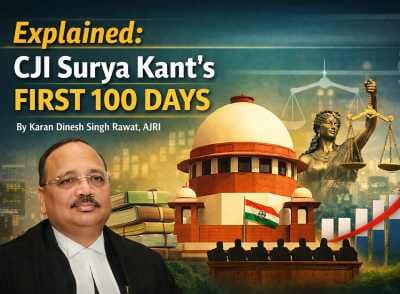
New Delhi (ABC Live): Currently, India’s judicial system is facing an unprecedented structural challenge. The Supreme Court of India is managing more than 92,000 pending cases. Meanwhile, courts across the country are collectively handling over 50 million pending matters. Consequently, pressure on the justice delivery system continues to intensify.
Against this backdrop, Surya Kant assumed office as the 53rd Chief Justice of India in November 2025. Importantly, the official composition of the Court is available on the Supreme Court’s judges page:
https://www.sci.gov.in/chief-justice-judges/
Unlike several recent Chief Justices, who served short tenures, CJI Surya Kant has roughly 14 months in office. Therefore, he has a rare opportunity to pursue structural reforms rather than simply manage administrative pressures.
Earlier, ABC Live analysed expectations surrounding his tenure in:
https://abclive.in/2025/11/25/explained-why-cji-surya-kant-may-succeed-where-others-struggled/
Similarly, ABC Live examined his judicial philosophy in:
https://abclive.in/2025/06/08/justice-surya-kant-judgement/
Accordingly, this report evaluates the Chief Justice’s first 100 days and examines how his early reforms may shape the future of India’s judiciary.
Moreover, the debate over judicial reform reflects broader concerns about efficiency, transparency, and institutional capacity.
Supreme Court Snapshot
| Indicator | Data |
|---|---|
| Pending cases | ~92,180 |
| Increase in 2025 | ~10,000 |
| Constitution Bench cases | 29 |
| Sanctioned judges | 34 |
| Working judges | 33 |
Notably, February 2026 recorded a modest decline in pendency. However, the overall trend still shows rising caseload pressure.
Consequently, policymakers increasingly view pendency as a systemic governance challenge.
Timeline: Supreme Court Reform Trajectory (2014–2026)
Over the past decade, India’s judiciary has experienced multiple reform initiatives. However, implementation has often remained uneven. Nevertheless, each reform has gradually shaped the institutional framework.
| Year | Reform Event | Institutional Impact |
|---|---|---|
| 2014 | Expansion of the National Judicial Data Grid | Nationwide judicial data digitised |
| 2015 | Supreme Court Advocates-on-Record Association v. Union of India | Collegium system restored |
| 2017 | Case Management Rules introduced | Hearing timelines debated |
| 2018 | Live-streaming approved | Transparency expanded |
| 2020 | Pandemic accelerates virtual hearings | Digital courts expand |
| 2021–2023 | e-Courts Phase III launched | Online filing improves |
| 2024 | Structured listing reforms debated | Implementation uneven |
| 2025 | Pendency crosses 90,000 | Institutional concern rises |
| Nov 2025 | CJI Surya Kant assumes office | Administrative reform begins |
| 2026 | Focus on mediation and Constitution Benches | Backlog reduction strategy |
Thus, technological reforms have improved transparency. However, structural capacity constraints remain.
Similarly, each reform phase reveals the limits of administrative change without structural capacity expansion.
The Pendency Crisis
Currently, the backlog of cases remains the Supreme Court’s most pressing challenge. Indeed, the Court continues to manage a growing docket. Meanwhile, litigation inflow remains high.
Pendency Trend
| Year | Pending Cases |
|---|---|
| 2014 | ~62,000 |
| 2018 | ~58,000 |
| 2020 | ~59,000 |
| 2023 | ~70,000 |
| 2025 | ~90,000+ |
| 2026 | ~92,000 |
Several factors explain this increase. First, Special Leave Petitions have grown rapidly. Second, constitutional disputes involving policy questions have expanded. Third, appeals from regulatory tribunals now reach the Court more frequently.
Consequently, the Supreme Court faces both constitutional and appellate pressures.
Accordingly, reform proposals now emphasise both procedural discipline and institutional expansion.
Constitution Bench Revival Strategy
Meanwhile, another reform priority under CJI Surya Kant has been the revival of Constitution Bench hearings.
Currently, the Court has 29 pending Constitution Bench cases. Moreover, many of these matters affect litigation across multiple High Courts.
Two major cases scheduled include:
| Case | Issue |
|---|---|
| Definition of “Industry” case | Labour law jurisprudence |
| Indian Young Lawyers Association v. State of Kerala | Constitutional limits of religious freedom |
However, Constitution Benches require larger judicial panels. Consequently, scheduling such benches remains challenging.
Nevertheless, if the Constitution Benches sit more frequently, constitutional interpretation could become clearer. As a result, High Court litigation awaiting clarity may progress faster.
Registry Reform: The Administrative Challenge
While judicial reform debates often focus on judges, administrative structures also shape court efficiency.
The Supreme Court Registry manages:
- case listing
- filing scrutiny
- bench allocation
- procedural compliance
However, critics argue that the system still reflects bureaucratic inertia.
Key Concerns
| Issue | Institutional Risk |
|---|---|
| Long-tenured staff | Institutional inertia |
| Non-uniform listing | Perception of arbitrariness |
| Procedural opacity | Reduced transparency |
| Informal networks | Institutional credibility concerns |
Therefore, administrative reform of the Registry may prove essential for sustainable institutional change.
Mediation as a Systemic Reform Tool
In addition, CJI Surya Kant has strongly promoted mediation as an alternative dispute resolution mechanism.
Key initiatives include:
- mediation awareness campaigns
- calls for stronger incentives for mediation
- expansion of mediation frameworks across courts
Consequently, mediation could reduce civil litigation inflow. Therefore, appellate courts may experience lower caseload pressure.
Collegium Transparency Debate
Meanwhile, judicial appointments remain one of the most debated institutional issues.
The Supreme Court Collegium manages appointments to the higher judiciary.
Collegium Activity (First 100 Days)
| Indicator | Number |
|---|---|
| Meetings held | 7 |
| High Court judges recommended | 19 |
| Ad-hoc judges recommended | 5 |
However, critics argue that the system remains opaque. Consequently, transparency reforms continue to be debated.
Ultimately, the success of judicial reform will depend on whether these initiatives reduce pendency in measurable terms.
Conclusion
In summary, the first 100 days of CJI Surya Kant reveal an emphasis on administrative discipline and procedural reform.
On the one hand, initiatives such as discouraging oral mentioning and promoting mediation represent meaningful steps. On the other hand, the scale of judicial backlog still requires deeper structural reform.
Therefore, the coming months may determine whether these reforms stabilise the Supreme Court’s caseload—or whether systemic backlog pressures persist.
Sources & Resources
- Supreme Court of India – Judges
https://www.sci.gov.in/chief-justice-judges/ - National Judicial Data Grid
https://njdg.ecourts.gov.in - ABC Live Analysis
https://abclive.in/2025/11/25/explained-why-cji-surya-kant-may-succeed-where-others-struggled/ - https://abclive.in/2025/06/08/justice-surya-kant-judgement/