
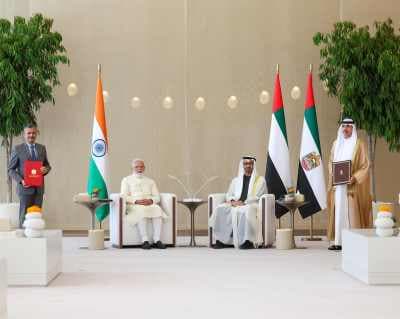
New Delhi (ABC Live): Prime Minister Narendra Modi’s UAE visit on 15 May 2026 was not a routine diplomatic stopover. Rather, it was a strategic-security visit shaped by energy risk, West Asian instability, shipping concerns, AI competition and the need for long-term capital.
The Ministry of External Affairs had stated before the visit that PM Modi would begin his five-nation tour from the UAE on 15 May 2026, meet UAE President Sheikh Mohamed bin Zayed Al Nahyan, and discuss energy cooperation along with regional and international issues. In addition, MEA underlined that energy security remains an important part of India–UAE relations. It also noted that more than 4.5 million Indians in the UAE act as a living bridge between the two countries.
Source MEA
Reuters reported that India and the UAE signed agreements during the visit on defence, strategic petroleum reserves and LPG supplies. It also placed the visit in the context of the Iran war, Strait of Hormuz disruption, UAE’s exit from OPEC and India’s effort to secure energy supplies.
Source: Reuters
Therefore, the main issue is not whether the visit produced agreements. It clearly did. The real question is whether these agreements give India long-term strategic security without creating new dependence on UAE energy, UAE capital or UAE-linked technology.
Why ABC Live Links This Visit with CEPA
This visit cannot be understood without the India–UAE CEPA background.
ABC Live had earlier analysed how the India–UAE CEPA works as a trade shield by using UAE’s re-export system, joint ventures and INR–AED settlement mechanism. That report argued that CEPA helps India protect exporters while advancing the wider non-oil trade vision.
Internal link: https://abclive.in/2025/10/01/india-uae-cepa/
However, CEPA was only the trade foundation. Modi’s UAE 2026 visit adds the next layer: energy security, defence cooperation, maritime industrial capacity, AI compute and strategic investment.
In simple terms, CEPA created the India–UAE trade corridor. Modi’s 2026 visit now tries to secure that corridor.
Agreements and Announcements at a Glance
| No. | Agreement / Announcement | Indian Side | UAE Side | Sector | Strategic Meaning |
|---|---|---|---|---|---|
| 1 | Strategic Collaboration Agreement on petroleum reserves | ISPRL | ADNOC | Energy security | Expands India’s crude storage options |
| 2 | Strategic Collaboration Agreement on LPG supplies | IOCL | ADNOC | Household energy | Opens pathway for long-term LPG supply |
| 3 | Framework for Strategic Defence Partnership | Ministry of Defence, India | UAE Ministry of Defence | Defence | Moves ties into hard-security cooperation |
| 4 | MoU for Ship Repair Cluster at Vadinar | Cochin Shipyard Ltd. | Drydocks World | Maritime industry | Builds India’s west-coast ship repair capacity |
| 5 | MoU on Skill Development in Ship Repair | CSL + CEMS | Drydocks World | Workforce | Creates trained maritime manpower |
| 6 | Term Sheet for 8 Exaflop Supercomputing Cluster | C-DAC | G42 / MBZUAI | AI / compute | Links India’s AI Mission with high-performance computing |
| 7 | UAE investment announcements | NIIF, RBL Bank, Sammaan Capital | ADIA, Emirates NBD, IHC | Infrastructure and finance | Deepens UAE capital in India’s growth sectors |
A UAE state-linked report through WAM listed the exchanged agreements, including ISPRL–ADNOC, IOCL–ADNOC, the strategic defence framework, the C-DAC–G42–MBZUAI 8-exaflop cluster, and the Cochin Shipyard–Drydocks World maritime agreements.
Source: https://www.urdupoint.com/en/middle-east/uae-president-and-indian-prime-minister-witne-2187909.html
1. Strategic Petroleum Reserves: India’s Most Critical Energy Shield
The most important agreement is the Strategic Collaboration Agreement between Indian Strategic Petroleum Reserves Limited (ISPRL) and ADNOC.
The agreement covers several possible areas of cooperation. These include potential ADNOC crude storage in India’s strategic petroleum reserves up to 30 million barrels, participation in facilities including Visakhapatnam, development of reserve facilities in Chandikol, Odisha, possible crude storage in Fujairah, and potential collaboration in LNG and LPG storage facilities in India.
Data Table: India’s Energy-Security Problem
| Indicator | Data / Status | Why It Matters |
|---|---|---|
| India’s crude import dependence | Around 88% as reported in energy-policy context | India remains exposed to global price and supply shocks |
| Existing Indian SPR capacity | 5.33 MMT | Emergency cover remains limited for a large importer |
| Planned reserve expansion | Nearly 12 MMT | India wants deeper emergency protection |
| Proposed ADNOC storage | Up to 30 million barrels | This can strengthen India’s oil buffer |
| Proposed Fujairah storage | UAE-based reserve element | It gives India offshore flexibility |
| Existing SPR locations | Visakhapatnam, Mangaluru, Padur | India already has a domestic underground reserve network |
Reuters reported before the visit that Modi was expected to seek UAE support for expanding India’s strategic oil reserves. It also reported that India was planning to expand reserve capacity from 5.33 million tonnes to nearly 12 million tonnes.
Source: Reuters
Critical Analysis
This agreement secures India because it can increase emergency oil depth. Nevertheless, its legal design will decide whether it becomes a true strategic reserve or only a commercial storage arrangement.
A strategic petroleum reserve is not an ordinary tank. It is a national-security instrument. Hence, India must retain control over emergency drawdown, release timing, pricing conditions and wartime access.
| Issue | Why It Matters |
|---|---|
| Emergency drawdown rights | India must access crude during crisis |
| Ownership structure | Commercial ownership must not override national-security use |
| Pricing formula | Emergency crude should not become unaffordable |
| Release trigger | India must decide when emergency use begins |
| Location control | Domestic and offshore storage must serve Indian needs |
| Sanctions and war-risk clauses | Reserve access must survive geopolitical shocks |
The agreement is strategically valuable. However, ADNOC’s participation must strengthen Indian sovereign control, not dilute it.
2. Fujairah Storage: India’s Backup Outside the Strait of Hormuz
The proposed storage of Indian strategic crude in Fujairah is a smart hedge.
Fujairah lies outside the Strait of Hormuz. As a result, crude stored there can help India if Hormuz becomes unsafe, restricted or costly for shipping.
Reuters reported that Strait of Hormuz disruption affected global energy markets because it is a vital chokepoint for roughly 20% of global oil flows.
Source: Reuters
Why Fujairah Matters
| Benefit | Strategic Value |
|---|---|
| Outside Hormuz | Reduces direct chokepoint exposure |
| Near Gulf supply | Allows faster sourcing from UAE-linked supply chains |
| UAE storage ecosystem | Uses existing energy infrastructure |
| External reserve option | Adds flexibility beyond Indian territory |
| Crisis diversification | Gives India more than one storage geography |
Critical Analysis
Fujairah storage is useful. Even so, it cannot replace domestic reserves.
During a serious regional crisis, India will still require tankers, insurance, naval security, diplomatic access and safe sea lanes. Therefore, India should follow a dual model: domestic underground reserves for sovereign control and Fujairah storage for regional flexibility.
That balance will secure India better than relying only on domestic storage or only on offshore storage.
3. LPG Agreement: Household Energy Becomes Strategic Diplomacy
The IOCL–ADNOC Strategic Collaboration Agreement on LPG supplies is politically and socially important.
LPG is not only an energy commodity. It affects household kitchens, rural families, food inflation, small restaurants, commercial users and welfare delivery. Consequently, a long-term LPG supply pathway can protect India from sudden price or supply shocks.
Reuters confirmed that India and the UAE signed pacts on strategic petroleum reserves and LPG supply during the visit.
Source: Reuters
LPG Security Matrix
| Dimension | Importance for India |
|---|---|
| Household fuel | Protects domestic consumers |
| Rural cooking energy | Supports clean cooking access |
| Inflation management | Fuel shocks affect household sentiment |
| Commercial LPG | Supports food services and small enterprises |
| Long-term supply | Reduces spot-market exposure |
| Storage collaboration | Creates short-term emergency cushion |
Critical Analysis
The LPG agreement secures India because it gives predictability. At the same time, India should not replace spot-market risk with supplier-concentration risk.
For that reason, India must follow three tracks. First, it should secure long-term LPG supply from the UAE. Second, it should keep alternative suppliers active. Third, it should expand domestic gas, bioenergy and clean-cooking alternatives.
Only then will LPG security become genuine resilience rather than dependence.
4. Defence Framework: UAE Moves from Energy Partner to Security Partner
The Framework for Strategic Defence Partnership is one of the most important outcomes of the visit.
Reuters reported that the framework covers defence industrial collaboration, innovation and advanced technology, training, exercises, maritime security, cyber defence, secure communications and information exchange.
Source: Reuters
Earlier, the January 2026 India visit of UAE President Sheikh Mohamed bin Zayed Al Nahyan had produced a Letter of Intent to work toward a Strategic Defence Partnership Framework. That document covered defence industrial collaboration, defence innovation, advanced technology, training, education, doctrine, special operations, interoperability, cyberspace and counter-terrorism.
Source: MEA
Defence Framework Table
| Area | How It Secures India |
|---|---|
| Defence industrial collaboration | Creates scope for joint production and supply-chain cooperation |
| Advanced technology | Supports future warfare and dual-use systems |
| Training and exercises | Builds operational familiarity |
| Education and doctrine | Aligns strategic understanding |
| Special operations | Signals high-trust security cooperation |
| Maritime security | Protects Gulf–Arabian Sea–Indian Ocean routes |
| Cyber defence | Protects critical digital infrastructure |
| Secure communications | Enables trusted exchange |
| Information sharing | Improves strategic awareness |
Critical Analysis
This framework secures India by adding a hard-security layer to the Gulf relationship. Until recently, India–UAE ties were viewed mainly through oil, trade, diaspora and investment. Now, the UAE is becoming a security partner as well.
Even so, India must remain careful. The UAE maintains relations with the United States, Saudi Arabia, Iran, Israel, China and Pakistan. Hence, India should deepen cooperation where interests converge, especially maritime security, counter-terrorism, cyber defence and defence industry.
The correct approach is clear: strategic cooperation without alliance entanglement.
5. Vadinar Ship Repair Cluster: Maritime Security Through Industrial Capacity
The MoU between Cochin Shipyard Limited and Drydocks World for setting up a Ship Repair Cluster at Vadinar is a quiet but important agreement.
India has ports, coastline and shipping traffic. Yet it still needs stronger ship repair, offshore fabrication and marine maintenance capability. The Vadinar project can help fill that gap.
WAM’s agreement list confirmed the MoU between Cochin Shipyard Limited and Drydocks World on setting up a ship repair cluster at Vadinar.
Source: https://www.urdupoint.com/en/middle-east/uae-president-and-indian-prime-minister-witne-2187909.html
Why Vadinar Matters
| Factor | Strategic Value |
|---|---|
| Western coast location | Close to Gulf and Arabian Sea shipping routes |
| Ship repair capacity | Reduces dependence on foreign repair yards |
| Offshore fabrication | Supports oil, gas and marine engineering |
| Drydocks World expertise | Adds global maritime know-how |
| Maritime Development Fund linkage | Connects with Indian maritime industrial policy |
| Employment potential | Creates skilled technical jobs |
Critical Analysis
Ports alone do not make a maritime power. A maritime power also needs repair yards, maintenance ecosystems, skilled technicians, spare-part supply chains and fast turnaround.
Therefore, the Vadinar cluster can secure India’s maritime economy in three ways. It can reduce dependence on foreign yards. It can attract repair traffic from ships moving through Gulf–India routes. Moreover, it can support offshore energy assets and naval-adjacent industrial capability.
However, success will depend on execution.
| Requirement | Why It Matters |
|---|---|
| Fast customs and port clearance | Ships cannot wait for procedural delays |
| Global certification | International vessels need trusted quality standards |
| Skilled workforce | Repair work is technical and safety-sensitive |
| Spare-part logistics | Downtime must be reduced |
| Competitive pricing | India must compete with Dubai and Singapore |
| Time-bound construction | MoU must not remain a paper commitment |
6. Skill Development in Ship Repair: Training Must Lead to Jobs
The tripartite MoU between Cochin Shipyard Limited, Drydocks World and CEMS aims to mobilise, train and employ skilled maritime workers.
WAM’s list confirmed the skill-development MoU in ship repair between CSL, Drydocks World and CEMS.
Source: https://www.urdupoint.com/en/middle-east/uae-president-and-indian-prime-minister-witne-2187909.html
Maritime Workforce Table
| Skill Category | Practical Use |
|---|---|
| Marine welding | Hull repair and fabrication |
| Electrical repair | Vessel systems and maintenance |
| Mechanical repair | Engines, pumps and propulsion |
| Offshore fabrication | Oil, gas and marine structures |
| Safety supervision | Compliance with global yard standards |
| Quality inspection | Certification and export-grade repair |
| Project management | Time and cost discipline |
Critical Analysis
This agreement secures India only if it creates employable workers.
India has seen many skill schemes where training certificates did not translate into jobs. Thus, this MoU must be measured through outcomes, not announcements.
| Metric | Why It Matters |
|---|---|
| Number of trainees per year | Shows scale |
| Placement rate | Shows employability |
| Average wage after placement | Shows job quality |
| International certification rate | Shows global acceptance |
| Apprenticeship conversion | Shows industry absorption |
| One-year retention | Shows stability |
| Women participation | Shows inclusive workforce development |
A maritime skill pipeline can become a major advantage if it connects training directly with shipyards, offshore fabrication units and global placement opportunities.
7. 8 Exaflop Supercomputing Cluster: India’s AI Security Layer
The term sheet between C-DAC, G42 Group and Mohamed bin Zayed University of Artificial Intelligence for an 8-exaflop supercomputing cluster in India is one of the most futuristic outcomes of the visit.
WAM’s list confirmed the term sheet for establishing the 8-exaflop supercomputing cluster in India.
Source: https://www.urdupoint.com/en/middle-east/uae-president-and-indian-prime-minister-witne-2187909.html
AI Compute Table
| Parameter | Details |
|---|---|
| Proposed capacity | 8 exaflops |
| Indian partner | C-DAC |
| UAE-side partners | G42 Group and MBZUAI |
| Location | India |
| Strategic use | AI compute and high-performance computing |
| Policy relevance | India AI Mission and sovereign AI capacity |
Critical Analysis
AI compute is now strategic infrastructure. In earlier decades, ports, oil reserves, telecom networks and power grids shaped national capacity. Today, large-scale compute power shapes AI sovereignty.
The 8-exaflop cluster can help India build Indian language AI models, public-sector AI systems, climate models, health research tools, defence simulations, scientific computing capacity and startup-level AI access.
Nevertheless, the risks are serious.
| Governance Question | Why It Matters |
|---|---|
| Who owns the hardware? | Determines strategic control |
| Where will data be stored? | Determines data sovereignty |
| Who controls access? | Determines domestic benefit |
| What will be the pricing model? | Determines startup access |
| Who audits cybersecurity? | Determines trust |
| Can sensitive state data be processed? | Determines national-security use |
| Will Indian researchers get priority? | Determines ecosystem value |
| Will technology transfer happen? | Determines long-term capability |
This agreement secures India only if it builds Indian-controlled capacity. Otherwise, it may become a foreign-backed compute facility on Indian soil with limited strategic value.
8. UAE Investment Announcements: Capital Security with Regulatory Caution
The visit also included major UAE investment announcements.
WAM reported announcements including Emirates NBD’s AED 11.02 billion investment to acquire a 60% stake in RBL Bank, ADIA’s AED 3.67 billion investment in NIIF, and IHC’s AED 3.67 billion investment to acquire an equity stake in Sammaan Capital.
Source: https://www.urdupoint.com/en/middle-east/uae-president-and-indian-prime-minister-witne-2187909.html
Reuters also reported that the Indian side announced UAE investments worth US$5 billion, pointing to Emirates NBD’s RBL Bank deal and IHC’s investment in Sammaan.
Source: https://www.reuters.com/world/india/india-signs-pacts-with-uae-defence-petroleum-during-modis-visit-2026-05-15/
Investment Table
| Investor | Indian Target / Partner | Reported Amount | Sector | Strategic Meaning |
|---|---|---|---|---|
| Emirates NBD | RBL Bank | AED 11.02 billion / about ₹28,300 crore | Banking | UAE capital enters Indian banking |
| ADIA | NIIF | AED 3.67 billion / about ₹9,440 crore | Infrastructure | Supports long-term infrastructure funding |
| IHC | Sammaan Capital | AED 3.67 billion / about ₹9,440 crore | NBFC / financial services | Deepens Gulf participation in Indian credit markets |
| Total package | Multiple | About US$5 billion | Infrastructure and finance | Builds India–UAE capital corridor |
Critical Analysis
UAE capital can secure India’s growth ambitions. Infrastructure needs long-term funding. Banks and NBFCs also need stable capital. For this reason, sovereign and institutional investors can help India finance its next growth cycle.
However, banking and NBFCs are not ordinary sectors. They influence household savings, credit allocation, systemic stability and data flows. Therefore, India must welcome capital but preserve regulatory control.
| Sector | Risk | Required Safeguard |
|---|---|---|
| Banking | Foreign influence over credit systems | RBI supervision and voting-right limits |
| NBFC | Concentration and lending risk | Strong governance and capital norms |
| Infrastructure | Project-control disputes | Transparent concession terms |
| Financial data | Customer-data exposure | Data localisation and cyber compliance |
| Related-party exposure | Hidden connected lending | Full disclosure and audit |
The strategic formula should be clear: invite UAE capital, but keep Indian financial sovereignty non-negotiable.
9. The Bigger Geopolitical Context: Why Modi Chose UAE Now
The visit came amid regional stress. Reuters linked it to the Iran war, global energy disruption, the Strait of Hormuz issue, UAE’s exit from OPEC and new Saudi–Pakistan strategic dynamics.
Source:Reuters
MEA’s pre-visit briefing also confirmed that Modi’s UAE stop was part of a larger five-nation tour from 15 to 20 May 2026, with the UAE as the first stop.
Source: MEA
Strategic Reading
Modi’s UAE visit sends five messages.
First, India is hedging against West Asian instability. Energy supplies, shipping lanes and Gulf security directly affect India’s inflation, trade and domestic economy.
Second, UAE is becoming India’s most diversified Gulf partner. Saudi Arabia remains important. Qatar remains important for gas. Oman remains important for maritime access. However, UAE connects energy, trade, diaspora, capital, ports, AI and defence in one package.
Third, India wants security depth without formal alliances. Instead of joining a Gulf military bloc, India is creating issue-based strategic partnerships.
Fourth, Gulf capital is entering India’s core sectors. The investment announcements show UAE money moving into banking, NBFCs and infrastructure, not only real estate or trade.
Finally, AI and maritime capacity are now part of diplomacy. The 8-exaflop cluster and Vadinar ship repair MoU show that future security includes compute power and industrial repair ecosystems.
10. Data Dashboard: How Modi’s UAE Visit Secures India
| Security Area | Agreement / Data Point | How It Secures India |
|---|---|---|
| Crude oil security | Proposed ADNOC storage up to 30 million barrels | Adds emergency oil depth |
| Offshore reserve flexibility | Fujairah storage possibility | Reduces direct Hormuz risk |
| LPG security | IOCL–ADNOC LPG collaboration | Supports household fuel stability |
| Defence security | Strategic Defence Partnership Framework | Adds maritime, cyber and industrial defence cooperation |
| Maritime security | Vadinar ship repair cluster | Builds west-coast repair capacity |
| Workforce security | CSL–DDW–CEMS skill MoU | Creates maritime technical manpower |
| AI security | 8-exaflop C-DAC–G42–MBZUAI cluster | Builds compute capacity for sovereign AI |
| Capital security | About US$5 billion UAE investment package | Supports infrastructure and finance |
| Diaspora bridge | Over 4.5 million Indians in UAE | Deepens people-to-people and economic linkages |
11. Risk–Benefit Dashboard
| Sector | Benefit for India | Risk for India | Required Safeguard |
|---|---|---|---|
| Strategic petroleum reserves | Larger emergency crude cover | Foreign role in strategic stock | Indian control over drawdown rights |
| Fujairah storage | Backup outside Hormuz | Dependence on shipping access | Use as supplement, not substitute |
| LPG | Household fuel predictability | Supplier concentration | Diversify sources |
| Defence | Maritime, cyber and industrial cooperation | Gulf bloc entanglement | Issue-based cooperation |
| Ship repair | Maritime jobs and industrial capacity | Slow implementation | Time-bound execution plan |
| Skill development | Employable maritime workforce | Certificate without jobs | Placement-linked training |
| AI compute | Sovereign AI capacity | Foreign-controlled compute risk | Indian data and audit safeguards |
| UAE investment | Long-term capital | Financial-sector exposure | Strong RBI and sectoral supervision |
ABC Live Editorial View: This Visit Builds a Strategic Shield
Modi’s UAE 2026 visit secures India because it builds a shield across five layers.
First, it secures energy through strategic reserves, LPG and offshore storage. Next, it secures maritime capacity through Vadinar ship repair. Moreover, it secures defence cooperation through a new strategic framework. In addition, it secures technology through the 8-exaflop AI compute cluster. Finally, it secures capital through UAE investment in infrastructure and finance.
However, India must remember one principle:
Strategic partnership is useful only when it builds national capacity.
If India uses UAE capital, UAE energy and UAE technology to build Indian-controlled systems, the visit will become a turning point. Otherwise, the strategic advantage may shrink.
How We Verified
This report uses MEA’s official pre-visit briefing, Reuters reporting, WAM-linked reporting, PIB’s official PMO release listing and ABC Live’s earlier India–UAE CEPA analysis.
| Source | Use in This Report |
|---|---|
| MEA briefing | Visit schedule, energy focus and Indian community data |
| Reuters | Agreements, regional context and UAE investment package |
| WAM-linked report | Detailed list of exchanged agreements |
| PIB | Official PMO release listing for the visit outcomes |
| ABC Live CEPA report | Internal editorial continuity and CEPA context |
PIB source: https://www.pib.gov.in/PressReleaseDetail.aspx?PRID=2261385®=3&lang=1
ABC Live internal source: https://abclive.in/2025/10/01/india-uae-cepa/
Conclusion: Securing India Without Surrendering Autonomy
Modi’s UAE 2026 visit secures India through a package of strategic instruments.
The petroleum reserve agreement can strengthen India’s emergency crude cover. The Fujairah storage option can reduce Hormuz-related risk. Meanwhile, the LPG agreement can stabilise household fuel supply. The defence framework can deepen maritime, cyber and technology cooperation. In addition, the Vadinar ship repair cluster can support India’s maritime-industrial base. The skill-development MoU can create trained workers. The 8-exaflop supercomputing project can strengthen AI capacity. Finally, UAE investments can support infrastructure and financial-sector growth.
Still, each advantage carries a condition.
India must control its strategic oil reserves. It must diversify LPG sources. It must also avoid Gulf bloc politics. At the same time, it must regulate foreign capital in banking and NBFCs. Moreover, it must protect data sovereignty in AI infrastructure. Above all, it must convert maritime MoUs into real yards, real jobs and real repair capacity.
Final assessment: Modi’s UAE 2026 visit secures India because it turns the India–UAE relationship from a trade corridor into a strategic shield. Yet that shield will protect India only if New Delhi converts partnership into Indian-controlled capacity, measurable implementation and long-term sovereign advantage.