
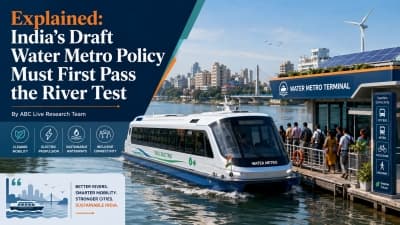
New Delhi (ABC Live): This critical analysis is based on two official sources of the Ministry of Ports, Shipping and Waterways. First, it relies on the PIB release titled “Centre Circulates Draft National Water Metro Policy for Inter-Ministerial Consultation Ahead of National Rollout in 18 Cities.” Secondly, it relies on the official Draft National Water Metro Policy, 2026 PDF.
India’s Water Metro Push Needs a River Reality Check
India’s Draft National Water Metro Policy is an important attempt to bring water-based mobility into the country’s formal urban transport system. Accordingly, the Ministry of Ports, Shipping and Waterways has circulated the Draft National Water Metro Policy, 2026, for inter-ministerial consultation before a proposed national rollout in 18 cities.
At present, the first phase includes Guwahati, Srinagar, Patna, Varanasi, Ayodhya and Prayagraj. In addition, Tezpur and Dibrugarh in Assam have been proposed for Phase II.
At first glance, the policy looks timely. India has rivers, canals, lakes, backwaters, estuaries, creeks and coastal waters. Therefore, water-based mobility can reduce road congestion, improve riverine connectivity and support cleaner public transport.
However, the policy cannot succeed on ambition alone. Instead, it must first pass four hard tests: year-round water availability, commuter ridership, ecological safety and financial viability.
Moreover, this policy should not become another infrastructure announcement driven by visual appeal. Rather, it must become a practical public transport reform backed by data, safety and accountability.
Above all, the policy must answer one basic question before rollout: Can each proposed river route support safe, affordable and reliable service throughout the year?
Why the Draft National Water Metro Policy Matters
The Draft National Water Metro Policy defines Water Metro as a mechanically propelled mass passenger transport system operating on inland, coastal or other water bodies. Therefore, it is not merely a ferry-modernisation plan.
Instead, the policy tries to create a new public transport layer. It aims to connect waterways with buses, metro rail, roads and last-mile mobility.
This is important because Indian cities cannot solve congestion only through roads. Moreover, metro rail is expensive and may not suit every corridor. Therefore, Water Metro can become a useful option where rivers or lakes already support daily movement.
Nevertheless, a city should not qualify merely because it has a river. Rather, the decisive question is different: Can that river support safe, reliable and affordable public transport throughout the year?
Consequently, the final policy must shift from a broad mobility vision to strict route-wise approval standards. Otherwise, weak projects may be approved simply because they look attractive on paper.
What the PIB Release Confirms
The PIB release confirms that the Government is preparing a national rollout of Water Metro services in 18 cities. Additionally, it states that the policy builds on the experience of the Kochi Water Metro.
Moreover, the release highlights electric and hybrid propulsion, standardised vessels, terminals, charging infrastructure, safety protocols, indigenisation and multimodal integration.
In addition, the release confirms that the proposed system will serve both daily commuters and tourism users. Therefore, the policy must carefully balance commuter needs with tourism revenue.
Table 1: Official Rollout Status
| Category | Official Position |
|---|---|
| Policy status | Draft National Water Metro Policy circulated for inter-ministerial consultation |
| Proposed rollout | 18 cities |
| Phase I cities | Guwahati, Srinagar, Patna, Varanasi, Ayodhya, Prayagraj |
| Phase II Assam cities | Tezpur and Dibrugarh |
| Model reference | Kochi Water Metro |
| Technology focus | Electric and hybrid propulsion |
| Main users | Daily commuters and tourism users |
| Policy objective | Water-based urban mobility |
What this table shows:
The project has moved beyond a general idea. Therefore, the policy now needs strong public scrutiny. In particular, each city must prove that its proposed route has enough water, enough passengers, enough safety and enough financial logic.
What the Draft National Water Metro Policy Gets Right
1. It Treats Water Metro as Public Transport
The strongest part of the Draft National Water Metro Policy is its public transport framing. Importantly, the policy does not treat Water Metro merely as a sightseeing ferry or tourism boat.
Instead, it presents Water Metro as a scheduled, organised and accessible mass transport service. Therefore, this approach is correct.
However, this public transport character must remain central. If tourism becomes the main purpose, the system may lose commuter value. As a result, Water Metro may become attractive for visitors but irrelevant for daily passengers.
Therefore, the final policy should clearly state that commuter service will receive priority wherever public money funds the project.
In short, Water Metro must function like transport first and tourism second.
2. It Supports Green and Low-Emission Vessels
The policy promotes zero-emission and low-emission vessels. In addition, the PIB release confirms the Government’s focus on electric and hybrid propulsion.
This is a welcome step because electric ferries can reduce local emissions. Moreover, they can support domestic manufacturing in batteries, charging systems, marine equipment and vessel design.
However, a green vessel does not automatically create a green project. Therefore, the full project must also protect riverbeds, wetlands, fish habitats, floodplains and local livelihoods.
Consequently, every Water Metro project must pass an ecological test, not just a technology test. Otherwise, the green label may hide serious environmental costs.
Similarly, the policy must examine battery disposal, charging energy sources and waste-management systems. In this way, green mobility can become measurable rather than merely promotional.
3. It Encourages Standardisation and Indian Shipbuilding
The policy encourages standardised vessel designs and indigenous construction. As a result, it can reduce costs and improve maintenance.
Moreover, Indian shipyards can benefit if the rollout creates regular demand for electric ferries, pontoons, charging systems and safety equipment.
However, standardisation should not become blind replication. For example, a vessel suitable for Kochi may not suit the Brahmaputra, Ganga, Jhelum, Dal Lake or Sarayu-Ghaghara system.
Therefore, each route needs local design adaptation. Similarly, each vessel class must match river depth, current, passenger load and weather risk.
In other words, standardisation should mean common safety principles, not identical vessels everywhere.
4. It Promotes Multimodal Integration
The Draft National Water Metro Policy rightly stresses multimodal integration. Therefore, Water Metro must connect with buses, metro rail, roads, pedestrian paths and last-mile services.
This is essential because passengers do not travel from jetty to jetty. Instead, they travel from home to workplace, school, market, court, hospital or tourist destination.
Therefore, terminal location will decide ridership. If a commuter loses time reaching the terminal, the water route will fail.
In addition, ticketing should integrate with other public transport modes. Otherwise, passengers may find the system inconvenient despite its novelty.
Consequently, Water Metro should be placed under a unified city transport plan, not treated as a standalone waterfront project.
The Missing Core Test: Enough Water Throughout the Year
The biggest policy gap is simple: Water Metro must first prove year-round water availability.
A Water Metro is not a seasonal ferry. Therefore, it must operate during summer, winter, monsoon and dry spells.
At the same time, high water can also create danger. Floods, strong currents, siltation and changing river channels may disrupt safe operations.
Therefore, the final policy should require a Year-Round Water Availability and Navigability Assessment for every proposed route.
Moreover, this assessment should not remain a technical appendix hidden inside a DPR. Instead, it should be disclosed publicly because citizens will bear the financial and environmental costs.
For example, a route that operates only during favourable months may support tourism. However, it cannot become dependable public transport.
Thus, water availability must become the first approval gate, not a later engineering issue.
River Data Must Guide Every DPR
India’s large rivers carry significant water. However, basin-level abundance does not guarantee city-level navigability.
For example, the Brahmaputra has enormous water volume. Nevertheless, Guwahati must deal with strong currents, flood risk, sediment load and shifting channels.
Similarly, the Ganga supports major waterway activity. However, Patna, Varanasi and Prayagraj face different local risks. Each city has different ghats, ferry patterns, siltation, religious activity and last-mile conditions.
Consequently, every DPR must rely on route-specific water data. Otherwise, the Government may approve routes that work during some months but fail as daily transport.
In other words, the policy must move from river presence to route performance.
Table 2: River Reality in Phase I Cities
| City | River / Water System | Main Water Question | Policy Risk |
|---|---|---|---|
| Guwahati | Brahmaputra | Is navigation safe across seasons? | Strong currents, floods and channel shifts |
| Srinagar | Jhelum / Dal Lake | Can mobility grow without ecological damage? | Lake ecology and winter operations |
| Patna | Ganga | Is lean-season depth reliable? | Siltation and terminal access |
| Varanasi | Ganga | Can services operate without disturbing ghats? | Crowd pressure and ecology |
| Ayodhya | Sarayu / Ghaghara | Is demand daily or event-based? | Tourism-heavy ridership |
| Prayagraj | Ganga-Yamuna | Can services handle seasonal variation? | Flood peaks and festival crowds |
What this table shows:
A river city is not automatically a Water Metro city. Therefore, every route needs route-wise certification.
Mandatory Water Data for Every Water Metro DPR
The final Draft National Water Metro Policy should require a separate hydrology chapter in every DPR. In particular, the DPR should publish the following data.
Table 3: Minimum Water Data Required
| Data Point | Minimum Requirement | Why It Matters |
|---|---|---|
| Monthly water level | 10-year gauge data | Tests seasonal reliability |
| Monthly discharge | Lean, monsoon and post-monsoon data | Tests safe navigation |
| Least available depth | Route-wise LAD certification | Determines vessel suitability |
| Siltation pattern | Annual sediment assessment | Shows dredging cost |
| Flood levels | Warning and danger levels | Guides suspension protocol |
| Current velocity | Seasonal route data | Protects passenger safety |
| Terminal variation | High-water and low-water design | Ensures access |
| Operating days | Guaranteed service days | Tests public transport reliability |
| Competing use | Drinking, irrigation and ecological flow | Avoids water conflict |
| Climate risk | Flood, drought and rainfall variation | Tests long-term viability |
ABC Live assessment:
No project should be approved only because a city has a river. Instead, approval should depend on whether the route has safe navigable water for most of the year.
In addition, the DPR should disclose how many days the route may remain suspended because of low water, flood, fog or unsafe current. As a result, the public can judge whether the project is truly reliable.
Furthermore, the policy should require annual verification of water data. Otherwise, climate variability may quickly make old feasibility reports unreliable.
The Assam-Brahmaputra Lesson
Assam is central to the Water Metro rollout because Guwahati is in Phase I, while Tezpur and Dibrugarh are proposed in Phase II.
On one hand, this creates opportunity. On the other hand, it also creates caution. The Brahmaputra belt is flood-sensitive, sediment-heavy and ecologically complex.
Therefore, Water Metro in Assam must follow climate-resilient and ecology-sensitive planning.
ABC Live’s earlier analysis of the Kaziranga Elevated Corridor made a similar point. Specifically, it argued that infrastructure in sensitive landscapes must balance strategic connectivity, ecological limits and climate risk. Likewise, the same principle applies to Water Metro.
Internal Link:
Explained: Why Kaziranga Tests India’s New Infrastructure Thinking
https://abclive.in/2026/01/19/kaziranga-elevated-corridor/
Table 4: Kaziranga Lesson for Water Metro
| Kaziranga Lesson | Water Metro Application |
|---|---|
| Infrastructure must respect ecology | River transport must protect aquatic systems |
| Floodplain design needs resilience | Terminals must survive flood and low-water cycles |
| Connectivity cannot ignore conservation | Mobility must not damage biodiversity |
| Context-specific design is essential | Each river route needs local hydrology |
| Multiple agencies must coordinate | Water Metro needs strong institutional control |
ABC Live assessment:
The Kaziranga lesson is clear. Modern infrastructure must combine utility, restraint and resilience. Therefore, Water Metro must prove that it is good for commuters without becoming harmful for rivers.
Moreover, Assam’s Water Metro projects should become a model for climate-resilient water transport. If they fail on ecology, they may weaken public trust in the entire national rollout.
Consequently, Assam should become the test case for river-sensitive mobility, not merely the next site for ferry expansion.
Ridership: The Policy Needs a Stronger Test
The policy refers to ridership and demand suitability. However, this test must become sharper.
A public transport system cannot rely mainly on tourists. Instead, it needs daily users. Therefore, every project must prove regular commuter demand.
In addition, the Government should separate commuter routes from tourism routes. Otherwise, tourist potential may justify projects that do not solve daily mobility problems.
For instance, a pilgrimage city may show high seasonal footfall. Nevertheless, seasonal footfall is not the same as daily commuter ridership.
Table 5: Ridership Tests Needed
| Ridership Test | Why It Is Needed |
|---|---|
| Daily commuter ridership | Separates public transport from tourism |
| Peak-hour demand | Tests mass-transit relevance |
| Route-wise demand | Identifies weak corridors |
| Fare elasticity | Shows whether users will shift |
| Travel-time comparison | Tests advantage over roads |
| Conservative scenario | Prevents inflated projections |
| Subsidy per passenger | Shows real public cost |
Policy correction needed:
The final policy should classify tourism-heavy routes separately. Otherwise, tourism corridors may appear as public transport projects without enough commuters.
Moreover, the policy should publish route-wise demand assumptions before approval. Consequently, citizens can challenge inflated projections.
Ultimately, ridership must decide project scale, not political attractiveness.
Finance: Lower Capital Cost Is Not Enough
The Government argues that Water Metro can cost less than metro rail because it uses existing waterways and needs less land. This argument has merit.
However, Water Metro still requires vessels, terminals, pontoons, chargers, command systems, safety equipment, repair yards, emergency vessels, insurance and trained staff.
Moreover, electric ferries may create future costs through battery replacement and charging infrastructure maintenance.
Therefore, the financial test should not stop at capital cost. Instead, it should include lifecycle cost, operational subsidy and replacement cost.
Table 6: Hidden Long-Term Costs
| Cost Head | Why It Matters |
|---|---|
| Vessel maintenance | Marine assets need specialised upkeep |
| Battery replacement | Creates future capital burden |
| Charging systems | Need backup and repairs |
| Terminal operations | Daily cost of staff, safety and cleaning |
| Navigation aids | Require regular maintenance |
| Dredging support | May become recurring cost |
| Insurance | Protects passengers and operators |
| Disaster response | Essential in flood-prone areas |
ABC Live assessment:
Every DPR should include a 15-year O&M liability statement. Otherwise, the project may look cheap at construction but become costly after inauguration.
In addition, the policy should disclose expected subsidy per passenger. Consequently, citizens and State Governments can understand the real cost of the service.
Meanwhile, PPP models should not hide public risk. If ridership fails, the State may still carry the burden through viability-gap funding, guarantees or renegotiated contracts.
Therefore, financial realism must precede ceremonial rollout.
Ecology: Electric Boats Alone Are Not Enough
The Draft National Water Metro Policy uses green mobility language. That is positive. However, the ecological test must go beyond vessel emissions.
Water Metro can reduce road pollution if it replaces road trips. However, it can also damage riverbeds, wetlands, ghats, fish habitats and floodplains if poorly planned.
Therefore, every project must assess both environmental benefits and environmental risks.
Table 7: Environmental Risks
| Risk | Why It Matters |
|---|---|
| Dredging | Disturbs sediment and habitats |
| Jetty construction | Affects wetlands and riverbanks |
| Battery lifecycle | Needs recycling and fire safety |
| River traffic | Affects fishermen and local boats |
| Terminal commercialisation | Pressures riverfront land |
| Noise and lighting | Disturbs aquatic life |
| Waste discharge | Pollutes water bodies |
| Floodplain interference | Weakens natural drainage |
Policy correction needed:
Every Water Metro DPR should include a corridor-level environmental and social impact assessment.
Moreover, this assessment should examine livelihoods, biodiversity, dredging, terminal construction, battery disposal and floodplain impact. Otherwise, the project may transfer congestion from roads to rivers.
Similarly, projects in lakes and wetlands should face higher scrutiny than ordinary river crossings.
In brief, electric mobility must not become ecological negligence.
Tourism Cannot Override Commuter Service
The PIB release says Water Metro will serve both commuters and tourism. This is logical because several Phase I cities have high religious or tourist value.
However, tourism and public transport follow different logic.
Table 8: Commuter Service vs Tourism Service
| Issue | Commuter Logic | Tourism Logic |
|---|---|---|
| Fare | Affordable | Premium possible |
| Timing | Peak-hour discipline | Leisure timing |
| Route | Direct | Scenic |
| Demand | Daily | Seasonal |
| Public duty | Essential mobility | Destination branding |
Tourism can support revenue. However, it cannot capture assets meant for daily passengers.
Therefore, the final policy should state that commuter service obligations will receive priority over cruise, tourism and event operations.
In addition, tourism-linked services should disclose whether they cross-subsidise daily commuters or merely use public infrastructure for premium travel.
Above all, public funding should protect public mobility first.
Kochi Model: Inspiration, Not Template
The national rollout builds on the Kochi Water Metro experience. Kochi offers useful lessons because it has backwaters, island-mainland travel, existing ferry culture and metro-style governance.
However, Kochi cannot be copied blindly.
Table 9: Why Kochi Cannot Be Applied Everywhere
| Factor | Kochi Advantage | Risk Elsewhere |
|---|---|---|
| Geography | Backwaters and islands | Many cities lack continuous routes |
| Demand | Daily plus tourism | Some cities may have tourism-only demand |
| Integration | Metro-linked system | Weak city transport integration |
| Water condition | Suitable stretches | Seasonal rivers may need dredging |
| Public behaviour | Ferry familiarity | Road preference may remain strong |
| Governance | Dedicated structure | Fragmented agencies elsewhere |
Policy correction needed:
Every DPR should explain whether the Kochi model is fully applicable, partly applicable or not applicable.
Moreover, the policy should require each city to define its own operating model. As a result, Kochi can remain a guide without becoming a one-size-fits-all template.
In short, Kochi should inspire Water Metro planning. However, Kochi should not replace local feasibility.
Therefore, replication must remain evidence-based.
Legal and Institutional Clarity Is Needed
Water Metro projects will involve Union, State, municipal, environmental and safety authorities. Therefore, the final policy should include a clear approval matrix.
Table 10: Approval Matrix Needed
| Area | Authority Concerned | Why Clarity Is Needed |
|---|---|---|
| National Waterway | IWAI | Route and NOC coordination |
| Non-national waterway | State Government | Local jurisdiction |
| Vessel standards | DG Shipping / IRS | Safety approval |
| Inland vessel compliance | Inland Vessels Act framework | Registration and safety |
| Environment | Environmental regulators | Wetlands, CRZ and pollution |
| Urban land | Municipal bodies | Terminal access |
| Disaster response | State disaster authorities | Flood and accident planning |
| Public transport | City transport authority | Fare and feeder integration |
ABC Live assessment:
Without clear approval responsibility, agencies may blame each other during delays, accidents or cost overruns.
Therefore, the final policy should attach a model approval flowchart. In addition, it should fix time limits and accountability for each approval stage.
Furthermore, a single city-level transport authority should coordinate routes, fares, feeder services and passenger data.
Otherwise, Water Metro may suffer from fragmented governance before it even begins operation.
Safety Must Precede Rollout
Water Metro safety cannot depend only on general vessel rules. Instead, it needs passenger-specific and route-specific standards.
Table 11: Minimum Safety Code
| Safety Area | Required Rule |
|---|---|
| Boarding | Anti-slip ramps and controlled entry |
| Accessibility | Wheelchair-friendly terminals |
| Weather | Flood, storm and fog protocols |
| Navigation | GPS, AIS, buoys and control systems |
| Battery safety | Fire suppression rules |
| Rescue | Emergency boats and medical aid |
| Passenger load | Digital occupancy control |
| Insurance | Passenger liability framework |
ABC Live assessment:
One major accident can damage public confidence in the entire rollout. Therefore, safety must come before inauguration.
Moreover, safety drills should occur before commercial operations begin. Consequently, passengers will trust the system only when they see visible preparedness.
In addition, operators should publish emergency response timelines. As a result, safety will become measurable rather than symbolic.
Finally, passenger insurance and liability rules should be clear before ticketed service starts.
Public Dashboard Should Be Mandatory
The policy supports monitoring through indicators such as safety, punctuality, ridership, service quality and environmental performance.
However, the final policy should specify public disclosure indicators.
Table 12: Monthly Public Dashboard
| Indicator | Why It Matters |
|---|---|
| Daily ridership | Shows real use |
| Peak-hour occupancy | Tests commuter value |
| Route-wise ridership | Identifies weak routes |
| Fare revenue | Measures finances |
| Subsidy per passenger | Shows public cost |
| Trip punctuality | Measures reliability |
| Cancelled trips | Shows disruption |
| Water-level disruption days | Tests year-round service |
| Safety incidents | Tracks risk |
| Energy use | Tests green claim |
| Emission savings | Measures climate benefit |
| Complaints | Shows service quality |
ABC Live assessment:
The dashboard must include water-level disruption days. Otherwise, the public will not know whether Water Metro works throughout the year.
In addition, the dashboard should publish route-wise data. As a result, policymakers can improve weak routes rather than hiding them inside system-wide averages.
Finally, the dashboard should remain public from the first month of operations.
Thus, transparency should become a design feature, not a later compliance exercise.
ABC Live Policy Scorecard
| Parameter | Score | Assessment |
|---|---|---|
| Vision | 8.5/10 | Strong and timely idea |
| Public transport framing | 8/10 | Correct direction |
| Green mobility | 7/10 | Needs lifecycle safeguards |
| Standardisation | 8/10 | Useful but must be localised |
| Year-round water test | 4.5/10 | Needs explicit hydrology annexure |
| City suitability | 6/10 | Needs route-wise proof |
| Ridership realism | 5.5/10 | Threshold needs strengthening |
| Financial realism | 5.5/10 | O&M disclosure needed |
| Environmental safeguards | 5/10 | Corridor assessment required |
| Safety | 6.5/10 | National safety code needed |
| Monitoring | 7/10 | Dashboard must be detailed |
| Overall readiness | 6.5/10 | Promising but not rollout-proof |
Final Verdict
India’s Draft National Water Metro Policy is a forward-looking mobility proposal. Importantly, it recognises that waterways can become part of India’s urban transport system. Moreover, it supports electric and hybrid vessels, indigenous shipbuilding, multimodal integration, affordability and monitoring.
However, the final policy must become sharper before rollout.
First, every route must prove year-round water availability. Secondly, every city must publish route-wise depth, discharge, siltation and flood-risk data. Thirdly, ridership thresholds must become stricter. Fourthly, States must know their long-term O&M burden. Finally, environmental safeguards must cover the entire river corridor, not only the terminal site.
The Kaziranga Elevated Corridor debate also offers a wider lesson. Infrastructure in sensitive landscapes must combine strategic utility, climate resilience and ecological restraint. Therefore, Water Metro must follow the same principle, especially in Assam and other flood-sensitive river systems.
In conclusion, the Water Metro idea is strong. However, it must move from infrastructure enthusiasm to river-tested mobility accountability.
If India gets hydrology, ecology, finance, safety and commuter demand right, Water Metro can become a new pillar of sustainable urban transport. Otherwise, it may become scenic infrastructure: attractive on paper, costly in operation and unreliable for daily commuters.
Official Sources
PIB Release: Centre Circulates Draft National Water Metro Policy for Inter-Ministerial Consultation Ahead of National Rollout in 18 Cities
https://www.pib.gov.in/PressReleasePage.aspx?PRID=2262535®=3&lang=1
Official Draft Policy PDF: Draft National Water Metro Policy, 2026
https://shipmin.gov.in/sites/default/files/Draft%20National%20Water%20Metro%20Policy%2C%202026.pdf
ABC Live Internal Link: Explained: Why Kaziranga Tests India’s New Infrastructure Thinking
https://abclive.in/2026/01/19/kaziranga-elevated-corridor/