
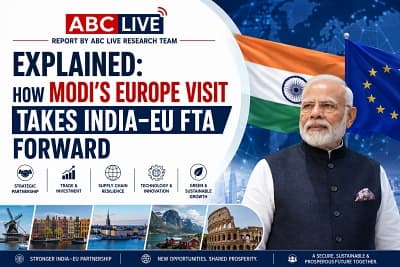
New Delhi (ABC Live): This analysis is based on official updates from the Ministry of External Affairs, the Prime Minister’s Office, the European Commission, the European Council, the Government of Sweden, EFTA, and Norway’s official India portal. In addition, it builds on ABC Live’s earlier background report, Explained: India–EU FTA.
Why This Visit Was Not Routine Diplomacy
Prime Minister Narendra Modi’s May 2026 visit to Europe came at a decisive moment for India’s trade diplomacy. In fact, the wider tour was listed as a May 15–20, 2026 visit to the UAE, Netherlands, Sweden, Norway and Italy. Therefore, strictly speaking, it was a six-calendar-day, five-nation tour, with the Europe-focused leg covering the Netherlands, Sweden, Norway and Italy.
The timing was equally important. On January 27, 2026, India and the European Union concluded negotiations for the India–EU Free Trade Agreement. However, the European Commission has clarified that the published FTA texts remain subject to legal revision. Moreover, the agreement will become binding only after both parties have completed their internal legal procedures.
Therefore, Modi’s European visit did not complete the India–EU FTA story. Instead, it moved the agreement into its next stage: ratification momentum, business mobilisation, standards preparation, investment conversion and country-specific implementation. In other words, the visit converted a negotiated text into a delivery agenda.
The Core Argument: From FTA Text to FTA Delivery
An FTA creates value only when exporters, investors, ports, customs authorities, regulators, certification bodies and businesses actually use it. Therefore, Modi’s visit to Europe was important because it shifted the India–EU FTA conversation from negotiation to execution.
The most important FTA signal came in Gothenburg, Sweden. There, Modi addressed the European Round Table for Industry on May 17, 2026. The event included Swedish Prime Minister Ulf Kristersson, European Commission President Ursula von der Leyen, senior European industry leaders and major Indian and European companies. Moreover, Modi welcomed the conclusion of India–EU FTA negotiations and described the agreement as a transformative partnership for trade, technology, manufacturing, services and resilient supply chains.
In other words, India used the visit to tell Europe that the FTA should not remain a tariff document. Rather, it should become an industrial partnership. Consequently, the visit turned a trade agreement into a boardroom agenda.
Why the India–EU FTA Matters Economically
The EU–India trade relationship already has scale. European Council data records EU–India goods trade at over €120 billion in 2024, with €71.4 billion in EU imports from India and €48.8 billion in EU exports to India. In addition, the EU is India’s second-largest goods trading partner, accounting for 11.5% of India’s goods trade.
Moreover, services are becoming equally important. EU–India services trade crossed €66 billion in 2024. Therefore, IT services, professional mobility, digital trade, engineering, consulting, research, and finance will account for a major part of the FTA’s real value.
However, India remains underweight in Europe’s overall trade structure. As a result, the FTA gives India a large opportunity to expand its role in European supply chains. At the same time, it also exposes Indian firms to tougher competition, higher standards and stricter compliance systems.
Thus, the FTA must be judged not only by tariff cuts. Instead, it must be judged by export growth, investment flows, standards readiness, services mobility and MSME participation.
How Modi’s Visit Took the FTA Forward
| FTA Stage | What Modi’s Visit Added | Why It Matters |
|---|---|---|
| Negotiation completed | Political follow-up after the January 2026 conclusion | Therefore, momentum remains alive before legal ratification |
| Industry mobilisation | Gothenburg European Round Table for Industry | As a result, European CEOs entered the FTA story |
| Country-specific delivery | Netherlands, Sweden and Italy engagements | Consequently, the EU-wide FTA gained practical corridors |
| Standards readiness | Focus on green transition, digital tech and manufacturing | Moreover, India received a compliance roadmap |
| Parallel European model | Norway leg linked with India–EFTA TEPA | Meanwhile, India gained an operational FTA template |
| Investment conversion | Pitch to European business leaders | Therefore, the FTA became linked to manufacturing and jobs |
Netherlands: Turning the FTA into a European Export Gateway
The Netherlands matters because it is a major European hub for logistics, ports, and distribution. Therefore, the India–EU FTA can help Indian goods enter wider European markets through ports, warehousing, customs systems, and re-export channels.
As a result, the Netherlands can become India’s hub for FTA utilisation. Moreover, it can help Indian exporters reduce distribution friction inside Europe. In addition, Dutch logistics networks can support Indian sectors such as pharma, chemicals, electronics, agri-products and processed food.
| Area Why | y It Matters |
|---|---|
| Ports and logistics | Helps Indian exporters distribute goods across Europe |
| Pharma and chemicals | Supports standards-sensitive Indian exports |
| Agri-tech and food processing | Helps India meet EU food and sanitary standards |
| Semiconductors and high technology | Supports India’s emerging electronics ecosystem |
| Water and climate cooperation | Links trade with sustainability and infrastructure |
However, India should not depend only on Dutch re-export routes. Instead, it must build direct buyer networks across Europe. Otherwise, headline export numbers may rise without deeper market penetration. Therefore, India must use the Netherlands as a gateway, not as a substitute for a wider EU market strategy.
Sweden: The Industrial and Technology Platform of the FTA
Sweden became the most important stop in the implementation of the FTA because it hosted the European industry engagement. At Gothenburg, Modi placed the India–EU FTA before European industrial leadership. Consequently, the FTA’s character changed from a legal text to a boardroom agenda.
Sweden’s importance lies in green technology, telecom, innovation, cybersecurity, defence dialogue, digital transformation, and supply chain resilience. Moreover, Sweden can help the Indian industry understand the standards that will shape Europe’s future market. Therefore, Sweden offers India both access to technology and standards discipline.
| Sector | India’s Gain |
|---|---|
| Green transition | Helps India prepare for EU climate-linked trade rules |
| Digital transformation | Connects Indian IT strength with the European industry |
| Innovation and R&D | Supports high-value manufacturing |
| Supply-chain security | Positions India as a trusted China+1 partner |
| Defence and cyber cooperation | Adds strategic technology depth |
Nevertheless, Indian MSMEs may not benefit automatically. They will need support on ESG documentation, carbon reporting, traceability, certification and product standards. Therefore, India must create sector-wise support systems before the FTA becomes fully operational. Otherwise, large firms may capture most of the gains, while smaller exporters remain outside the value chain.
Norway: A Live European FTA Model through EFTA TEPA
Norway is not part of the European Union. However, it is part of the European Free Trade Association. Therefore, Modi’s engagement with Norway matters because India already has an operational trade agreement with EFTA.
The India–EFTA Trade and Economic Partnership Agreement entered into force on October 1, 2025. Consequently, Norway provides India with a live European FTA model before the India–EU FTA enters into force. Moreover, TEPA allows India to test investment tracking, rules-of-origin compliance, customs facilitation and sector-wise monitoring.
Why Norway Matters for India–EU FTA Learning
| TEPA Lesson | Relevance for India–EU FTA |
|---|---|
| Rules of origin | Indian exporters must know how products qualify for benefits |
| Investment tracking | India must measure FTA-linked investment and jobs |
| Services market access | Mobility and recognition systems need practical follow-up |
| Trade facilitation | Customs and documentation must become faster |
| Sector targeting | FTA benefits must be linked with real projects |
Therefore, India should use TEPA as an implementation laboratory. If India tracks investment, jobs, sector gains and utilisation under TEPA, it can apply the same model to the India–EU FTA. In addition, Norway can support India in maritime technology, blue economy, clean energy and offshore systems. Thus, the Norway leg has value beyond bilateral trade.
Italy: FTA, IMEC and Industrial Corridors
Italy gives India an industrial bridge into southern Europe. It has strong capabilities in machinery, design, shipbuilding, defence manufacturing, food processing, fashion, automotive components and small industrial clusters.
For India, Italy’s value lies in converting the India–EU FTA into industrial corridors, not just trade statistics. Moreover, Italy can help India connect the FTA with IMEC, Mediterranean logistics and European manufacturing ecosystems. As a result, Italy can become a practical partner for Make in India, defence co-development, critical minerals, marine exports and food processing.
| Area | Why It Matters |
|---|---|
| IMEC | Connects India with Europe through West Asia and the Mediterranean |
| Machinery | Helps Indian manufacturers upgrade production |
| Defence manufacturing | Supports Make in India and co-development |
| Critical minerals | Strengthens EV, battery and clean-energy supply chains |
| Marine exports | Tests India’s EU food safety and traceability systems |
| Agriculture and food processing | Opens premium export opportunities |
However, Italy’s potential will not convert automatically. India needs sector-specific action plans. Otherwise, the strategic partnership may remain diplomatic language rather than commercial conversion. Therefore, India should create an India–Italy industrial corridor plan with measurable targets for trade, investment and jobs.
What Changed After the Visit?
1. The FTA Became a Business Agenda
Before the visit, the India–EU FTA was mainly a negotiated legal text. After the Gothenburg industry engagement, however, it became a direct business signal to European CEOs. Consequently, European companies received a political message that India wants investment, manufacturing partnerships and supply-chain integration.
2. India Linked the FTA with Supply-Chain Security
Europe wants trusted partners because of China dependence, geopolitical risk and trade disruptions. Therefore, India used the visit to position itself as a stable democratic manufacturing and services partner. Moreover, this positioning supports India’s China+1 opportunity.
3. Country-Specific Routes Emerged
| Country | Role in FTA Strategy |
|---|---|
| Netherlands | EU logistics and export gateway |
| Sweden | Green tech, standards and innovation |
| Italy | Industrial corridors and IMEC |
| Norway | EFTA implementation model |
4. Standards Became Central
The next stage is not only tariffs. Instead, it is compliance. Indian exporters must prepare for EU rules on carbon, product quality, food safety, labour standards, traceability, data and certification. Therefore, India must treat standards as industrial upgrading tools, not merely as trade barriers.
Critical Challenges Ahead
The visit created momentum. However, India must now address hard implementation problems.
| Challenge | Why It Matters |
|---|---|
| Legal ratification | The FTA becomes binding only after internal procedures |
| MSME readiness | Smaller exporters may struggle with EU standards |
| Certification capacity | Weak testing infrastructure can become a bottleneck |
| Low utilisation risk | Exporters may not claim FTA benefits without guidance |
| Services mobility | India must secure practical pathways for professionals |
| Import competition | European goods may pressure Indian sectors |
| State-level coordination | FDI projects need land, logistics and approvals |
Therefore, the next test is domestic capacity. India negotiated the FTA at the national level. Nevertheless, it must implement the FTA through exporters, ports, labs, states and firms. Otherwise, the agreement may remain strong on paper but weak in utilisation.
What India Should Do Next
India should create a National India–EU FTA Implementation Mission with ministries, exporters, industry bodies, standards agencies, state governments and logistics players.
| Timeline | Action |
|---|---|
| 0–3 months | Publish sector-wise FTA guides for exporters |
| 3–6 months | Set up EU compliance cells in major export clusters |
| 6–12 months | Upgrade testing and certification labs |
| 12 months | Launch India–EU MSME export readiness platform |
| 18 months | Publish FTA utilisation data |
| 24 months | Review exports, FDI, jobs, services mobility and sector gains |
In addition, India should publish a country-wise FTA dashboard. This dashboard should track exports, investment, standards approvals, services mobility and MSME participation. As a result, the public can judge whether the FTA is delivering real value. Moreover, such transparency will help industry identify bottlenecks early.
Data Dashboard: Why Implementation Matters
| Indicator | Data Point | Meaning |
|---|---|---|
| EU–India goods trade | Over €120 billion in 2024 | Large economic base |
| EU imports from India | €71.4 billion in 2024 | Strong Indian export opportunity |
| EU exports to India | €48.8 billion in 2024 | India will also face European competition |
| EU–India services trade | Over €66 billion in 2024 | Services and mobility are crucial |
| EU share in India’s goods trade | 11.5% | EU is a top Indian trade partner |
| India–EU FTA negotiations | Concluded on January 27, 2026 | Agreement now moves toward legal and domestic procedures |
| Binding legal status | After internal legal procedures | Implementation depends on ratification and legal finalisation |
Thus, the India–EU relationship already has commercial scale. However, the FTA’s success will depend on implementation, not announcement. Therefore, India must measure outcomes through exports, investment, MSME participation, services mobility and certification speed.
Sources & Resources
| Source | Relevance |
|---|---|
| ABC Live Internal Link: Explained: India–EU FTA | Background explainer on the FTA’s negotiation history and strategic meaning |
| European Commission — EU–India FTA Texts | Confirms publication of FTA texts, legal revision status and internal procedure requirement |
| Prime Minister’s Office — European Round Table for Industry | Confirms Modi’s Gothenburg industry address and FTA implementation message |
| European Council — EU–India Trade Facts | Provides goods and services trade data |
| European Commission — EU Trade Relations with India | Gives updated trade and FTA status |
| EFTA / Norway official material | Provides India–EFTA TEPA implementation context |
ABC Live View: Modi’s Visit Opened the Implementation Chapter
Modi’s Europe visit took the India–EU FTA forward because it turned a concluded negotiation into a delivery agenda.
The Netherlands offers logistics. Sweden offers green technology and standards. Italy offers industrial corridors and IMEC connectivity. Meanwhile, Norway offers a working European FTA model through EFTA TEPA. Moreover, the Gothenburg European Round Table for Industry gave the FTA direct exposure to European business leadership.
However, the next stage will be tougher than negotiation. India must now prove that its exporters, MSMEs, regulators, ports, testing labs and state governments can actually use the agreement. Therefore, implementation capacity will decide whether the FTA becomes a national economic opportunity or a narrow corporate benefit.
Consequently, the conclusion is clear:
Modi’s Europe visit did not finish the India–EU FTA journey. Instead, it pushed the FTA into its real test — implementation. Ultimately, the success of that test will depend on exports, investment, standards compliance, services mobility, MSME participation and measurable trade gains.