
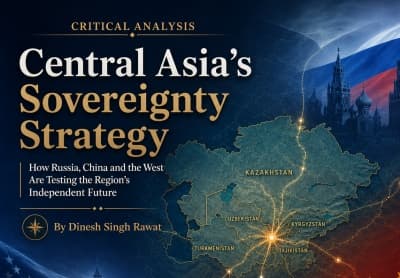
New Delhi (ABC Live): Central Asia has entered a decisive geopolitical moment. For decades, analysts viewed the region mainly through Russian influence, Soviet history and post-Soviet security dependence. However, that old reading no longer explains the full picture.
Today, Kazakhstan, Uzbekistan, Kyrgyzstan, Tajikistan and Turkmenistan are shaping their own diplomatic space. Instead of merely reacting to Russian power, these states are building a sovereignty strategy. Through this approach, they engage Russia, China, the West, Turkey, India, Iran and Gulf countries without surrendering independent decision-making.
In fact, the uploaded draft correctly frames this approach as controlled engagement, where Central Asian states use Russia for security, China for economics, the West for balance and other partners for strategic flexibility.
Controlled Engagement, Not Camp Politics
Importantly, this strategy does not mean a complete break with Russia. Likewise, it does not mean joining a Western camp. Nor does it mean handing the region’s economic future to China. Instead, regional governments are trying to work with all major powers while preventing any one power from becoming dominant.
Therefore, the real question is not whether these states will choose Russia, China or the West. Rather, the deeper question is whether they can use all three without becoming dependent on any one of them.
Why the Strategy Is Risky
On one side, Moscow still matters because of security ties, military coordination, labour migration, language networks and regional institutions. On another side, Beijing has become vital because of infrastructure, trade, energy routes and investment. At the same time, Europe and the United States offer technology, finance, education, diplomatic balance and sanctions-safe engagement.
Yet, every partnership carries risk. For example, Russian security support can become political pressure, while Chinese infrastructure finance can create economic dependence. Meanwhile, Western engagement may invite Russian suspicion, although it cannot always provide hard security. As a result, this sovereignty strategy is not a luxury; rather, it is a survival mechanism.
Why Sovereignty Has Become the Core Issue
Geography Creates Both Risk and Leverage
The region’s main concern is not ideology. Instead, its real concern is sovereignty.
Geographically, these states sit between major powers and fragile security zones. To the north, Russia remains a powerful neighbour. Meanwhile, China has become an economic giant to the east. To the south, Afghanistan creates continuing security concerns. In addition, Iran, South Asia and the Caspian space add further strategic complexity.
Because of this location, any neighbourhood crisis can quickly affect border security, trade routes, energy flows and internal stability. For that reason, Central Asian governments follow one central rule:
Keep all doors open, but do not allow any one power to control the room.
Turning Location Into Bargaining Power
This rule explains why the region avoids openly joining anti-Russia blocs. At the same time, it does not want to return to exclusive Russian dependence. Although Chinese investment remains welcome, governments remain cautious about overexposure. Similarly, Western ties are expanding, yet local leaders avoid turning the region into a frontline zone in great-power rivalry.
In simple words, the region is trying to convert geography from a vulnerability into bargaining power.
Data Dashboard: Central Asia’s Economic Weight
| Country | GDP 2024 | Strategic Meaning |
|---|---|---|
| Kazakhstan | US$291.5 billion | Largest economy; energy-rich; enjoys the highest bargaining power. |
| Uzbekistan | US$115 billion | Most populous state; rising regional power; seeks independent diplomacy. |
| Turkmenistan | US$51.4 billion | Gas-rich; uses neutrality to protect sovereignty. |
| Kyrgyz Republic | US$17.5 billion | Smaller economy; more exposed to remittances and external pressure. |
| Tajikistan | US$14.2 billion | Security-sensitive due to Afghan border and migration dependence. |
Critical Reading of the Data
Therefore, the GDP table shows that Central Asia’s sovereignty strategy is not equal across the region. While Kazakhstan and Uzbekistan have stronger economic weight, Kyrgyzstan and Tajikistan face sharper dependence risks. As a result, larger economies can negotiate with Russia, China and the West from a stronger position, whereas smaller economies must balance more cautiously.
For this reason, the region cannot be treated as one uniform bloc. While Kazakhstan balances from relative strength, Uzbekistan uses reform, population size and regional ambition. However, Kyrgyzstan and Tajikistan balance under greater vulnerability.
Russia: Security Provider or Strategic Pressure Point?
Moscow’s Continuing Influence
Moscow remains the most important security actor in Central Asia. Because of old military ties, Russian-language networks, labour migration links and institutional tools, it still enjoys deep influence. Through the CSTO, CIS, EAEU and SCO-related frameworks, Russia can also present itself as the natural guardian of regional stability.
After the Ukraine war, however, this role has become more complicated. Consequently, Central Asian governments have watched how quickly the Kremlin can convert security language into political pressure. Therefore, they want Russian cooperation, but not Russian dominance.
Moreover, the analysis notes that Moscow may use Afghanistan-related instability, Iran-US tensions, terrorism risks and fear of Western military presence to strengthen its role in Central Asia.
Russia’s Leverage in Central Asia
| Area of Leverage | How Russia Uses It | Sovereignty Risk |
|---|---|---|
| Security institutions | CSTO, CIS and regional security coordination | Security dependence may limit foreign-policy freedom. |
| Military links | Training, bases and border-security cooperation | Defence systems may remain Russia-linked. |
| Labour migration | Jobs for Central Asian workers in Russia | Migrant pressure can become political leverage. |
| Language and media | Russian remains influential in public life | Narrative influence can shape domestic opinion. |
| Energy and logistics | Transit corridors, pipelines and fuel supply | Trade routes can become strategic pressure points. |
Critical Reading
Therefore, Russia’s influence is not limited to military cooperation. Instead, Moscow uses security institutions, labour migration, language networks and logistics routes together. As a result, even without direct pressure, Russia can shape policy choices in the region.
However, excessive pressure may also push Central Asian states toward China, Turkey, India, Gulf partners and the West. For that reason, Russia must balance pressure with partnership. Otherwise, its security role may begin to look like strategic control.
China: Economic Opportunity With Dependency Risks
Beijing’s Economic Pull
China gives Central Asia what Russia cannot fully provide: large-scale economic expansion. Because Chinese investment supports roads, railways, pipelines, logistics corridors, energy projects and trade routes, it is highly attractive for landlocked states.
Moreover, Beijing gives the region non-Russian access to markets, finance and connectivity. However, its role is not risk-free because infrastructure loans, resource deals, trade imbalance and corridor dependence can create long-term pressure.
Therefore, Central Asian states do not want Russian strategic dependence to be replaced by Chinese economic dependence.
China’s Economic Role
| Chinese Role | Central Asian Benefit | Long-Term Risk |
|---|---|---|
| Infrastructure finance | Roads, railways and logistics corridors | Debt and project dependence |
| Energy investment | Pipelines, oil, gas and mining projects | Resource dependence |
| Trade expansion | Larger export and import market | Trade imbalance |
| Connectivity projects | Non-Russian routes to global markets | Chinese corridor dominance |
| Industrial links | Manufacturing and processing potential | Local industry may remain weak |
Critical Reading
Similarly, China’s influence is not only about trade. Rather, it is about infrastructure, finance, energy routes and long-term connectivity. Therefore, Beijing gives Central Asia an economic alternative to Russia.
However, if loans, pipelines and corridors become too dominant, Chinese engagement may create a new dependency problem. While Moscow may dominate through security structures, Beijing may dominate through finance, trade and infrastructure. For that reason, the region must treat Chinese engagement as an opportunity, not as a substitute master.
The West: Useful Balance, But Limited Reach
Why Western Engagement Matters
Europe and the United States give Central Asian states diplomatic breathing space. Through investment, education, technology, governance support, clean energy cooperation and sanctions-safe trade options, they can widen regional choices.
Nevertheless, Western influence has limits. First, geography remains a major barrier. Likewise, Europe and the United States cannot match Russia’s security depth or China’s infrastructure speed. Moreover, Moscow views Western military or political presence in Central Asia with deep suspicion.
Therefore, Western engagement is useful as a balancing force, but it cannot become the region’s primary security shield.
The West’s Balancing Role
| Western Offer | Strategic Value for Central Asia | Limitation |
|---|---|---|
| EU investment | Infrastructure, clean energy, transport and raw materials | Slower than China |
| US diplomacy | Political balance against Russia and China | Limited geography and security reach |
| Education and technology | Human capital and digital modernization | Long-term impact, not immediate security |
| Sanctions-safe trade | Alternative market access | Risk of Russian backlash |
| Critical minerals cooperation | Helps diversify export partners | May still keep region resource-dependent |
Critical Reading
Meanwhile, Western engagement gives Central Asian states diplomatic breathing space. However, this support has clear limits because Europe and the United States cannot replace Russia’s security role or China’s infrastructure speed. Therefore, the West is useful as a balancing partner, but not as a full strategic substitute.
Thus, regional governments will welcome Western engagement. At the same time, they will avoid becoming openly anti-Russia or anti-China platforms. In practice, this means the West can widen choices, but it cannot guarantee hard security.
Dependency Risk Matrix
| External Power | Type of Dependence | Most Exposed Countries | Critical Risk |
|---|---|---|---|
| Russia | Security, migration and institutions | Kyrgyzstan, Tajikistan, partly Kazakhstan | Political pressure through security and labour channels |
| China | Trade, infrastructure and finance | Kazakhstan, Kyrgyzstan, Tajikistan, Uzbekistan | Economic dependence and debt exposure |
| West / EU / US | Technology, finance and diplomacy | Kazakhstan, Uzbekistan | Limited hard-security protection |
| Turkey | Defence, culture and soft power | Kazakhstan, Kyrgyzstan, Uzbekistan | Limited economic depth |
| India | Education, pharma and strategic balance | Uzbekistan, Kazakhstan, Tajikistan | Connectivity gap |
| Gulf States | Capital, energy and logistics | Kazakhstan, Uzbekistan, Turkmenistan | Selective and project-based engagement |
Critical Reading
In other words, every external partner gives Central Asia an opportunity as well as a risk. While Russia offers security, it may also create political dependence. Similarly, China offers growth, but it can create economic exposure. Meanwhile, the West offers balance, although it cannot fully protect the region.
Therefore, sovereignty depends on diversification, not alignment. Clearly, these states must engage outside powers. However, the real issue is whether engagement can remain partnership-based rather than dependency-based.
Sovereignty Capacity by Country
| Country | Main Strength | Main Vulnerability | Sovereignty Strategy |
|---|---|---|---|
| Kazakhstan | Oil, gas, minerals and large economy | Long border with Russia | Balance Russia, China, EU and US carefully. |
| Uzbekistan | Population, reforms and regional ambition | Double landlocked geography | Build independent regional leadership. |
| Kyrgyzstan | Transit location and China links | Remittance and debt exposure | Use Russia and China while seeking selective Western support. |
| Tajikistan | Security relevance near Afghanistan | Border insecurity and migration dependence | Depend on Russia for security but seek wider economic partners. |
| Turkmenistan | Gas reserves and neutrality | Export-route dependence | Avoid blocs; sell energy through multiple routes. |
Critical Reading
For example, Kazakhstan wants balance without provoking Russia. Meanwhile, Uzbekistan seeks leadership without overdependence. Similarly, Kyrgyzstan and Tajikistan need security and finance, but their bargaining room remains limited. In contrast, Turkmenistan uses neutrality, although its gas-export dependence still limits full autonomy.
Therefore, Central Asia’s sovereignty strategy is regional in appearance but national in execution. In practical terms, each country follows a different version of the same strategy because each faces a different mix of economic, geographic and security risks.
Country-Wise Balancing Scorecard
| Country | Russia Dependence | China Dependence | Western Engagement | Overall Balancing Capacity |
|---|---|---|---|---|
| Kazakhstan | Medium-High | High | High | Strong |
| Uzbekistan | Medium | Medium-High | Medium-High | Rising |
| Kyrgyzstan | High | High | Low-Medium | Weak to Moderate |
| Tajikistan | High | Medium-High | Low-Medium | Weak |
| Turkmenistan | Low-Medium | Medium | Low | Limited but insulated |
Critical Reading
As a result, Kazakhstan and Uzbekistan are best placed to pursue a confident sovereignty strategy. In contrast, Kyrgyzstan and Tajikistan have less room because security needs, migration dependence and economic limits narrow their choices. Although Turkmenistan remains insulated through neutrality, insulation is not the same as full strategic freedom.
Therefore, the balancing scorecard shows a clear divide between stronger and more vulnerable states. While larger economies can bargain more actively, smaller states must manage dependence more carefully.
Strategic Choices Before Central Asia
| Strategic Choice | Benefit | Risk |
|---|---|---|
| Stay close to Russia | Security protection and continuity | Loss of strategic independence |
| Move closer to China | Infrastructure and trade growth | Economic dependence |
| Expand Western ties | Diplomatic balance and technology | Russian suspicion and limited hard security |
| Build regional cooperation | Collective bargaining power | Intra-regional rivalries |
| Diversify through India, Turkey and Gulf | More options | Connectivity and scale limitations |
Critical Reading
Instead of choosing a single alignment, the region needs layered diversification. In practice, that means security ties with Russia, economic ties with China, technology and investment ties with the West, and additional balancing links with India, Turkey and Gulf countries.
However, this strategy will succeed only if Central Asian states build stronger domestic institutions and regional coordination. Otherwise, external balancing may remain tactical rather than transformative. Therefore, internal reform is as important as external diplomacy.
Likely Strategic Moves
Russia’s Security Consolidation
Moscow will likely continue to present itself as the region’s first security responder. Because Afghanistan, terrorism, drug trafficking, border tensions and fears of Western military presence remain real concerns, Russia can justify a deeper institutional role.
Yet, this approach creates a contradiction. Regional governments need help against real security threats. At the same time, they fear that excessive Russian security dependence may reduce their independent decision-making power. Therefore, Moscow’s security role will remain useful, but politically sensitive.
China’s Corridor Expansion
Beijing will likely deepen its infrastructure, trade and energy footprint. Through roads, railways, pipelines and logistics corridors, China will continue to expand its regional influence.
However, Chinese influence will face public and political caution. Local governments want Chinese money, but they also want to avoid excessive debt, resource capture and public resentment. Therefore, Beijing’s success will depend on whether it can offer development without appearing dominant.
Western Selective Diversification
Western governments will likely focus on critical minerals, energy transition, transport corridors, education, digital systems and governance partnerships. As a result, these areas give Central Asian states alternatives without requiring formal military alignment.
Still, Western engagement must overcome distance, slow financing and weak security depth. Therefore, it can help Central Asia diversify, but it cannot replace Russia or China.
India, Turkey and Gulf States: The Secondary Balancers
For instance, Turkey offers cultural links, defence cooperation and soft power. Similarly, Gulf states provide capital, logistics and energy investment. In addition, India can contribute education, pharmaceuticals, technology, strategic balance and civilizational links.
However, each partner faces limits. Ankara lacks China’s financial scale. Gulf engagement is often project-based. Meanwhile, New Delhi faces a major connectivity gap because direct land access remains blocked by Pakistan and complicated by Afghanistan.
Still, these partners matter because they widen Central Asia’s choices. Therefore, secondary balancers may not replace Russia, China or the West, but they can reduce the region’s dependence on any one major power.
Core Problem: Sovereignty Without Isolation
Central Asian states cannot isolate themselves because their economies need trade. Moreover, young populations require jobs, while governments need investment for growth and stability. In addition, border regions demand security, and infrastructure expansion still depends on foreign capital.
Therefore, sovereignty does not mean staying away from great powers. Instead, it means managing them without surrendering national decision-making. Rather than defeating Russia, challenging China or joining the West, the region is trying to survive among all three.
The Real Test: Domestic Strength
Foreign-policy balancing alone cannot protect sovereignty. Therefore, Central Asian states also need strong domestic capacity.
| Domestic Requirement | Why It Matters |
|---|---|
| Stronger institutions | Prevents external powers from exploiting weak governance. |
| Diversified economies | Reduces dependence on one export, route or lender. |
| Independent security capacity | Limits overdependence on Russian military systems. |
| Regional cooperation | Increases collective bargaining power. |
| Transparent infrastructure deals | Reduces debt and corruption risks. |
| Human capital investment | Builds long-term independence through education and skills. |
Critical Reading
Weak states cannot balance great powers for long. Therefore, this sovereignty strategy will succeed only if external diversification is matched by internal reform. In other words, diplomacy can create space, but only domestic strength can preserve it.
Critical Conclusion
In conclusion, Central Asia’s sovereignty strategy is a practical response to great-power competition. On one side, Russia wants to remain the region’s security anchor. Meanwhile, China seeks wider economic influence through infrastructure, trade and finance. At the same time, Western governments want to offer alternatives through technology, education, investment and diplomacy. In addition, Turkey, India and Gulf states are looking for selective strategic entry.
For regional governments, therefore, the objective is clear: they want options, autonomy and bargaining power. However, this strategy will remain fragile because every partnership carries a dependency risk. For example, Moscow may use instability to deepen security dependence. Similarly, Beijing may use infrastructure and trade to expand economic leverage. Meanwhile, Western support may help diversification, but it cannot fully protect the region.
Moreover, smaller Central Asian states may face sharper pressure because their economies and security systems are more exposed. Therefore, the real test is not whether Central Asia can balance major powers for a few years. Rather, the deeper test is whether it can build strong institutions, diversified economies, regional unity and independent security capacity.
ABC Live Takeaway
Ultimately, Central Asia’s sovereignty strategy is not neutrality. Instead, it is controlled engagement.
In practice, the region will cooperate with Russia for security, China for growth and the West for balance. In addition, it will use Turkey, India and Gulf partners to widen its diplomatic space. However, long-term success will depend on whether Central Asian states can prevent every partnership from becoming dependency.
In the final analysis, the region’s future will not be decided only in Moscow, Beijing, Brussels or Washington. Rather, it will be decided by how effectively Kazakhstan, Uzbekistan, Kyrgyzstan, Tajikistan and Turkmenistan turn geography into leverage, diversity into strength and sovereignty into policy.
Also, Read ABC Live Report
Explained: Civilizational Geopolitics and the End of Neutrality