
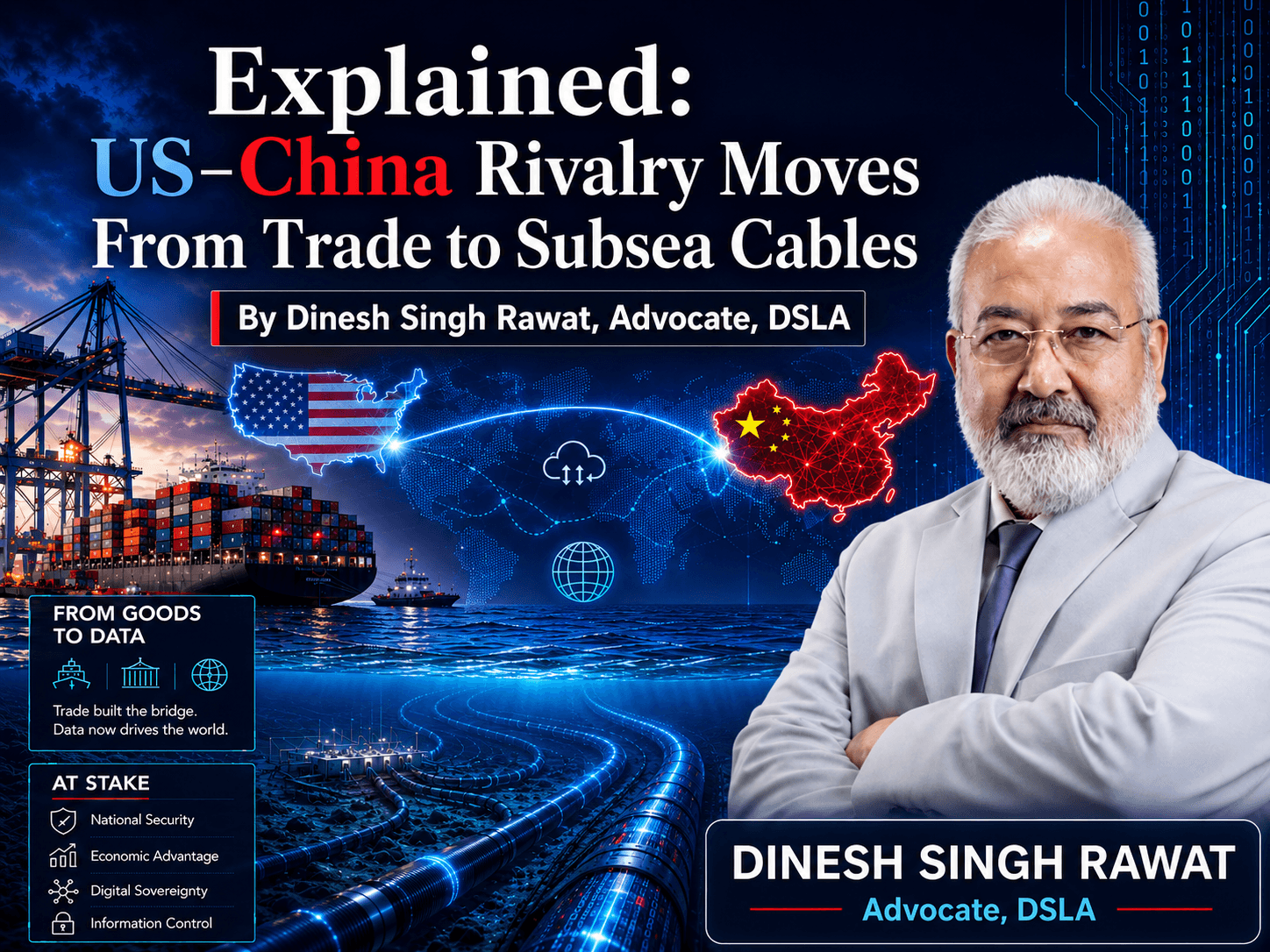
New Delhi (ABC Live): After trade wars, chip controls, 5G restrictions, port-security debates, and cloud-sovereignty disputes, US–China competition has entered a deeper and less visible domain: subsea internet cables.
From Industrial Age to Digital Age
Historically, great-power competition has followed the dominant economic age. In the industrial age, powers competed for coal, steel, factories, railways, ports, oil routes, and sea lanes. Later, in the trade age, they competed for markets, supply chains, shipping lanes, tariffs, currencies, and investment flows.
Now, in the digital age, competition has opened new strategic fronts. These include data, cloud infrastructure, semiconductors, AI systems, cyber networks, satellites, data centres, and subsea cables. Therefore, subsea cables must be understood as strategic infrastructure, not merely as telecom assets.
Why Subsea Cables Are the New Sea Lanes
Subsea cables are the digital-age equivalent of ports, railways, sea lanes, and oil corridors. After all, they move the data on which modern economies, governments, militaries, banks, platforms, and cloud systems depend.
Although these cables lie quietly under oceans, they carry the digital life of the modern world. For example, banking transactions, cloud services, diplomatic communication, defence data, online platforms, stock-market flows, AI workloads, and media traffic all depend on them.
Moreover, the International Telecommunication Union says submarine cables carry about 99% of the world’s internet traffic and support critical services such as financial transactions, cloud computing, and government communication. In addition, the ITU notes that, as of 2024, more than 500 active and planned telecommunication submarine cable systems were estimated to span the globe.
As a result, subsea cables are no longer just telecom infrastructure. Instead, they have become strategic infrastructure. Consequently, whoever influences cable routes, cable builders, landing stations, repair systems, and data corridors gains long-term geopolitical power.
Why ABC Live Is Publishing This Report Now
ABC Live is publishing this report because the US–China subsea cable rivalry is no longer an isolated telecom story. Rather, it now sits inside a larger shift from the industrial age to the trade age and, finally, to the digital age.
From Industrial Power to Digital Power
Historically, great-power rivalry has followed the dominant economic age. In the industrial age, powers competed for coal, steel, factories, railways, ports, oil routes, and sea lanes. Later, in the trade age, they competed for markets, supply chains, shipping lanes, tariffs, currencies, and investment flows.
Now, in the digital age, competition has opened new strategic fronts. These include data, cloud infrastructure, semiconductors, AI systems, cyber networks, satellites, data centres, and subsea cables. Therefore, subsea cables must be understood as part of the same strategic shift that has already made semiconductors, cloud systems, and AI infrastructure central to global power.
Why the Hormuz Context Matters
Moreover, the continuing US–Iran conflict context and the Strait of Hormuz crisis show why this issue matters now. Modern chokepoints are no longer only about oil tankers, naval passages, and shipping insurance. Increasingly, they are also about data routes, cloud access, AI infrastructure, telecom resilience, and cable repair security.
Therefore, the Hormuz debate is relevant even when no confirmed subsea cable attack has taken place there. In practical terms, the same geography that shapes energy security can also shape digital-infrastructure risk if cables, data centres, and repair routes become part of crisis politics.
Why ABC Live Is Analysing the Cable Risk
Therefore, ABC Live is publishing this report to explain a deeper point. The world’s next infrastructure crisis may not come only from a blocked oil route or a tariff war. Instead, it may come from the disruption, exclusion, or politicisation of the cables that carry the digital economy.
At the same time, this report does not claim that every cable threat is proven or that every cable cut is sabotage. In fact, reference material reviewed for this analysis notes that open investigations have not confirmed state-directed sabotage across the large number of routine annual cable incidents, while attribution remains difficult in grey-zone cases.
Why This Matters for India
For India, the issue is especially important. India wants to build a larger data-centre economy, strengthen cloud capacity, support AI growth, and position itself as a trusted Indo-Pacific digital power. However, these goals depend on secure, diverse, and geopolitically trusted subsea cable connectivity.
For that reason, this report links the US–China cable rivalry with India’s own data-centre future, including ABC Live’s earlier report on Google’s Visakhapatnam data-centre investment:
ABC Live Internal Link:
https://abclive.in/2025/10/15/google-data-centre-visakhapatnam/
In short, ABC Live is publishing this report because subsea cables have become the digital-age equivalent of sea lanes, ports, and oil routes. Consequently, whoever controls, secures, repairs, or excludes these cables will shape the next phase of global power.
Why Subsea Cables Matter?
| Indicator | Data Point | Strategic Meaning |
|---|---|---|
| Share of global internet traffic carried by subsea cables | Around 99% | Subsea cables are the real backbone of the internet, not satellites. |
| Active and planned submarine cable systems | More than 500 as of 2024 | Cable geography shapes global digital power. |
| Global cable length | More than 1.7 million km in recent ITU resilience discussions | Cable routes form the physical map of digital dependence. |
| Annual cable faults globally | Around 150–200 in several public estimates | Damage is frequent, although most faults are not proven sabotage. |
| Main causes of faults | Fishing, anchoring, natural hazards, and equipment failure | Security policy must address accidents as well as grey-zone risks. |
| SeaMeWe-6 rival bids | HMN Tech about $475 million, SubCom near $600 million | Security trust can defeat lower pricing. |
Taken together, these figures show why subsea cables now attract both telecom and security attention. Although most damage still comes from routine maritime activity, the strategic value of these cables makes every major disruption politically sensitive. Moreover, India’s PIB has noted that submarine cables face an estimated 150–200 faults globally every year, caused by fishing, anchoring, natural hazards, and equipment failure.
Therefore, governments cannot treat cable faults as purely technical events. Instead, they must prepare for accidents, commercial delays, grey-zone threats, and crisis-time disruption together.
In other words, cable resilience is not only about protecting one line on the seabed. Rather, it is about protecting the financial, security, cloud, diplomatic, and public-service systems that depend on that line. Consequently, cable policy must now combine telecom planning with maritime security and national-risk management.
The Core Argument
The core argument is clear:
The US–China rivalry has moved from trade and technology into the physical routes of the internet. Subsea cables now sit at the centre of a global contest over data security, digital sovereignty, commercial access, and alliance power.
However, this rivalry does not mean every cable cut is sabotage. Many cable faults happen because of fishing activity, anchors, natural causes, or ordinary accidents. Still, the fear of sabotage, espionage, and strategic dependency has become strong enough to change how countries approve and build cable projects.
In short, the world has entered a new phase where connectivity is no longer neutral. Therefore, countries must now ask not only whether a cable is cheap and fast, but also whether it is trusted, secure, resilient, and commercially usable during geopolitical stress.
Why Subsea Cables Matter
Subsea cables carry most international internet traffic. Moreover, they connect financial systems, defence networks, cloud platforms, governments, businesses, data centres, and citizens.
| Strategic Function | Why It Matters | Risk If Disrupted |
|---|---|---|
| Internet traffic | Carries cross-border data between countries and continents | Slower connectivity, outages, and platform disruption |
| Banking and finance | Supports real-time payments and market transactions | Settlement delays and financial instability |
| Cloud computing | Links data centres, AI systems, and enterprise platforms | Cloud downtime and business disruption |
| Defence communication | Supports command, control, surveillance, and coordination | Reduced military readiness |
| Digital trade | Enables e-commerce, outsourcing, fintech, and IT services | Loss of service exports and platform reliability |
| Diplomacy and intelligence | Supports state communication and sensitive data flows | Security exposure and diplomatic disruption |
| AI infrastructure | Supports cross-border data movement and compute access | Slower AI model training and deployment |
Because of this role, subsea cables are not merely wires under the sea. Rather, they are the physical backbone of digital power.
Therefore, this table shows why subsea cables cannot be treated as ordinary telecom wires. Instead, they should be read as the hidden infrastructure of finance, defence, diplomacy, cloud computing, AI growth, and digital trade. Moreover, because one cable disruption can affect several sectors together, governments must plan for resilience before a crisis occurs.
In practical terms, any major cable disruption can affect banks, platforms, cloud systems, governments, military networks, and businesses at the same time. For that reason, cable security has become a national security issue as well as a commercial issue.
From Cheap Connectivity to Trusted Connectivity
Earlier, cable projects were judged mainly by cost, route, capacity, and technical reliability. However, that model is changing quickly. Today, governments and telecom consortia must also examine vendor nationality, data-security risk, sanctions exposure, repair access, landing-station control, and hyperscaler trust.
As a result, a new rule has emerged:
A cable that is cheap to build may become expensive to operate if major governments, cloud firms, and Western companies refuse to trust it.
Importantly, Indo-Pacific states are no longer deciding only where future cables should land. Instead, they are deciding which alliance-defined digital architecture their data will depend on for decades. Reference material reviewed for this analysis also highlights this shift from simple cable routing to long-term alliance-linked digital dependence.
Therefore, the lowest bid is no longer always the best bid. Rather, the real question is whether the cable will remain commercially useful, legally safe, and geopolitically trusted over its full life.
Old Cable Economy vs New Cable Economy
| Earlier Cable Economy | New Cable Economy |
|---|---|
| Cost and capacity were the main concerns. | Trust, security, sanctions, and vendor origin now matter. |
| Telecom operators dominated cable decisions. | Governments, intelligence agencies, cloud firms, and regulators now influence projects. |
| Vendor choice was largely commercial. | Vendor choice has become geopolitical. |
| Route planning focused on distance and demand. | Route planning now considers conflict zones, maritime claims, and alliance risk. |
| Cable faults were treated mainly as technical issues. | Cable faults are increasingly assessed through a grey-zone security lens. |
| Cheaper bids had stronger commercial appeal. | Lower-cost bids may lose value if trusted users avoid the cable. |
In other words, the old cable economy was mainly about price and capacity. However, the new cable economy is about trust, access, security, and sanctions risk. Consequently, a lower-cost cable may still become a weak investment if major cloud firms, governments, or telecom operators refuse to use it.
Earlier, the cheapest and fastest project had a clear commercial advantage. Now, however, governments and hyperscalers also ask whether the cable will remain acceptable during sanctions, conflict, or diplomatic tension.
Consequently, vendor identity has become almost as important as cable capacity. Moreover, the political trust attached to a cable can decide whether it attracts premium traffic or remains commercially weak.
The US Position: Keep Foreign-Adversary Risk Out of Cable Systems
Washington’s Security Logic
The United States has tightened its approach to submarine cable security. In 2025, the FCC moved to strengthen submarine cable landing rules. Accordingly, the approach addressed foreign-adversary risks, restrictions on covered equipment, cybersecurity duties, and physical security conditions. FCC materials describe these changes as measures to address national-security threats to submarine cable systems.
In simple terms, Washington’s position is clear:
If a cable connects to the US digital system, the United States wants to know who built it, who operates it, who supplies its equipment, who can repair it, and whether any foreign adversary can influence it.
Cable Landing Is Now a Security Question
Consequently, a cable landing licence is no longer only a telecom permission. Instead, it is now part of a wider national security review.
This approach shows that Washington is no longer looking only at the cable itself. Instead, it is examining the entire cable ecosystem, from landing permission to repair access.
What the US Is Trying to Control
| Cable Element | Why It Matters to the US |
|---|---|
| Cable landing licence | Decides whether a cable can connect to US territory or US-linked infrastructure |
| Vendor identity | Helps screen foreign-adversary influence |
| Submarine line terminal equipment | Controls how traffic enters and exits cable systems |
| Network management systems | May create monitoring or manipulation risk |
| Capacity leasing | Determines who can use the cable commercially |
| Repair and maintenance access | Affects outage recovery and security exposure |
| Cybersecurity controls | Protects data flows from intrusion or manipulation |
| Physical security | Protects landing stations and related infrastructure |
Therefore, the US approach is not limited to one vendor or one cable route. Rather, it covers the full cable chain, from landing permission to network equipment and repair access. As a result, submarine cable regulation has moved from telecom administration into national security governance.
Moreover, the United States wants to prevent strategic dependence before a crisis begins. For that reason, cable approval has become part of national security policy, not merely telecom regulation.
Why China-Linked Vendors Are Under Scrutiny
The main Chinese-linked company in this debate is HMN Tech, formerly associated with Huawei Marine. For Western governments, HMN Tech is often viewed through the wider security debate around Huawei, Chinese state influence, 5G networks, the Digital Silk Road, and possible data-access risks.
Reuters reported that the US government helped American company SubCom win the SeaMeWe-6 contract after a campaign involving pressure and incentives. According to Reuters, HMN Tech had offered to build the cable for about $475 million, while SubCom’s revised offer was close to $600 million.
This example shows the new cable economy. Price still matters. Nevertheless, trust has become a commercial asset. Therefore, a cheaper Chinese-linked bid may still lose if the cable later risks sanctions, distrust, or reduced Western traffic.
Case Study 1: SeaMeWe-6 and the Price of Trust
SeaMeWe-6 became a major example of cable geopolitics. The project was designed to connect Asia, the Middle East, and Europe. However, its vendor selection turned into a strategic contest between US-backed and China-linked cable ecosystems.
Reuters reported that SubCom lowered its bid to nearly $600 million, while HMN Tech offered about $475 million. Despite the lower Chinese-linked bid, the contract ultimately went to SubCom after US pressure and sanctions-risk concerns.
SeaMeWe-6 Vendor Data Table
| Item | HMN Tech | SubCom |
|---|---|---|
| Reported bid | About $475 million | Close to $600 million |
| Cost advantage | Lower upfront cost | Higher upfront cost |
| Geopolitical risk perception | Higher in US-led systems | Lower in US-led systems |
| Strategic concern | Possible future sanctions and trust issues | Better Western acceptance |
| Final result | Did not win contract | Won contract |
As a result, SeaMeWe-6 became a turning point in the politics of digital infrastructure. Although HMN Tech offered a lower price, SubCom carried stronger trust value for US-aligned users. Therefore, the case shows that future cable economics will depend not only on cost, but also on sanctions exposure, traffic confidence, and geopolitical acceptability.
Therefore, SeaMeWe-6 became more than a commercial procurement dispute. Rather, it became a test case for the new politics of digital trust.
Although HMN Tech offered a cheaper bid, the US-backed alternative carried lower geopolitical risk for Western-aligned users. As a result, the final decision showed that future cable value depends not only on construction cost but also on sanctions risk, traffic access, and investor confidence.
ABC Live Reading
SeaMeWe-6 proves that a cable’s value now depends on more than engineering quality. In addition, it depends on whether governments, cloud firms, telecom operators, and investors will trust the route.
Consequently, the cheaper bid was not necessarily the safer commercial choice. If a cable loses Western traffic because of sanctions risk or security concerns, its lower construction cost may not matter.
Case Study 2: Vietnam and the Pressure on Non-Aligned States
Vietnam shows how this rivalry affects countries that do not want to choose one camp openly. The country needs more cable capacity because its existing network has faced repeated outages and reliability concerns. However, its plan to build new undersea internet cables by 2030 has attracted US attention.
Reuters reported in 2024 that the United States urged Vietnam to avoid HMN Technologies and other Chinese companies in its undersea cable plans. Washington’s concern was clear: Chinese participation could create security risks and reduce future American investment confidence.
Vietnam Cable Dilemma Table
| Vietnam’s Need | Strategic Problem |
|---|---|
| More international cable capacity | Existing outages make redundancy urgent. |
| Lower-cost infrastructure | Chinese-linked vendors may offer attractive pricing. |
| US investment and technology confidence | Chinese vendor participation may create pressure from Washington. |
| Balanced foreign policy | Vietnam does not want full dependence on either camp. |
| Long-term digital growth | Cable choices will affect cloud, data-centre, and platform investment. |
For this reason, Vietnam’s case matters for other non-aligned states. On the one hand, cheaper infrastructure can accelerate digital growth. On the other hand, vendor choices can affect future investment, cloud partnerships, and strategic trust. Therefore, cable procurement has become part of foreign policy, not merely telecom planning.
This is why Vietnam’s case matters beyond Southeast Asia. On the one hand, Vietnam needs fast and affordable digital infrastructure. On the other hand, it also needs continued access to US technology, cloud investment, and global platform confidence.
Therefore, its cable policy cannot remain a narrow telecom decision. Instead, it has become part of Vietnam’s wider strategic balancing between China and the United States.
Strategic Lesson
For non-aligned states, cable decisions now carry two costs. First, they must calculate the upfront cost of construction. Second, they must assess the long-term cost of geopolitical alignment or exclusion.
As a result, countries cannot judge cable projects only by the lowest bid. Instead, they must ask whether a cable will remain trusted, useful, and financially viable across its full life.
Case Study 3: The Philippines and Cable Concentration Risk
The Philippines has become an increasingly important cable hub because of its geography. It connects the Pacific, Southeast Asia, Taiwan, Japan, and the wider Indo-Pacific. However, South China Sea tensions make route planning more complex.
Reference material reviewed for this analysis notes that Western-aligned cables often avoid sensitive maritime zones. As a result, routes may become longer, costlier, and more concentrated around trusted landing hubs. It also notes that the Philippines already has several in-service and under-construction international cable systems, creating both opportunity and concentration risk.
Philippines Cable Hub Table
| Advantage | Risk |
|---|---|
| Strong location between the Pacific and Southeast Asia | High cable concentration can create single-region exposure. |
| Useful alternative to sensitive South China Sea routes | Longer routes may increase cost. |
| Can attract data-centre and connectivity investment | Regulatory and repair pressure may rise. |
| Supports US-aligned Indo-Pacific connectivity | May become more exposed during regional crises. |
At first glance, more cable landings appear to strengthen the Philippines as a digital hub. However, excessive concentration can also create a new point of vulnerability. Consequently, route diversity, landing-site diversity, and repair readiness must grow along with cable investment.
After all, more cable landings can bring investment, jobs, and digital-infrastructure value. However, concentration also creates a new vulnerability. If too many routes depend on one archipelago, then any major disruption, regulatory delay, or regional crisis can affect several cables at once. Thus, diversification remains as important as trust.
The Sabotage Debate: Real Risk, Difficult Proof
The sabotage debate is complex. On one side, governments are worried about grey-zone activity. Baltic Sea incidents, Taiwan-related cable disruptions, and wider undersea infrastructure concerns have pushed several states to increase maritime patrols and monitoring.
On the other hand, proof of state-directed sabotage is often difficult. Reference material reviewed for this analysis notes that no subsea cable incident among the large number of annual cable incidents has been openly confirmed as state-directed sabotage. It also highlights the difficulty of attribution in grey-zone operations.
Moreover, industry estimates put global subsea cable faults at about 200 per year, with fishing and anchoring accounting for a large share of faults. Similarly, PIB has noted that submarine cables face an estimated 150–200 faults globally every year, caused by fishing, anchoring, natural hazards, and equipment failure.
Cable Fault Cause Table
| Cause of Damage | Nature of Risk | Policy Meaning |
|---|---|---|
| Fishing activity | Accidental or negligent | Needs route awareness and maritime coordination |
| Anchoring | Accidental or negligent | Needs better anchorage controls and monitoring |
| Natural hazards | Earthquakes, landslides, storms | Needs redundancy and resilient route planning |
| Ageing and technical faults | Infrastructure degradation | Needs maintenance and timely replacement |
| Suspected sabotage | Grey-zone security risk | Needs surveillance and legal attribution capacity |
| Conflict-zone disruption | War or instability | Needs strategic route diversification |
This table also explains why policy must remain balanced. Although sabotage risk is real, most routine cable faults still come from fishing, anchoring, natural hazards, or equipment failure. Therefore, a serious cable policy must combine maritime safety, technical repair capacity, legal reporting, and security surveillance.
Although state-backed disruption is a serious concern, fishing and anchoring still explain many cable faults. Therefore, a strong policy cannot focus only on military threats. It must also improve maritime awareness, route marking, coastal regulation, repair speed, and industry reporting. Only then can cable resilience become practical rather than rhetorical.
Balanced Assessment
The threat should not be exaggerated without evidence. Nevertheless, the vulnerability is real.
Because attribution is difficult, states often act on risk before they get courtroom-level proof. Consequently, suspicion alone can change cable policy, insurance, vendor choice, and landing approvals.
The Commercial Cost of Securitised Cables
Why Security Raises Project Cost
Security-driven cable policy has a price. Once governments exclude certain vendors, the pool of qualified builders becomes smaller. Moreover, routes may become longer, approvals may become slower, and compliance costs may rise.
Reference material reviewed for this analysis explains that longer cable routes can add major costs because submarine cable construction is priced across thousands of kilometres. Even an additional 100 kilometres can become expensive when projects require specialised engineering, armouring, landing permissions, and repair planning.
Cost Impact Table
| Cost Factor | Direct Impact | Long-Term Effect |
|---|---|---|
| Vendor exclusion | Reduces competition | Higher project costs |
| Longer routing | Adds cable length | Higher construction and repair expense |
| Landing concentration | More traffic at fewer hubs | Greater disruption exposure |
| Security screening | More compliance review | Slower approvals |
| Sanctions risk | Reduces investor comfort | Lower commercial usage |
| Repair restrictions | Limits response options | Longer outages |
| Insurance premium | Increases project finance cost | Higher consumer and operator cost |
| Route armouring | Raises engineering cost | More expensive shallow-water segments |
As these costs show, security-driven cable policy can create new commercial burdens. Moreover, smaller states may face higher financing pressure when trusted routes become longer and approved vendors become fewer. Therefore, Indo-Pacific governments must calculate both strategic risk and economic cost before approving major cable projects.
Why Smaller States May Pay More
As these costs show, securitisation does not make cable systems risk-free. Instead, it shifts risk from vendor trust to price, route length, repair flexibility, and landing concentration.
Moreover, smaller economies may bear these costs more heavily than major powers. Consequently, Indo-Pacific states need careful cost-benefit modelling before they accept any alliance-driven cable architecture.
The Asymmetry: The US Pays a Premium, China Faces an Access Ceiling
The current cable rivalry has an asymmetrical structure.
US-aligned projects may pay more for trusted vendors, longer routes, and compliance-heavy systems. However, they keep access to high-value commercial traffic, hyperscaler investment, and Western regulatory trust.
By contrast, Chinese-linked vendors may offer lower costs and fast build capacity. Yet, they face exclusion from US-linked routes and suspicion from Western-aligned digital ecosystems.
Reuters reported in 2023 that US pressure had already slowed China’s subsea cable expansion. For example, Reuters reported that HMN Tech had supplied 18% of subsea cables brought online in the previous four years but was due to build only 7% of cables then under development worldwide, based on cable length.
Strategic Asymmetry Table
| Side | Main Cost | Main Advantage | Long-Term Risk |
|---|---|---|---|
| US-led cable system | Higher build cost and fewer vendor options | Trust, traffic, cloud investment, regulatory access | Higher cost burden and possible digital fragmentation |
| China-linked cable system | Access restrictions and security suspicion | Lower cost and competitive construction capacity | Exclusion from premium traffic routes |
| Non-aligned states | Harder strategic choices | Ability to bargain and diversify | Pressure from both blocs |
| Hyperscalers | Need trusted, resilient routes | Ability to shape cable economics | Concentration in politically safe routes |
In practical terms, the US-led system pays more but keeps access to premium traffic. By contrast, China-linked vendors may build cheaper cables but face a growing access ceiling. Meanwhile, non-aligned states must balance cost, sovereignty, and market access. Therefore, cable rivalry is now about long-term usability, not only construction.
In practical terms, the US-led system accepts higher costs in exchange for trust and market access. By contrast, China-linked vendors may offer cheaper construction but face a growing ceiling on premium global traffic.
Meanwhile, non-aligned states must manage pressure from both sides. Therefore, the real competition is not only about who builds cables, but also about whose cables remain commercially usable.
Why Hyperscalers Matter
Governments are not the only actors shaping subsea cables. In fact, big technology companies and cloud firms also play a decisive role.
Cloud platforms, social-media companies, search firms, e-commerce platforms, and AI infrastructure providers need trusted, high-capacity, low-latency routes. Therefore, their decisions can decide whether a cable becomes commercially valuable.
A cable may be technically strong. However, if hyperscalers avoid it because of sanctions risk, security concerns, or regulatory uncertainty, the cable may fail to attract premium traffic.
The New Two-Layer Cable Economy
| Layer | Key Question | Who Decides? |
|---|---|---|
| Construction layer | Who builds the cable, and at what cost? | Telecom consortia, vendors, lenders |
| Trust layer | Who will use the cable after it is built? | Governments, hyperscalers, cloud firms, regulators |
| Security layer | Can the cable be trusted during crisis? | National security agencies and telecom regulators |
| Commercial layer | Will the cable attract high-value traffic? | Platforms, enterprises, carriers, investors |
Increasingly, the trust layer may matter more than the construction layer. Therefore, cable economics must now include not only engineering cost, but also platform confidence, sanctions risk, regulatory trust, and future traffic demand.
Indo-Pacific Countries Face a 25-Year Infrastructure Choice
Subsea cables are long-life assets. Therefore, a cable landing decision made today may shape national connectivity into the 2040s.
For that reason, Indo-Pacific states must examine more than price. They must model sanctions risk, traffic demand, vendor resilience, repair access, data-centre strategy, and alliance pressure.
Indo-Pacific Policy Choice Table
| Policy Choice | Benefit | Risk | Best Use Case |
|---|---|---|---|
| Choose Chinese-linked vendor | Lower upfront cost | US scrutiny, sanctions risk, lower Western traffic | Domestic or non-US-linked routes with risk controls |
| Choose Western vendor | Higher trust and US access | Higher cost and fewer vendor options | Strategic routes linked to US, Japan, Australia, Europe |
| Diversify vendors | Reduces dependence | Pressure from both sides | Countries seeking strategic autonomy |
| Build regional cable cooperation | Improves resilience | Needs diplomacy and financing | ASEAN, Pacific Islands, Indian Ocean networks |
| Strengthen domestic rules | Improves sovereignty | Needs legal and technical capacity | Emerging digital economies |
| Mandate route redundancy | Reduces outage impact | Higher project cost | Financial hubs, defence-linked networks, cloud corridors |
For this reason, Indo-Pacific governments must treat cable decisions as long-term strategic commitments. First, they must calculate construction cost. Second, they must assess sanctions exposure. Third, they must examine whether cloud firms and telecom operators will actually use the route.
Finally, they must ask whether the cable will strengthen or weaken national digital sovereignty. Thus, digital sovereignty now requires cable strategy.
India’s Strategic Lesson
India should study this rivalry carefully because it is a major digital market, a financial-services hub, an emerging data-centre location, and an Indo-Pacific power. Therefore, subsea cable policy directly affects India’s digital sovereignty, cloud growth, defence readiness, financial resilience, and AI infrastructure.
Moreover, this issue connects directly with India’s growing data-centre push. ABC Live has earlier analysed Google’s data-centre investment in Visakhapatnam and its wider meaning for India’s cloud, AI, and digital-infrastructure future:
ABC Live Internal Link:
https://abclive.in/2025/10/15/google-data-centre-visakhapatnam/
This link matters because data centres and subsea cables are part of the same digital ecosystem. Data centres store and process digital activity. By contrast, subsea cables move that data across borders. Therefore, India cannot build a serious data-centre economy without reliable, secure, and diverse international cable connectivity.
For that reason, India should not treat subsea cables as routine telecom plumbing. Instead, it should treat them as strategic national infrastructure.
India’s Priority Areas
| Priority | Why It Matters | Suggested Action |
|---|---|---|
| More cable landing diversity | Reduces dependence on a few coastal points | Encourage multiple landing geographies |
| Trusted vendor screening | Protects national data and critical systems | Create transparent vendor-risk framework |
| Faster repair coordination | Limits outage impact | Streamline repair-vessel permissions |
| Data-centre integration | Supports cloud, AI, fintech, and digital trade | Link cable policy with data-centre policy |
| Regional cable diplomacy | Strengthens India’s Indo-Pacific role | Build Indian Ocean and ASEAN cable partnerships |
| Legal clarity | Helps investors and telecom operators | Update cable landing and security guidelines |
| Maritime monitoring | Detects accidental and suspicious activity | Integrate coast guard, navy, telecom, and port data |
| Strategic autonomy | Avoids full dependence on any bloc | Use risk-based screening, not blind alignment |
For India, the main question is not blind alignment with any bloc. Rather, the question is how to build a trusted, open, secure, and sovereign cable framework. Therefore, India should combine transparent vendor screening with route diversity, faster repair approvals, and stronger Indian Ocean partnerships.
For India, the central issue is not whether to follow the US model or reject Chinese vendors entirely. Rather, the issue is how to build a trusted, open, and sovereign cable framework.
Therefore, India should combine commercial competition with transparent security screening. At the same time, it should expand cable landings, link them with data-centre growth, and strengthen repair readiness across the Indian Ocean.
India Cable Doctrine: Suggested Framework
| Pillar | Policy Meaning |
|---|---|
| Security | Screen vendors, landing stations, equipment, and management systems |
| Sovereignty | Ensure India controls critical approvals and incident response |
| Redundancy | Build multiple routes and landing points |
| Openness | Keep investment channels open with clear rules |
| Resilience | Improve repair speed, route monitoring, and disaster recovery |
| Strategic autonomy | Avoid dependence on either US-only or China-only digital architecture |
| Regional leadership | Position India as a trusted cable hub in the Indian Ocean |
In short, India needs a cable doctrine that connects data-centre growth with international connectivity. Otherwise, India may build strong digital platforms without securing the routes that carry their data. Above all, subsea cables must become part of India’s wider digital public infrastructure, AI, cloud, and Indo-Pacific strategy.
In short, India needs a cable doctrine that balances openness with security. Otherwise, India may build data centres and digital platforms without securing the international routes that move their data.
Above all, India should treat subsea cables as part of its larger digital public infrastructure, cloud economy, AI readiness, and Indo-Pacific strategy.
The Legal and Regulatory Dimension
Subsea cables raise serious legal and regulatory questions. These questions include cable landing approvals, maritime rights, cybersecurity duties, vendor disclosure, lawful interception, sanctions compliance, ownership transparency, and repair vessel access.
The FCC’s 2025 rulemaking shows how cable regulation is moving from telecom licensing into national security governance. Therefore, other Indo-Pacific states will also need clearer rules before approving strategically important cable systems.
Legal Risk Table
| Legal Question | Why It Matters |
|---|---|
| Who owns the cable system? | Ownership may create influence risk |
| Who supplies the equipment? | Equipment may create security vulnerability |
| Who controls landing stations? | Landing stations are critical access points |
| Who repairs the cable? | Repair access affects outage recovery |
| Who reports incidents? | Incident transparency improves resilience |
| Who buys capacity? | Commercial use decides cable value |
| Who reviews national security risk? | Clear review reduces arbitrary decisions |
| Which law governs disputes? | Cross-border cable disputes may involve multiple jurisdictions |
| What happens during war or sanctions? | Operators need clarity before crisis |
Therefore, legal clarity is now a strategic requirement. Without it, cable investors may face delay, uncertainty, and security objections after committing capital. As a result, countries need clear rules for ownership disclosure, landing approvals, repair access, incident reporting, and emergency coordination.
Without legal clarity, cable approval may become unpredictable. As a result, investors may delay projects, and states may lose digital infrastructure opportunities.
Therefore, countries need clear rules for cable landing, vendor disclosure, cybersecurity duties, repair coordination, incident reporting, and national security review. Otherwise, strategic uncertainty may itself become a barrier to investment.
Critical Analysis: Security Policy or Digital Bloc Politics?
The Security Case
The US position has a genuine security logic. Critical infrastructure cannot be separated from national security. If a rival state can influence cable equipment, repair systems, landing points, or network management, the risk is serious.
Therefore, screening cable vendors, landing stations, management systems, and repair arrangements is reasonable. Moreover, countries that depend on global data flows cannot wait until a crisis exposes hidden vulnerabilities.
The Bloc-Politics Risk
At the same time, the same policy also creates digital bloc politics. Countries may feel pushed into US-trusted or China-linked cable ecosystems. As a result, the global internet’s physical infrastructure may slowly split into rival networks.
Security vs Bloc Politics Table
| Security Argument | Counter-Risk |
|---|---|
| Foreign adversaries should not control critical digital routes. | Overbroad exclusion can reduce competition and raise costs. |
| Cable systems need trusted vendors. | Trust may become a political label instead of a technical standard. |
| Sanctions risk must be anticipated early. | Smaller states may lose cheaper infrastructure options. |
| Grey-zone sabotage requires preventive policy. | Suspicion without proof can distort investment decisions. |
| US-linked routes need strong screening. | Excessive screening may fragment global connectivity. |
Therefore, the policy debate must avoid two extremes. On the one hand, ignoring security risks would be dangerous. On the other hand, turning every cable project into a rigid bloc choice could raise costs and reduce connectivity. In other words, the better model is risk-based screening, not panic-based exclusion.
ABC Live Assessment
The US concern is not baseless. However, a blanket exclusion model can create higher costs, fewer choices, and fresh concentration risks. Therefore, the better approach should be risk-based screening, not panic-based exclusion.
In other words, cable security should protect national interests without destroying commercial flexibility. Likewise, strategic autonomy should not mean strategic blindness.
ABC Live Dashboard: Subsea Cable Rivalry at a Glance
| Question | Answer |
|---|---|
| What is the issue? | US–China competition has reached subsea internet cables. |
| Why does it matter? | Cables carry data, finance, cloud traffic, military communication, and digital trade. |
| How much internet traffic do cables carry? | Around 99% of global internet traffic. |
| How many active/planned cable systems exist? | More than 500 as of 2024. |
| How many cable faults occur annually? | Around 150–200 accidental or unintentional damages. |
| What usually causes cable damage? | Fishing, anchoring, natural hazards, and equipment failure are major causes. |
| What does the US fear? | Espionage, sabotage, vendor control, and foreign-adversary influence. |
| What does China fear? | US-led exclusion from global digital infrastructure. |
| Who is most affected? | Indo-Pacific states, telecom firms, cloud companies, and coastal regulators. |
| What is the commercial risk? | A cheaper cable may lose value if trusted users avoid it. |
| What is the strategic risk? | The internet’s physical infrastructure may split into rival blocs. |
| What should India do? | Build trusted, diverse, secure, and strategically autonomous cable capacity. |
Overall, the dashboard shows that subsea cable policy is no longer a narrow telecom issue. Instead, it now sits at the intersection of national security, digital trade, cloud infrastructure, maritime governance, and great-power rivalry.
Key Takeaways
Taken together, the report shows that subsea cable rivalry is not only a technical issue. Rather, it is a test of digital sovereignty, alliance politics, market access, and national resilience. Therefore, the key takeaways should be read as strategic signals, not merely telecom observations.
- Subsea cables are now strategic infrastructure.
They carry the data flows that power finance, defence, cloud computing, AI systems, and digital trade. - US–China competition has moved below the sea.
The contest now covers cable routes, vendors, landing stations, repairs, and traffic access. - The cheapest vendor may not be the safest choice.
If a cable loses Western trust, it may lose high-value commercial traffic. - Most cable faults are not proven sabotage.
However, the risk of grey-zone activity is enough to reshape policy. - Non-aligned states face the hardest choices.
They must balance price, sovereignty, security, and access to global digital markets. - India needs a cable doctrine.
India should build resilient, trusted, diverse, and strategically autonomous cable infrastructure.
Taken together, these takeaways show that the subsea cable race is not only about technology. Rather, it is about who controls the foundations of the digital world.
Conclusion: The Seabed Is Now Strategic Territory
The US–China rivalry over subsea cables marks a deeper change in world politics. Earlier, trade wars focused on goods. Then, chip wars focused on technology. Now, cable wars focus on the physical routes through which digital civilisation moves.
This is why subsea cables have become a new battlefield. Navies are not openly fighting over every cable. Instead, states are competing to decide who builds, controls, repairs, trusts, and monetises the infrastructure beneath the sea.
The central lesson is clear: connectivity is no longer neutral. Every cable route now carries strategic meaning. Every landing station has alliance value. Moreover, every vendor decision has future commercial consequences.
Therefore, Indo-Pacific countries must stop treating subsea cables as routine telecom projects. Instead, they must treat them as long-term national infrastructure. A wrong decision may save money today. However, it can reduce strategic freedom tomorrow.
For India, the challenge is sharper. It must secure digital infrastructure without becoming dependent on any one bloc. At the same time, it must welcome investment without accepting hidden vulnerability. Above all, India must understand that the next phase of global competition may not begin on land, in the air, or in space.
It may begin quietly under the sea.
Sources and Methodology
For this report, ABC Live reviewed reference material prepared for this analysis, ITU material on submarine cable resilience, FCC submarine cable security materials, Reuters reporting on SeaMeWe-6 and Vietnam-linked cable competition, PIB material on annual cable faults, and public-domain material on cable security, vendor exclusion, and Indo-Pacific digital infrastructure.
In addition, the report connects this debate with ABC Live’s earlier coverage of India’s data-centre expansion, including its report on Google’s Visakhapatnam data-centre investment.
ABC Live Internal Link:
https://abclive.in/2025/10/15/google-data-centre-visakhapatnam/
The report focuses on three questions. First, how did subsea cables become strategic infrastructure? Second, how does vendor exclusion affect cost and connectivity? Third, what does this rivalry mean for Indo-Pacific states, including India?