
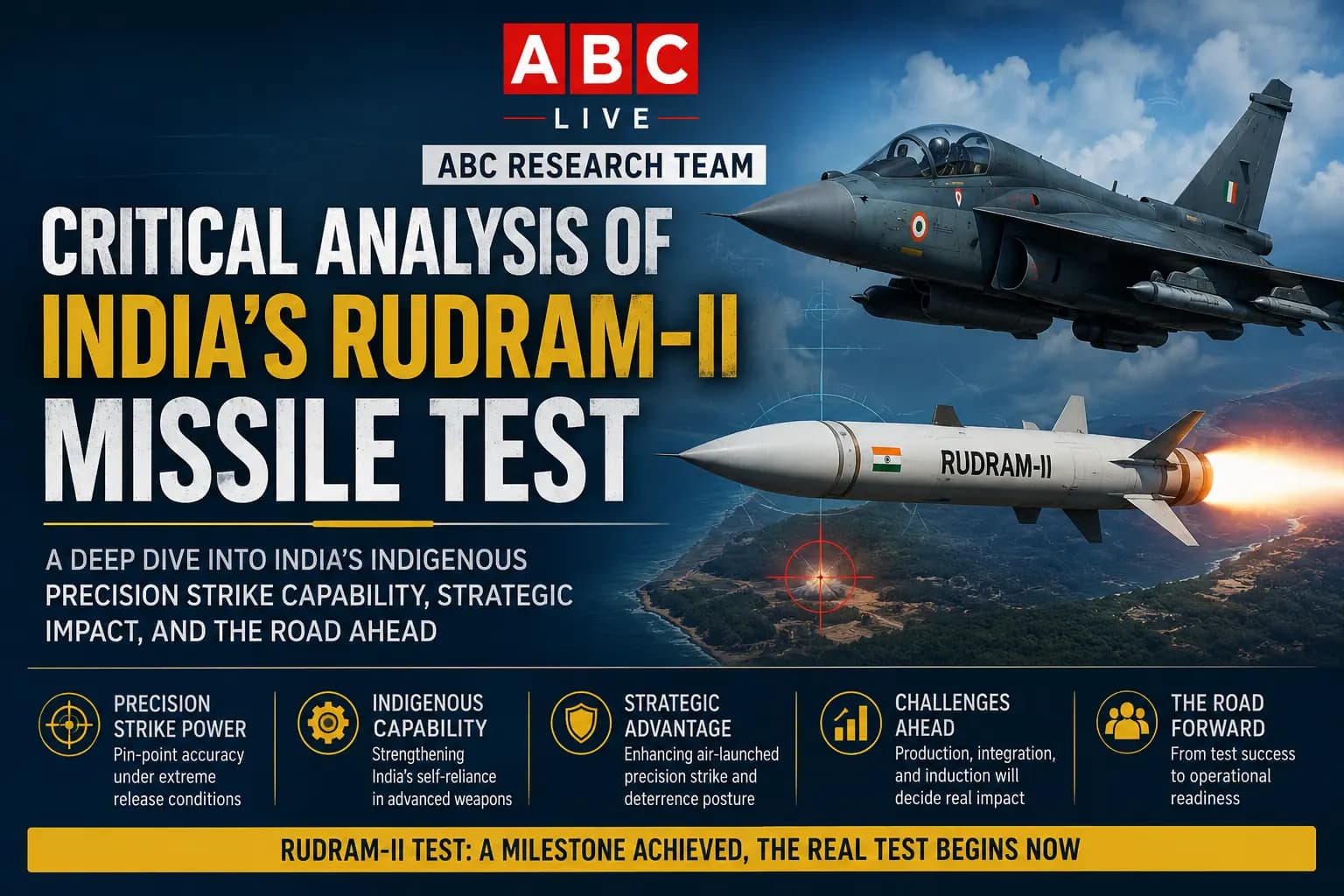
New Delhi (ABC Live): India’s successful RudraM-II missile test marks an important step in the country’s indigenous air-to-surface strike programme. Accordingly, the Defence Research and Development Organisation and the Indian Air Force tested the missile from an airborne platform under extreme release conditions. Moreover, the Ministry of Defence said the missile reached a predefined target with pin-point accuracy.
However, the test needs careful reading. Although it shows technological progress, it does not prove full operational induction. Therefore, RudraM-II’s real value will depend on aircraft integration, production scale, user acceptance, and future deployment doctrine.
In short, the test is a major validation milestone. Nevertheless, India must now convert this test success into reliable combat capability.
Key Points
| Key Issue | ABC Live Reading |
|---|---|
| Missile tested | RudraM-II air-to-surface missile |
| Agencies involved | DRDO and Indian Air Force |
| Test condition | Extreme release conditions |
| Test outcome | Missile hit a predefined target with pin-point accuracy |
| Strategic value | Strengthens air-launched precision-strike capability |
| Indigenous angle | Supports Aatmanirbharta in advanced weapons |
| Critical caution | Test success does not mean induction |
| Next challenge | Production, integration, training, and deployment |
Why ABC Live Is Publishing This Report Now
ABC Live is publishing this report now because the RudraM-II missile test comes at a time when modern warfare increasingly depends on precision weapons, stand-off strike capability, and aircraft-missile integration.
Moreover, India faces a complex security environment. Therefore, the Indian Air Force needs reliable indigenous weapons that can strike important targets with accuracy while reducing exposure to enemy air defence. For this reason, RudraM-II is not merely a technical event. Instead, it is a public-interest issue linked with defence readiness, fiscal prudence, industrial capacity, and national security planning.
At the same time, responsible analysis must avoid overstatement. Since the official release does not disclose full technical data such as range, seeker, warhead, or induction timeline, readers should treat the test as a major validation step. In other words, the test shows progress, but it does not prove full operational deployment.
Furthermore, India’s missile-readiness debate cannot stop at successful test launches. Rather, it must examine whether indigenous systems can enter service on time, remain reliable in field conditions, and support actual military doctrine.
What Has Happened?
DRDO and the Indian Air Force successfully tested the RudraM-II air-to-surface missile from an airborne platform. According to the Ministry of Defence, the teams conducted the tests under extreme release conditions. In addition, the missile’s critical trajectory established the capability of its subsystems.
After release, the missile moved towards a predefined target and achieved pin-point accuracy. Further, range instruments at the Integrated Test Range, Chandipur, captured the flight data and confirmed that the test met all objectives.
Importantly, the official release identified Research Centre Imarat, Hyderabad as the nodal DRDO laboratory. Besides this, other DRDO laboratories, HAL, airworthiness agencies, quality assurance bodies, development-cum-production partners, and industry players contributed to the programme. Thus, the test reflects both missile technology and defence-industrial coordination.
Consequently, RudraM-II should not be viewed only as a single missile test. Instead, it should be read as part of India’s wider effort to build a stronger domestic ecosystem for advanced weapon systems.
Legal / Policy Background
India’s defence policy now gives strong importance to self-reliance in advanced weapon systems. In this policy setting, RudraM-II matters because it shows progress in an indigenous air-launched missile class.
Moreover, the test fits into the larger policy push behind Aatmanirbhar Bharat in defence manufacturing. India wants to reduce dependence on imported weapon systems, build domestic design capacity, and create production-ready defence supply chains. Consequently, missile programmes like RudraM-II carry both military and industrial value.
However, self-reliance cannot rest only on successful testing. Instead, India must also prove timely production, quality control, maintenance support, upgrade capacity, and actual user induction. Thus, RudraM-II should be assessed not only as a missile test, but also as a defence-industrial test.
Therefore, the policy question is clear. Can India move from laboratory success to fleet-level confidence?
Data and Evidence
RudraM-II Missile Test Data Dashboard
| Parameter | Available Information | Critical Reading |
|---|---|---|
| Missile name | RudraM-II | Indigenous Indian missile system |
| Missile type | Air-to-surface missile | Supports air-launched strike role |
| Testing agencies | DRDO and IAF | Shows joint developer-user validation |
| Launch mode | Airborne platform | Confirms aircraft-based release |
| Test condition | Extreme release conditions | Indicates stress testing |
| Target result | Pin-point accuracy | Supports precision-strike claim |
| Test validation | Flight data from ITR Chandipur | Confirms tracked performance |
| Nodal lab | Research Centre Imarat, Hyderabad | Shows advanced missile development lead |
| Induction status | Not announced | Test success does not mean deployment |
| Range / seeker / warhead | Not officially disclosed | Avoid unsupported claims |
Institutional Role Matrix
| Institution / Agency | Role in Programme |
|---|---|
| DRDO | Leads the missile development ecosystem |
| Indian Air Force | Acts as user agency and flight-test partner |
| Research Centre Imarat, Hyderabad | Serves as nodal DRDO laboratory |
| Defence Research and Development Laboratory | Supports missile development |
| High Energy Materials Research Laboratory | Supports energetic material and propulsion-related work |
| Armament Research & Development Establishment | Supports weapon-system development |
| Integrated Test Range, Chandipur | Tracks flight data and validates test performance |
| Hindustan Aeronautics Limited | Supports platform-linked work |
| Regional Centre for Military Airworthiness | Handles airworthiness-related support |
| Missile System Quality Assurance Agency | Supports quality assurance |
| Development-cum-Production Partners | Support production-linked development |
| Indian defence industry | Supports manufacturing and subsystems |
Officially Confirmed vs Not Yet Public
| Issue | Status | Responsible Reporting Approach |
|---|---|---|
| Missile name | Confirmed | RudraM-II |
| Missile class | Confirmed | Air-to-surface missile |
| Launch mode | Confirmed | Airborne platform |
| Accuracy | Confirmed | Pin-point target engagement claimed |
| Test objectives | Confirmed | All objectives met |
| Launch aircraft | Official text does not name it | Use only with media attribution |
| Range | Not disclosed | Avoid exact claim |
| Seeker type | Not disclosed | Avoid speculation |
| Warhead | Not disclosed | Avoid speculation |
| Production timeline | Not disclosed | Await official clarity |
| Operational induction | Not disclosed | Do not claim induction |
ABC Live Analysis
1. RudraM-II Strengthens India’s Precision-Strike Architecture
RudraM-II improves India’s air-launched strike basket. As a result, it can increase combat flexibility for the Indian Air Force. Moreover, such missiles allow aircraft to hit selected ground targets with better accuracy.
In addition, air-launched precision weapons may reduce risk to pilots if the final operational range permits safer launch distances. Therefore, RudraM-II deserves attention as part of India’s wider air-power modernisation.
This matters because modern air warfare rewards precision, speed, and survivability. Consequently, a fighter aircraft becomes more effective when it can release a weapon under difficult conditions and still achieve the mission objective.
However, the test does not reveal the full combat envelope. As a result, its exact role in future IAF doctrine remains open. Thus, analysts should treat the test as a strong signal, but not as a complete operational picture.
2. The Test Shows Subsystem Maturity
The official statement says the missile’s critical trajectory established subsystem capability. This point is important because a missile test does not only check whether a weapon hits a target.
Instead, it also tests release behaviour, control systems, guidance, onboard electronics, propulsion, safety logic, and tracking. Therefore, the success shows growing confidence in the technology chain.
Even so, one successful test does not close the development cycle. More tests under different conditions may still follow before operational acceptance. Hence, RudraM-II should be viewed as a strong milestone, not as the final endpoint.
Furthermore, subsystem maturity matters because missile reliability depends on many linked parts working together. If even one critical subsystem fails, the weapon may lose accuracy, safety, or mission value.
3. The Test Supports Aatmanirbharta, But Production Will Decide Success
RudraM-II strengthens India’s self-reliance narrative. Importantly, it brings together DRDO labs, the IAF, HAL, certification agencies, quality assurance bodies, development-cum-production partners, and industry.
However, India’s defence self-reliance must move beyond prototype success. Therefore, the real question is whether the system can enter production at scale, reach users on time, remain serviceable, and receive upgrades across its life cycle.
In practical terms, the production chain matters as much as the test range result. If production remains slow or limited, the strategic value of the test will also remain limited. Conversely, if India scales production well, RudraM-II can strengthen both defence readiness and domestic industry.
Therefore, the test should also push policymakers to review industrial readiness. Otherwise, India may celebrate technical success without achieving timely operational depth.
4. Aircraft Integration Will Be a Major Operational Test
Air-launched weapons depend heavily on aircraft integration. For this reason, a missile must work with the aircraft’s software, fire-control systems, pylons, targeting systems, release mechanisms, and safety protocols.
Therefore, RudraM-II’s battlefield value will depend on how smoothly the IAF integrates it with selected aircraft platforms. In addition, it will depend on pilot training, mission planning, and maintenance readiness.
Ultimately, the missile’s success will not rest only on the laboratory or test range. Rather, it will also depend on squadron-level confidence. Hence, integration will become the bridge between test success and combat usefulness.
At the same time, aircraft integration can take time because safety and reliability standards remain strict. Therefore, public debate should not expect instant deployment after a successful test.
5. Limited Public Data Requires Careful Reporting
The official release does not disclose range, seeker type, warhead class, production numbers, or induction timeline. Although this approach is understandable for a defence system, it limits independent analysis.
Consequently, public reporting should not exaggerate the test. The correct conclusion is that India has achieved an important validation milestone. However, further conclusions must wait for more official data.
Until then, responsible analysis should separate confirmed facts from possible operational interpretation. Similarly, defence commentary should avoid exact technical claims unless official records support them.
Risks and Concerns
Production Delay Risk
India has made major progress in indigenous defence technologies. However, production timelines often decide whether a system becomes operationally useful. If production slows, the strategic value of the test may weaken. Therefore, timely manufacturing will become a major test of India’s defence ecosystem.
Integration Risk
A missile’s success on a test range must translate into safe and reliable use by frontline squadrons. Therefore, aircraft integration remains a critical risk area. Moreover, even a technically sound missile may face delays if platform certification takes longer than expected.
Data Gap Risk
Since key technical details remain undisclosed, analysts cannot fully judge the missile’s operational envelope. As a result, exaggerated claims and weak criticism may both enter public debate. For this reason, public discussion should remain evidence-based.
Doctrine Risk
The IAF must decide how RudraM-II fits into mission planning. It may support precision strike, suppression of enemy air defence, or other target roles. However, official clarity on mission doctrine is still awaited. Therefore, any final assessment of its combat role would be premature.
Strategic Impact Dashboard
| Strategic Area | Positive Impact | Remaining Question |
|---|---|---|
| Air power | Adds precision-strike capability | Which aircraft will carry it operationally? |
| Deterrence | Signals stronger strike options | What final mission profile will the IAF adopt? |
| Self-reliance | Shows indigenous missile maturity | Can India produce it at scale? |
| Industry | Expands public-private defence role | Are supply chains ready? |
| Technology | Validates subsystems under stress | What further tests remain? |
| Doctrine | Supports modern air warfare | How will the IAF deploy it? |
What Happens Next?
The next phase will decide whether RudraM-II becomes a major operational asset. First, DRDO and the IAF will likely review test data. Next, they may validate performance under more flight conditions. Thereafter, they may examine platform integration more deeply.
After that, production-linked decisions may follow. If user evaluation succeeds, RudraM-II may become part of India’s broader precision-strike architecture.
Moreover, RudraM-II fits into India’s wider missile-readiness framework. Earlier, ABC Live analysed how the Agni-I test strengthened India’s short-range readiness and deterrence posture. Therefore, readers can place RudraM-II within a wider pattern of Indian missile-readiness work.
In that context, RudraM-II adds an air-launched precision-strike layer, while Agni-I reflects India’s short-range deterrence posture. Together, these developments show India’s push for layered missile readiness.
Read the related ABC Live report here:
Agni-I Test: India’s Short-Range Readiness
Likely Next Steps
| Stage | What May Happen | Why It Matters |
|---|---|---|
| Data review | DRDO and IAF examine test data | Confirms subsystem performance |
| Further testing | More launch profiles may follow | Builds confidence |
| Platform integration | Aircraft compatibility checks continue | Ensures safe use |
| User evaluation | IAF assesses operational utility | Determines acceptance |
| Production planning | Industry prepares scale-up | Converts test into inventory |
| Possible induction | System enters service after approval | Creates real combat capability |
ABC Live Takeaway
The RudraM-II missile test is a meaningful achievement. However, readers should not treat it as the end of the journey. It proves that India’s indigenous missile ecosystem is gaining strength. Moreover, it shows that the IAF and DRDO are working together to build precision air-strike capability.
Yet, real military power does not come from a single successful test. Instead, it comes from repeated validation, reliable production, smooth platform integration, trained users, and clear doctrine. Therefore, RudraM-II’s real test begins after the flight-test.
In short, RudraM-II is not only a missile story. Rather, it is a test of India’s ability to convert research success into operational power. Consequently, the next official updates on integration, user trials, and production will matter as much as the test itself.
Sources and Methodology
ABC Live based this report on the official Ministry of Defence / PIB statement dated June 2, 2026, which confirmed the successful RudraM-II flight-tests, launch conditions, target accuracy, institutional participation, and official comments.
ABC Live also reviewed public media reporting for wider context. However, where media reports add details not stated in the official release, this report treats those details with caution. Therefore, the report gives priority to official facts and uses external reporting only for background.
Additionally, ABC Live linked this report with its earlier missile-readiness coverage for editorial continuity. As a result, readers can understand RudraM-II as part of a wider defence-readiness pattern, not as an isolated event.
Source Links
| Source | Relevance | Link |
|---|---|---|
| Press Information Bureau / Ministry of Defence | Official RudraM-II test announcement | PIB: DRDO & IAF conduct successful flight-tests of RudraM-II Air-to-Surface Missile |
| Times of India | Wider defence context and public reporting | Times of India: India successfully test-fires RudraM-II |
| Economic Times | Media report mentioning Su-30MKI platform | Economic Times: DRDO, IAF test RudraM-II from Su-30MKI |
| ABC Live Internal Link | Related missile-readiness analysis | ABC Live: Agni-I Test and India’s Short-Range Readiness |
FAQ
What is the RudraM-II missile?
RudraM-II is an indigenous Indian air-to-surface missile tested by DRDO and the Indian Air Force. In simple terms, it strengthens India’s air-launched strike capability.
Why does the RudraM-II missile test matter?
It matters because it validates India’s air-launched precision-strike capability under demanding release conditions. Moreover, it shows progress in India’s indigenous missile ecosystem. Therefore, the test has both military and industrial importance.
Has RudraM-II entered Indian Air Force service?
The official release confirms successful flight-tests. However, it does not confirm operational induction. Therefore, readers should not treat the test as proof of deployment.
What information is still not public?
The official release does not disclose the missile’s range, seeker type, warhead class, production timeline, or induction schedule. Therefore, exact battlefield claims should be avoided.
What is the main strategic meaning of the test?
The test shows that India’s indigenous missile ecosystem is maturing. However, its real value will depend on production scale, aircraft integration, and IAF operational acceptance. Ultimately, RudraM-II will matter most if India converts test success into reliable combat capability.