
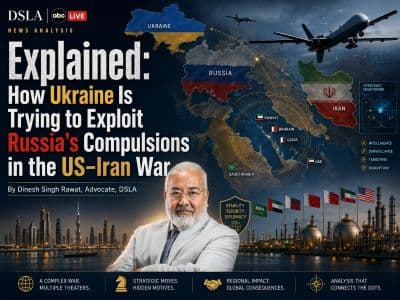
New Delhi (ABC Live): The US–Iran war and Gulf security crisis have opened a diplomatic opportunity for Ukraine against Russia.
Moscow needs Iran because Iranian-designed Shahed/Geran drones have become central to its war against Ukraine. At the same time, Tehran’s drone and missile pressure has threatened Gulf states that Russia cultivated for capital, oil coordination and diplomatic influence.
Therefore, a strategic contradiction has emerged. Moscow wants Gulf trust. However, it cannot easily confront Tehran because Iran remains important to Russia’s war effort. As a result, Kyiv is using that gap by offering Gulf states practical counter-drone expertise.
In simple terms, Ukraine is trying to turn Russia’s Iran dependence into a Gulf security opportunity. Moreover, the supplied analytical note makes the same argument. According to that reading, Kyiv is offering capability without asking Gulf states to publicly explain their earlier accommodation of Russian capital and diplomacy.
Deep Analytical Summary
Kyiv Converts War Experience Into Diplomacy
Ukraine’s Gulf outreach is not ordinary diplomacy. Rather, it is a calculated attempt to convert battlefield experience into geopolitical leverage.
For years, Ukrainian forces have faced Russian attacks using Iranian-designed Shahed/Geran drones. As a result, Kyiv has built one of the world’s most practical counter-drone knowledge bases. Now, that knowledge has value beyond Ukraine’s own war.
For Gulf states, this matters because Iran’s drone and missile pressure threatens airports, energy sites, ports, data centres, aviation routes and long-term investment plans. In addition, such pressure damages the perception that Gulf economies are safe global hubs for capital, trade and technology.
Consequently, Ukraine’s offer has military, economic and diplomatic value at the same time. It is not only about shooting down drones. Instead, it is also about protecting investor confidence, aviation safety and the Gulf’s long-term development model.
Thus, Kyiv is trying to convert survival knowledge into strategic influence. In this sense, battlefield experience has become a diplomatic currency.
Russia’s Contradiction Creates the Opening
At the centre of this issue lies Russia’s contradiction. Moscow wants Gulf capital, Gulf neutrality, oil coordination and Middle East influence. However, Tehran has also become an important military and drone partner for Russia in Ukraine.
Consequently, Moscow cannot easily act as a credible protector of Gulf states against Iran. In other words, Russia wants to be useful to the Gulf, but its most important wartime partner has become one of the Gulf’s main security threats.
Kyiv is exploiting this contradiction carefully. Instead of asking Saudi Arabia, Qatar, the UAE or other Gulf states to publicly abandon Russia, it is offering a narrow but valuable product: real experience in detecting, jamming and intercepting Shahed/Geran-type drones.
Therefore, Ukraine’s offer becomes easier for Gulf states to accept. It does not demand a public anti-Russia position. Instead, it gives them a practical security option.
Meanwhile, Russia remains stuck between two relationships. It wants Gulf confidence. Yet, it also needs Iran’s military support. As a result, Moscow’s room for manoeuvre becomes limited.
Gulf States Can Accept Help Without Breaking With Moscow
The Ukrainian offer is easier for Gulf capitals to accept because it does not look like ideological alignment with the West. Instead, it appears as a practical defence transaction.
Moreover, Gulf states have their own reasons to listen. Their development model depends on stability. Saudi Arabia’s Vision 2030, the UAE’s finance and data infrastructure ambitions, Qatar’s LNG diplomacy and mediation role, and the wider Gulf ports-and-aviation economy all require security confidence.
Even limited drone or missile attacks can raise insurance costs, disturb air routes, reduce investor confidence and damage the Gulf’s image as a safe global hub. Therefore, Ukrainian counter-drone experience has economic value as well as military value.
At the same time, this cooperation allows Gulf states to preserve strategic flexibility. They can work with Ukraine on drones while maintaining other ties with Russia, China, Europe and the United States.
For this reason, the Ukrainian offer fits the Gulf style of foreign policy. It adds one more useful partner without forcing a public break with another.
The Shift Is Real but Limited
Still, Kyiv’s role should not be overstated. It cannot replace the United States as the Gulf’s main security partner. Nor can it offer a complete shield against Iran.
Regional foreign policy will likely remain multi-aligned. For that reason, Gulf capitals may continue talking to Moscow, trading with China, relying on US security systems and cooperating with Ukraine at the same time.
Therefore, the real shift is not a dramatic geopolitical defection. Instead, it is a quiet diversification of Gulf security partnerships.
Kyiv is entering the Gulf not because it has oil, sovereign wealth or old regional influence. Rather, it is entering because modern drone warfare has created a new market for survival knowledge.
Ultimately, Ukraine is trying to exploit Russia’s Iran compulsion by showing Gulf states that Moscow’s partner is their threat, while Ukrainian battlefield experience can become their protection.
Key Points
| Issue | Simple Explanation |
|---|---|
| Russia’s compulsion | Moscow depends on Iran’s drone ecosystem for its Ukraine war. |
| Gulf vulnerability | Gulf states face Iranian drones, missiles and maritime pressure. |
| Ukraine’s advantage | Kyiv has real battlefield experience against Shahed/Geran drones. |
| Diplomatic opening | Gulf states can take Ukrainian help without openly joining an anti-Russia bloc. |
| Strategic risk | Kyiv’s role is useful but limited; Gulf states will continue multi-alignment. |
| Editorial caution | Claims about direct Russian targeting support to Iran need independent verification. |
Why ABC Live Is Publishing This Report Now
ABC Live is publishing this report because the Gulf crisis has turned drone warfare into a wider geopolitical contest.
The issue matters beyond Ukraine and Iran. Gulf states sit at the centre of oil flows, aviation routes, sovereign wealth, data infrastructure, ports and maritime trade. Therefore, drone and missile pressure in the Gulf can affect energy prices, investor confidence, insurance rates, shipping routes and defence procurement.
In addition, the Russia–Ukraine war is no longer only a European battlefield. It now interacts with the US–Iran conflict, Gulf air defence, the Strait of Hormuz, drone technology and great-power diplomacy.
For this reason, Kyiv’s Gulf outreach deserves close attention. The move is not merely a search for sympathy. Instead, it is an attempt to convert operational knowledge from the Ukraine war into a strategic asset in the Middle East.
Moreover, this issue links with Ukraine’s wider diplomatic search for leverage. ABC Live has tracked the Ukraine peace process and the pressure around Washington-backed settlement proposals. For background, readers may read ABC Live’s earlier reports: US Peace Plan Ukraine and US Peace Plan Ukraine Rejection.
Thus, this report connects three moving parts: Ukraine’s war experience, Russia’s Iran dependence and Gulf security anxiety.
What Has Happened?
Kyiv has offered Gulf states counter-drone and air-defence cooperation at a time when Iran’s drone and missile campaign has created new insecurity in the region.
Official Ukrainian statements say Ukraine has begun cooperation with Saudi Arabia, the UAE, Qatar, Kuwait and Jordan, with signals also coming from Bahrain. Furthermore, President Volodymyr Zelenskyy said Ukraine’s experience in protecting lives and critical infrastructure was visible through the work of Ukrainian expert teams in the Middle East and Gulf region.
Public reporting and official releases also describe Ukraine’s Gulf outreach. For example, the Ukrainian presidency said Kyiv and Abu Dhabi agreed on security and defence cooperation during Zelenskyy’s UAE visit, while the teams were finalising details of the agreements.
Yet, the political meaning is more important than the paperwork alone. The offer has been calibrated carefully. Rather than publicly lecturing Gulf states for their earlier neutrality toward Russia, Kyiv is offering usable defence capability at the moment when Gulf states need it most.
The supplied analytical note describes this as a “capability without judgment” approach. Indeed, that phrase captures the diplomatic logic of Ukraine’s move.
Therefore, Ukraine’s message is practical, not moralistic. Instead of asking Gulf states to choose sides publicly, Kyiv is offering help against a real and immediate drone threat.
Policy Background
Gulf Multi-Alignment
The Gulf crisis has three policy layers. The first layer is multi-alignment.
Since the Russia–Ukraine war began, Gulf states have maintained relations with the United States, Europe, Russia, China and Ukraine instead of joining one bloc fully. Consequently, this approach gave them flexibility. Moreover, it allowed them to benefit from multiple channels at the same time.
In practice, this means Gulf capitals can accept Ukrainian counter-drone help without declaring a strategic break from Moscow. Therefore, Kyiv’s offer fits the Gulf habit of keeping several partnerships open at once.
At the same time, Gulf states can avoid the political cost of appearing fully aligned with the West. Thus, Ukrainian cooperation becomes easier to absorb inside a multi-aligned policy.
Russia’s Iran Dependence
The second layer is Russia’s dependence on Iran.
Iranian-designed Shahed/Geran drones have supported Moscow’s war strategy in Ukraine. As a result, Russia faces limits when Gulf states expect it to act against Tehran.
Recent reporting also shows that Russia continues to upgrade and adapt Shahed-style drones. For instance, Russia has reportedly converted some Shahed-type drones into operator-guided weapons that can hunt moving targets and challenge Ukrainian defences.
This does not mean Moscow has lost all influence. Nevertheless, Russia cannot easily present itself as a clean security partner against Iran.
Therefore, Moscow’s Gulf position becomes complicated. It can speak to Gulf states. However, it cannot fully pressure Iran without hurting its own wartime interests.
Ukraine’s Defence-Industrial Push
The third layer is Ukraine’s defence-industrial diplomacy.
Kyiv is trying to build defence-industrial partnerships outside Europe. Because of this, its counter-drone experience gives it a specialised role in countries exposed to Iranian drones and missiles.
Therefore, the Gulf move is both diplomatic and industrial. It may lead to training, technology sharing, co-production, funding and future procurement.
In turn, such cooperation may help Ukraine strengthen its own defence industry while helping Gulf states reduce dependence on expensive missile-only defence systems.
Moreover, this model could support Ukraine’s wartime economy. Likewise, it could give Gulf states a lower-cost layer of defence against drone saturation.
Data and Evidence
Table 1: The Strategic Triangle
| Actor | Immediate Interest | Main Constraint | Ukraine’s Opening |
|---|---|---|---|
| Gulf States | Protect airports, oil sites, ports, data centres and cities | Iran can use drones and missiles to raise risk | Ukraine can offer counter-drone expertise |
| Russia | Keep Gulf capital, oil coordination and diplomatic relevance | Moscow depends on Iran | Kyiv can expose Russia’s limited usefulness against Tehran |
| Iran | Pressure Gulf and US-linked regional infrastructure | Gulf air defence and US presence limit escalation | Tehran’s pressure creates demand for Ukrainian expertise |
| Ukraine | Gain partners, funding, air defence and co-production | Kyiv also lacks interceptors | Ukraine converts battlefield experience into diplomacy |
Taken together, these four positions explain the strategic triangle. Therefore, Ukraine’s Gulf move should be read as a security transaction and a diplomatic manoeuvre.
Table 2: Ukraine–Gulf Defence Outreach
| Country | Reported / Official Cooperation | Main Area | Strategic Meaning |
|---|---|---|---|
| Saudi Arabia | Ukraine says cooperation has begun | Counter-drone systems, air defence, technology | Opens a major Gulf defence channel for Kyiv |
| Qatar | Ukrainian experts assessed Qatar’s aerial-threat protection needs | Missile and drone defence | Helps protect aviation, LNG and mediation credibility |
| UAE | Ukrainian presidency says teams are finalising security and defence cooperation details | Counter-drone and air-defence cooperation | Supports confidence in finance, ports and data infrastructure |
| Kuwait | Listed by Ukraine among regional cooperation partners | Drone and missile defence support | Shows wider Gulf demand for Ukrainian expertise |
| Jordan | Included in Ukraine’s regional cooperation track | Air-defence and regional security support | Extends Kyiv’s role beyond Gulf monarchies |
| Bahrain | Ukraine noted signals from Bahrain | Possible drone-defence cooperation | Matters because of its US-linked strategic position |
During Zelenskyy’s Qatar visit, Ukrainian specialists briefed him on Qatar’s capabilities to counter aerial threats and developed concrete solutions to strengthen airspace protection.
Therefore, the cooperation appears operational, not only symbolic.
Table 3: Russia’s Gulf Compulsion
| Russia’s Goal | Why It Matters | Iran’s Effect | Result |
|---|---|---|---|
| Keep Gulf investment | Gulf capital and finance matter for Moscow | Iran threatens Gulf stability | Gulf trust in Russia weakens |
| Maintain OPEC+ relevance | Saudi–Russia oil coordination helps Moscow | Iran creates oil and shipping instability | Russia gains leverage but loses reliability |
| Appear as mediator | Moscow wants Middle East influence | Tehran is the Gulf’s threat | Russia cannot act as a neutral protector |
| Preserve Iran partnership | Tehran helps Moscow in Ukraine | Gulf states fear Iran | Russia must balance conflicting partners |
| Use UN influence | Moscow has veto power | Gulf states seek action against Iran | Russian positions expose its constraints |
In short, Russia wants influence in the Gulf. However, Iran’s conduct makes that influence harder to defend.
Table 4: UN Security Council Signals
| Date | Issue | Outcome | Russia’s Position | Meaning |
|---|---|---|---|---|
| March 11, 2026 | Iran’s attacks against regional neighbours | Security Council adopted Resolution 2817 | Russia abstained | Moscow avoided full alignment with Gulf states against Iran |
| March 19, 2026 analysis | Gulf diplomatic response at UNSC | Regional analysts described the resolution as a Gulf diplomatic counterstrike | Russia and China abstained | Gulf unity became visible, while Russia hedged |
The UN said the Security Council adopted Resolution 2817 on March 11, 2026, condemning Iran’s attacks against regional neighbours, with 13 votes in favour and abstentions by Russia and China. Likewise, regional analysis noted that Russia and China abstained while the rest of the Council voted in favour.
Thus, the UN record supports the view that Moscow avoided full alignment with Gulf states against Tehran.
Table 5: Why Ukraine’s Counter-Drone Experience Matters
| Gulf Threat | Traditional Defence Problem | Ukraine’s Relevant Experience | Practical Value |
|---|---|---|---|
| Shahed-type drones | Cheap drones can force expensive interceptor launches | Ukrainian forces have fought Shahed/Geran drones for years | Lower-cost defence methods |
| Drone swarms | Many drones can overwhelm fixed systems | Ukraine uses layered detection and mobile teams | Better area protection |
| Low-flying drones | They can be hard to detect early | Kyiv uses sensors, spotters, jamming and mobile fire groups | Faster response |
| Missile-drone combinations | Mixed attacks stress air defence | Ukraine has faced combined Russian attacks | Better prioritisation |
| Constant upgrades | Drones evolve quickly | Ukrainian tactics adapt after each attack cycle | Faster learning |
Ukraine’s Gulf offer rests on practical battlefield exposure rather than theory. Therefore, Gulf states may treat Ukrainian counter-drone experience as a useful supplement to their existing air-defence systems.
Moreover, Ukraine’s approach can help address the cost problem. Cheap drones can force defenders to use costly interceptors. Consequently, layered and lower-cost defence becomes strategically important.
Table 6: Gulf Vulnerability Matrix
| Gulf State | Main Vulnerability | Why Iranian Pressure Matters | Why Ukraine Becomes Useful |
|---|---|---|---|
| UAE | Finance, aviation, ports, real estate and data infrastructure | Investor confidence depends on security | Ukraine can help with layered drone defence |
| Saudi Arabia | Vision 2030, oil assets, mega-events and long-term projects | Stability is central to economic transformation | Kyiv offers battle-tested counter-drone methods |
| Qatar | LNG, mediation identity and Hamad International Airport | Qatar’s influence depends on safe neutrality | Ukraine can help protect aviation and strategic assets |
| Kuwait | Energy sites and US-linked security infrastructure | Drone and missile threats widen regional risk | Ukrainian tactics can improve readiness |
| Bahrain | US-linked strategic position and limited geographic depth | Small geography raises risk from any strike | Counter-drone systems reduce exposure |
| Oman | Strait of Hormuz diplomacy and maritime stability | Shipping disruption affects its regional role | Ukraine’s role may remain indirect but relevant |
Overall, the Gulf vulnerability map shows why this issue is not only military. Rather, it also concerns investment confidence, aviation stability and long-term state branding.
Table 7: Claim Verification Dashboard
| Claim | Status | ABC Live Treatment |
|---|---|---|
| Ukraine has strong experience against Shahed/Geran drones | Strongly supported | State directly |
| Gulf states need counter-drone systems | Supported by regional context | State with caution |
| Ukraine has begun Gulf defence cooperation | Supported by Ukrainian official statements | State with citations |
| Russia depends on Iran in Ukraine | Supported | Mention drone and military support |
| Russia cannot easily protect Gulf states from Iran | Strong analysis | Present as analysis |
| Russia shared satellite imagery with Iran | Unverified allegation | Say “Ukraine has alleged” |
| Ukraine is weakening Russia’s Middle East network | Plausible but developing | Present as strategic trend |
| Gulf states will abandon Russia | Not proven | Avoid this claim |
| Ukraine can fully shield Gulf states | Overstated | Say “reduce risk,” not “eliminate threat” |
Accordingly, ABC Live should use firm language for confirmed facts and cautious language for intelligence-style allegations.
ABC Live Analysis
Battlefield Knowledge as Diplomatic Currency
Ukraine’s move is clever because it turns battlefield suffering into diplomatic leverage.
For years, Russia used Iranian-designed Shahed/Geran drones to attack Ukrainian cities and infrastructure. Now, Kyiv is telling Gulf states that the same threat gives it unique operational knowledge.
In simple terms, the Ukrainian message is direct: Russia’s partner is your threat, and we know how to fight that threat.
Thus, Ukraine is not only asking for help. It is also offering something valuable in return.
More importantly, this offer changes Kyiv’s diplomatic image. It is not only a recipient of aid. Instead, it becomes a provider of specialised security knowledge.
Why Gulf Capitals May Find the Offer Useful
This approach avoids a common diplomatic problem. Western security offers often come with political expectations, such as sanctions alignment, governance pressure or public distancing from Moscow.
By contrast, the Ukrainian offer is narrower and more practical. It says: let us help you solve a defence problem.
That matters because Gulf states dislike being forced into binary choices. Saudi Arabia, Qatar and the UAE prefer strategic flexibility. They want American protection, Russian channels, Chinese trade, European technology and regional autonomy at the same time.
Consequently, Ukraine’s counter-drone offer fits the Gulf model. It does not require a public ideological shift.
Moreover, it gives Gulf states a way to respond to Iran without completely rewriting their foreign policy.
Therefore, the offer is politically low-cost and operationally useful.
Why the Claim Still Needs Caution
The argument remains strong, but it needs careful limits.
Kyiv can help Gulf states reduce drone risk. Even so, it cannot offer perfect protection. No defence system can stop every drone, every missile or every mixed attack.
Moreover, Ukraine cannot replace the United States as the Gulf’s main security provider. Its role is more specialised. Kyiv can offer counter-drone systems, training, tactical learning, software, jamming methods and co-production experience.
Therefore, the safest conclusion is that Ukraine is becoming a useful specialist partner, not a full security guarantor.
Likewise, claims about direct Russian targeting support to Iran should not be presented as proven unless independent evidence confirms them.
Russia’s Real Weakness
Russia’s weakness is not that it has no Middle East influence. Moscow still has oil leverage, diplomatic links, intelligence ties, arms relationships and a UN Security Council veto.
The real weakness is more specific. Tehran has become too important to Moscow’s Ukraine war. Therefore, Russia cannot easily act against Iran when Gulf states need help against Iranian pressure.
That is exactly where Kyiv sees an opening. It cannot outspend Russia in the Gulf. Nor can it replace Gulf energy diplomacy. However, Ukraine can offer one thing Russia cannot credibly offer: battle-tested protection knowledge against Iranian-designed drone warfare.
In effect, Russia’s Iran partnership limits Moscow, while Ukraine’s Iran-linked battlefield experience creates an opening for Kyiv.
Consequently, the Gulf may not abandon Russia. However, it may reduce Russia’s role in the most urgent defence problem: protection against Iranian drones and missiles.
Risks and Concerns
| Risk | Explanation |
|---|---|
| Escalation risk | Iran may view Ukrainian support to Gulf states as hostile. |
| Russian response | Moscow may punish Kyiv diplomatically or militarily for expanding Gulf cooperation. |
| Interceptor shortage | Ukraine and Gulf states may compete for limited Patriot and other air-defence missiles. |
| Overstatement risk | Ukrainian expertise matters, but it is not a complete shield. |
| Gulf hedging | Gulf states may take Ukrainian help while keeping ties with Russia. |
| Verification risk | Claims about Russian satellite support to Iran should be treated as allegations unless independently confirmed. |
Therefore, the opportunity is real, but the risks are also serious.
What Happens Next?
Defence Cooperation May Deepen
Counter-drone cooperation between Ukraine and Gulf states may deepen in the next phase. Saudi Arabia, Qatar and the UAE are the most important countries to watch.
In addition, Gulf states may invest in Ukrainian drone, interceptor and electronic-warfare production. Such cooperation would help Kyiv financially and industrially. At the same time, it would help Gulf states build lower-cost defences against drone saturation.
Therefore, defence-industrial cooperation may become the next stage of Ukraine’s Gulf strategy.
If this happens, Ukraine’s wartime defence industry may gain a wider export and partnership base.
Russia May Move Closer to Iran
Moscow may move even closer to Tehran if the Ukraine war continues and Russian military needs remain high. If that happens, Russia’s ability to act as a Gulf protector against Iranian pressure will shrink further.
As a result, Kyiv’s argument may become stronger over time.
Meanwhile, Gulf states may read Russia’s deeper Iran alignment as another reason to diversify security partners.
Consequently, Ukraine’s role may grow even if Gulf states avoid public anti-Russia language.
Gulf States Will Still Hedge
Even so, Gulf states are unlikely to make a dramatic break with Russia. A multi-alignment policy will probably continue.
Therefore, the likely outcome is not a complete geopolitical shift. Instead, Ukraine may become one more specialised security partner in a broader Gulf defence basket.
In short, the Gulf may not choose Ukraine over Russia. However, it may choose Ukraine for a problem Russia cannot solve.
Conclusion
One of Russia’s biggest strategic compulsions is now clear: Moscow needs Iran, but Gulf states fear Iran.
That contradiction gives Kyiv a narrow but real opening. Gulf states are unlikely to abandon Russia. Nor will Ukraine replace the United States as the region’s main security partner. However, Kyiv can become a useful counter-drone partner because it has years of battlefield experience against Shahed/Geran drones.
Therefore, the Gulf crisis gives Ukraine a new diplomatic weapon. Instead of asking Gulf states to join an anti-Russia bloc, Kyiv is offering practical defence help at a time when Moscow cannot easily protect them from its own Iranian partner.
Ultimately, the deeper message is simple: Ukraine is turning Russia’s Iran dependence into a Gulf security opportunity.
At the same time, this shift should not be exaggerated. Gulf states will continue hedging. Nevertheless, Ukraine has found a narrow but meaningful space inside the Gulf security architecture.
Sources and Methodology
This report relies on publicly available reporting, UN records, official Ukrainian statements, credible defence reporting and the supplied analytical text. ABC Live has separated facts, allegations and strategic interpretation.
Ukraine’s counter-drone expertise and Russia’s Iran constraint are treated as supported analytical claims. However, claims about direct Russian satellite support to Iran remain unverified allegations unless confirmed by independent public evidence.
For this reason, the report uses careful language on sensitive claims. It treats Ukraine’s Gulf outreach as a verified diplomatic and defence trend, while treating direct Russian targeting support as an allegation.
The supplied analytical note has been used as a source for the writer’s argument and interpretive frame.
External Sources and Hyperlinks
| Source | What It Supports |
|---|---|
| President of Ukraine: Results of visits to Saudi Arabia, UAE and Qatar | Ukraine–UAE security and defence cooperation; Gulf outreach. |
| President of Ukraine: Russia Must Not Win This War | Ukraine’s statement that cooperation began with Saudi Arabia, UAE, Qatar, Kuwait and Jordan, with signals from Bahrain. |
| President of Ukraine: Ukrainian experts in Qatar | Ukrainian experts assessed Qatar’s aerial-threat protection and proposed airspace-protection solutions. |
| UN Security Council Resolution 2817, March 11, 2026 | UNSC condemnation of Iran’s attacks against regional neighbours; Russia and China abstentions. |
| Middle East Council: The Gulf’s Diplomatic Counterstrike at the UNSC | Analysis of Gulf diplomatic strategy and Russia-China abstentions. |
| Al Jazeera: Ukraine sends advisers to Gulf | Ukraine’s Gulf adviser role and counter-drone relevance. |
| AGSI: Ukraine’s Counterdrone Assistance to the Gulf States | Strategic analysis of how Ukrainian help may affect Gulf neutrality. |
| Business Insider: Russia upgrades Shahed-style drones | Russia’s evolving Shahed-style drone threat and pressure on Ukrainian defences. |
Related ABC Live Reports
Readers may also read ABC Live’s earlier coverage on Ukraine diplomacy and US peace-plan pressure:
These reports provide useful background to understand why Ukraine is now trying to widen its diplomatic and defence options beyond Europe.
FAQ
What is the issue?
Ukraine is trying to use its experience against Iranian-designed Shahed/Geran drones to build defence partnerships with Gulf states during the US–Iran war.
Why does it matter?
The issue matters because Russia depends on Iran, while Gulf states fear Iran. Therefore, this contradiction gives Ukraine a diplomatic opening in the Gulf.
Who is affected?
Ukraine, Russia, Iran, Gulf states, the United States, global oil markets, aviation, shipping, insurance and defence industries are all affected.