
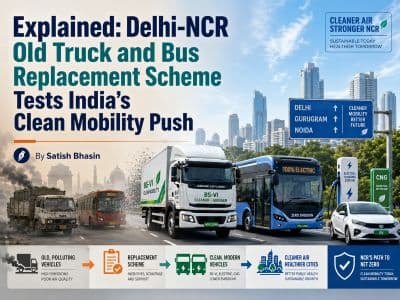
New Delhi (ABC Live): The Union Cabinet has approved a two-year scheme to support the replacement of old trucks and buses in the Delhi-NCR region. Importantly, the scheme will work through the National Capital Region Planning Board under the Ministry of Housing and Urban Affairs. At the same time, the Ministry of Road Transport and Highways and the Ministry of Petroleum and Natural Gas will help implement it with NCR states.
The scheme has a total financial outlay of ₹9,585 crore. Out of this amount, the Central Government will contribute ₹5,041 crore. Meanwhile, participating states will provide an estimated ₹1,601 crore through tax concessions. Overall, the scheme aims to benefit around 2.07 lakh vehicle owners, including 1.91 lakh truck owners and 16,329 bus owners in Delhi, Haryana, Rajasthan, and Uttar Pradesh.
In practical terms, the scheme tries to replace a small but highly polluting vehicle segment. Therefore, it can reduce emissions faster than a broad but weakly targeted vehicle policy.
Key Points
| Issue | Details |
|---|---|
| Scheme duration | Two-year enrolment window |
| Total outlay | ₹9,585 crore |
| Central support | ₹5,041 crore |
| State tax concessions | Estimated ₹1,601 crore |
| Target vehicles | BS-IV and older trucks and buses registered in Delhi-NCR |
| Beneficiaries | Around 2.07 lakh owners |
| Replacement options | BS-VI or stricter norm vehicles, CNG vehicles where allowed, or EVs |
| Special Delhi rule | Light goods vehicles must be electric; buses must be BS-VI CNG or electric |
| Monitoring | Empowered Committee chaired by Cabinet Secretary |
Why ABC Live Is Publishing This Report Now
Delhi-NCR’s air pollution debate returns every winter. However, the policy response often comes through emergency restrictions rather than long-term fleet reform. Therefore, this scheme matters because it tries to remove old and high-emission vehicles before pollution peaks.
Moreover, trucks and buses form a small share of the total vehicle fleet. Yet, they create a heavy pollution burden. For this reason, the scheme deserves close public scrutiny. If implemented well, it can become a cleaner mobility model for other polluted urban regions. However, it can also fail if financing, scrapping, tax waivers, and digital systems do not work smoothly.
In other words, the policy is not only about replacing vehicles. Instead, it is also a test of whether India can combine environmental urgency with transport-sector economics.
What Has Happened?
The Cabinet has approved financial support for owners of old trucks and buses in Delhi-NCR. Under the scheme, vehicles that comply with BS-IV or earlier emission norms will be targeted. In return, owners can replace them with BS-VI or stricter emission-compliant vehicles or electric vehicles.
For BS-III and older vehicles, scrapping at registered vehicle scrapping facilities will be mandatory. However, BS-IV vehicles may either be scrapped or sold outside NCR in non-NCAP cities and towns. After that, the owner must buy and register a cleaner vehicle within NCR.
The scheme also creates Delhi-specific rules. In Delhi, light goods vehicles purchased under the scheme must be electric. Similarly, buses must be BS-VI CNG or electric. Meanwhile, government vehicles will remain outside the scheme.
Thus, the scheme uses different rules for different vehicle categories. Consequently, the compliance burden will vary for truck owners, bus operators, and light goods vehicle owners.
Data and Evidence
The official note cites the 2018 source apportionment study by ARAI and TERI. According to that study, the transport sector contributes 14% of PM2.5, 40% of carbon monoxide, and 63% of nitrogen oxide emissions in Delhi-NCR. Within the transport sector, trucks and buses account for 36% of PM2.5 emissions, although they form only 3% of the total fleet.
| Pollution Indicator | Transport Sector Share in Delhi-NCR |
|---|---|
| PM2.5 | 14% |
| Carbon Monoxide | 40% |
| Nitrogen Oxides | 63% |
| Heavy Vehicle Pollution Fact | Official Estimate |
|---|---|
| Trucks and buses’ PM2.5 share within transport | 36% |
| Trucks and buses’ share of total fleet | 3% |
| One pre-BS heavy-duty vehicle emission equivalent | 14 BS-VI vehicles |
| One BS-IV vehicle emission level | 2.7 times a BS-VI vehicle |
Therefore, the policy logic is not based only on vehicle age. Instead, it focuses on the high emission impact of older heavy-duty vehicles. In simple terms, replacing fewer dirty vehicles can deliver larger pollution gains than replacing many low-emission private vehicles.
Besides, heavy vehicles often run longer distances and spend more hours on the road. As a result, their real-world emission impact can be greater than their fleet share suggests.
Benefits Under the Scheme
The Central Government will provide three main benefits. First, it will give a 5% interest subvention on loans for five years. Second, it will provide monthly fuel vouchers worth up to ₹4,800, depending on vehicle category. Third, it will provide lump-sum support for EV purchases or Certificate of Deposit trading.
State governments will also provide major support. For example, they will waive registration fees. In addition, they will grant up to 100% motor vehicle tax concession for new vehicles and 50% concession for used vehicles for ten years. Further, they will waive pending liabilities on old vehicles participating in the scheme.
Auto manufacturers will also contribute. As part of the scheme, participating OEMs will offer 8% discounts on ex-showroom prices. Consequently, the total benefit package combines central subsidy, state tax relief, manufacturer discount, and cleaner vehicle registration.
Taken together, these benefits try to reduce the upfront cost of replacement. However, the final decision will still depend on loan access, vehicle price, resale value, fuel cost, and daily business income.
ABC Live Analysis
1. The Scheme Targets a High-Pollution Segment
The scheme targets trucks and buses because their pollution impact is much higher than their fleet share. Although they form only a small part of total vehicles, they contribute heavily to PM2.5 emissions. Therefore, the policy has a strong environmental basis.
However, the real test lies in exit control. Old BS-III vehicles must be scrapped, which is useful. But BS-IV vehicles may be sold outside NCR in non-NCAP cities and towns. As a result, the pollution burden may shift if these vehicles continue to operate near NCR supply routes.
Therefore, the government must track where these BS-IV vehicles go after sale. Otherwise, the scheme may clean Delhi-NCR on paper while exporting pollution to smaller towns.
2. Incentives Are Better Than Ban-Only Governance
Delhi-NCR has often used bans, entry restrictions, fuel controls, and emergency directions to fight pollution. However, such measures usually hurt small transporters first. In contrast, this scheme gives owners a financial bridge to shift toward cleaner vehicles.
This is important because many truck and bus owners operate on thin margins. Without support, a sudden ban may destroy livelihoods. With support, the same owner can retire an old vehicle and enter a cleaner mobility system.
Even so, incentives must reach the right owner at the right time. Otherwise, larger operators may benefit first, while smaller single-vehicle owners may remain outside the scheme.
3. The EV Push Is Strong, but Charging Readiness Matters
The Delhi rule for electric light goods vehicles shows a strong policy push. Nevertheless, EV adoption in commercial transport requires more than a purchase subsidy. For example, it needs charging points, depot-level power supply, battery financing, repair networks, and resale confidence.
Therefore, the scheme should not be judged only by new registrations. Instead, it should also be judged by vehicle uptime, charging access, operating cost, loan repayment comfort, and owner satisfaction.
Moreover, electric commercial vehicles must work reliably during peak delivery hours. If charging delays reduce daily trips, small operators may lose income despite receiving benefits.
4. Digital Monitoring Can Improve Trust
The scheme will run through an integrated digital portal. Through this portal, authorities will check eligibility, process interest subvention claims, credit fuel vouchers, and monitor pollution reduction outcomes. Therefore, the portal can reduce paperwork and improve transparency.
However, digital systems often create new barriers for small operators. Some owners may struggle with documents, loan approvals, scrappage certificates, portal errors, and state-level approvals. For that reason, district-level help desks will be essential.
Additionally, the portal should publish non-personal public dashboards. This will help citizens see whether the scheme is actually reducing old vehicles and improving fleet quality.
Risks and Concerns
| Risk | Why It Matters | What Government Should Do |
|---|---|---|
| Old vehicles shift outside NCR | Pollution may move to nearby towns | Track sale and use patterns |
| Financing delays | Small owners may not afford replacement | Simplify loan and subvention process |
| EV charging gaps | Electric LGVs may face operational limits | Build depot and highway charging support |
| Portal errors | Benefits may get delayed | Provide offline help centres |
| Weak scrappage network | Mandatory scrapping may slow down | Expand registered scrapping facilities |
| State coordination gaps | Delhi, Haryana, UP, and Rajasthan must act together | Publish state-wise implementation dashboards |
In addition, the government should publish periodic progress data. This data should show how many vehicles were scrapped, how many were replaced, how many EVs entered service, and how much pollution reduction was achieved. Without such disclosure, the public will not know whether the scheme is producing real gains.
Similarly, lenders should publish simplified loan-processing norms. Otherwise, transporters may face delays even after becoming eligible on the portal.
What Happens Next?
The scheme will need detailed operational guidelines. These guidelines should explain eligibility, scrappage rules, vehicle categories, interest subvention procedure, fuel voucher mechanism, tax waiver process, OEM discount process, and grievance redressal.
The Empowered Committee chaired by the Cabinet Secretary will monitor the scheme at the top level. Meanwhile, District Collectors and District Magistrates will implement and monitor it locally. Therefore, the success of the scheme will depend on both central design and district-level administrative discipline.
Next, states must align their tax and registration systems with the central portal. After that, banks, OEMs, fuel companies, and scrapping facilities must connect their processes. Only then can vehicle owners receive benefits without repeated visits to different offices.
ABC Live View
The Delhi-NCR old truck and bus replacement scheme is a serious attempt to move from emergency pollution control to structural fleet reform. It rightly targets heavy vehicles because they produce disproportionate emissions. Moreover, it combines incentives with cleaner technology adoption.
Nevertheless, the policy must avoid three mistakes. First, it should not merely export old vehicles outside NCR. Second, it should not burden small owners with complex paperwork. Third, it should not announce EV targets without charging and financing support.
If implemented well, the scheme can reduce pollution, modernise freight movement, support cleaner public transport, and create a model for other polluted urban clusters. However, if implementation remains fragmented, the scheme may become another good policy trapped in administrative gaps.
Ultimately, the scheme will be judged by measurable outcomes. For that reason, the government should report vehicle replacement numbers, emission-reduction estimates, EV adoption rates, and owner-level benefit delivery.
Sources and Methodology
ABC Live reviewed the official Cabinet announcement, the PIB release, ARAI-TERI source apportionment findings cited in the policy note, and related clean-transport directions for Delhi-NCR. The analysis focuses on policy design, pollution impact, implementation risks, and likely governance challenges. In addition, ABC Live assessed whether the incentive structure is practical for small transport owners.
For clarity, this report separates official scheme details from ABC Live’s policy analysis. Therefore, readers can distinguish between government claims, pollution data, and implementation concerns.
FAQ
What is the Delhi-NCR old truck and bus replacement scheme?
It is a Cabinet-approved scheme to help owners of old trucks and buses replace BS-IV and older vehicles with cleaner vehicles. Under the scheme, eligible owners can shift to BS-VI, stricter emission-compliant vehicles, CNG vehicles where permitted, or electric vehicles.
Why does it matter?
It matters because trucks and buses form only a small share of the fleet. However, they contribute a large share of transport-related PM2.5 emissions in Delhi-NCR. Therefore, replacing them can produce a strong pollution-control benefit.
Who will benefit?
Around 2.07 lakh owners of eligible trucks and buses registered in Delhi-NCR may benefit. However, they must meet the scheme conditions. In particular, they must replace the old vehicle with an eligible cleaner vehicle registered within NCR.
Will BS-III vehicles have to be scrapped?
Yes. BS-III and older vehicles must be scrapped at registered vehicle scrapping facilities. Therefore, these vehicles cannot simply be shifted elsewhere under the scheme.
Can BS-IV vehicles be sold?
Yes. BS-IV vehicles may either be scrapped or sold outside NCR in non-NCAP cities and towns. However, the government must monitor this carefully so that pollution does not shift to nearby regions.
What is the main challenge?
The main challenge is implementation. Specifically, the scheme needs smooth financing, enough scrapping facilities, digital processing, state coordination, EV charging support, and strict monitoring. Without these safeguards, the scheme may struggle despite its strong policy intent.
Also, Read ABC Live Report