
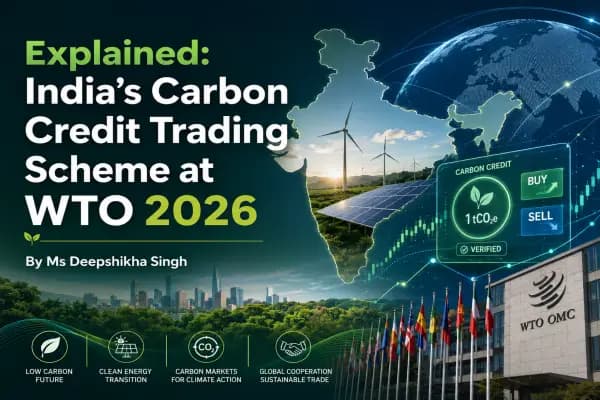
New Delhi (The Peepal): India used WTO Trade and Environment Week 2026 in Geneva to present its Carbon Credit Trading Scheme, renewable energy standardisation efforts, and green hydrogen standards before an international trade audience.
The presentation matters because climate policy is no longer only an environmental issue. It is now linked with export competitiveness, supply chains, carbon border rules, energy standards, and market access. Therefore, India’s message at the WTO was clear: developing economies need climate action, but they also need fair trade rules, capacity support, and recognition of equity.
According to the official PIB release, India said its non-fossil fuel-based installed electricity generation capacity reached 53.21% by March 2026, crossing the 50% target set for 2030. It also stated that India’s emissions intensity of GDP declined by 37.38% between 2005 and 2022, exceeding the NDC target of 33–35% reduction before the 2030 deadline.
Key Points
| Issue | What India Highlighted |
|---|---|
| Carbon market | National framework under the Carbon Credit Trading Scheme |
| Trading platform | Proposed national electronic carbon credit trading platform |
| Renewable energy | Standardisation and certification in emerging clean energy sectors |
| Green hydrogen | Emission thresholds and technical criteria for classification |
| Climate diplomacy | Equity, CBDR-RC, and multilateral cooperation |
| Trade concern | Risk from unilateral climate-linked trade restrictions |
| WTO platform | Trade and Environment Week 2026 in Geneva |
Why ABC Live Is Publishing This Report Now
ABC Live is publishing this report now because India’s climate policy has entered a trade-sensitive phase. Earlier, climate action was mainly discussed through domestic energy policy, forest policy, and international climate negotiations. However, the debate has now shifted toward carbon markets, green product standards, hydrogen certification, and carbon-linked trade barriers.
This shift directly affects Indian industry, exporters, MSMEs, power producers, steel, cement, aluminium, renewable energy developers, and green hydrogen investors. Moreover, WTO discussions on environment and trade are becoming important because developed economies are increasingly using climate-linked rules in trade policy.
Therefore, India’s WTO presentation is not just a diplomatic event. It is also a signal that India wants to defend its development space while building domestic instruments for a low-carbon economy.
What Has Happened?
On 5 June 2026, India organised a special session titled “Showcase of India’s Carbon Credit Trading Scheme and Standardization in Renewable Energy” during WTO Trade and Environment Week 2026 in Geneva. The WTO programme listed India’s session as Session 16 on 5 June 2026.
The event brought together officials and experts from the Ministry of Environment, Forest and Climate Change, Bureau of Energy Efficiency, Ministry of Power, and Ministry of New and Renewable Energy. They presented India’s climate action record, carbon market architecture, renewable energy standards, and green hydrogen framework.
India also referred to discussions held with Japan on 2 June 2026 regarding transparency and unilateral trade-restrictive measures. Those discussions focused on whether climate-linked trade measures could create unnecessary obstacles for countries and stakeholders with limited compliance capacity.
Legal and Policy Background
India’s climate position rests on three broad pillars.
First, India has committed itself to the Paris Agreement framework through its Nationally Determined Contributions. These targets include expansion of non-fossil fuel electricity capacity and reduction in emissions intensity of GDP.
Second, India has adopted the principle of Common but Differentiated Responsibilities and Respective Capabilities, or CBDR-RC. This principle recognises that developed and developing countries do not carry the same historical responsibility, financial capacity, or technological strength.
Third, India is now building domestic market instruments. The Carbon Credit Trading Scheme seeks to create an Indian Carbon Market through a national framework and an electronic trading platform. PIB describes the scheme as a market-based instrument to incentivise activities that reduce greenhouse gas emissions.
India’s Climate Claims at WTO
India presented two major achievement claims.
1. Non-Fossil Electricity Capacity
India stated that its share of non-fossil fuel-based installed electricity generation capacity reached 53.21% by March 2026. This exceeds the 2030 target of 50% nearly five years early.
2. Emissions Intensity Reduction
India also stated that emissions intensity of GDP declined by 37.38% between 2005 and 2022. This exceeds the NDC target of a 33–35% reduction by 2030.
These numbers strengthen India’s diplomatic argument. However, they also raise a deeper policy question: can India convert target achievement into credible, transparent, and internationally trusted carbon-market instruments?
ABC Live Analysis
India’s WTO presentation had three strategic purposes.
1. India Wants to Shape Climate-Trade Rules
Carbon markets, green hydrogen standards, and renewable energy certification will influence future trade flows. Therefore, India is positioning itself early. It does not want global climate-trade rules to be written only by developed economies.
This is important because climate standards can become hidden trade barriers when they ignore development gaps, technology access, finance costs, and administrative capacity.
2. Carbon Credits Need Trust, Not Just Trading
A carbon market succeeds only when credits are credible. Therefore, India must ensure strong measurement, reporting, verification, registry integrity, anti-double-counting safeguards, and transparent price discovery.
If the market becomes weak, industries may use credits as a compliance shortcut. However, if the market remains strict, it can push real emissions reduction and attract green investment.
3. Green Hydrogen Standards Can Build Investor Confidence
India’s green hydrogen framework is also significant. Emission thresholds and technical criteria can help investors, producers, buyers, and exporters understand what qualifies as green hydrogen.
However, standards must stay aligned with global expectations. Otherwise, Indian producers may face market-access issues in Europe, Japan, South Korea, and other clean-energy import markets.
Data and Evidence
| Indicator | India’s Reported Position | Policy Significance |
|---|---|---|
| Non-fossil installed electricity capacity | 53.21% as of March 2026 | 2030 target crossed early |
| NDC non-fossil target | 50% by 2030 | Achieved nearly five years ahead |
| Emissions intensity reduction | 37.38% from 2005 to 2022 | Exceeds 33–35% target |
| Carbon market instrument | Carbon Credit Trading Scheme | Market-based emissions reduction |
| Green hydrogen framework | Emission thresholds and technical criteria | Certification and investor certainty |
| WTO context | Trade and Environment Week 2026 | Climate policy linked with trade rules |
Risks and Concerns
India’s approach is promising, but four concerns remain.
First, the carbon credit system must avoid weak credits. Poorly verified credits can damage the credibility of the whole market.
Second, smaller firms may struggle with compliance costs. Therefore, India should design capacity-building tools for MSMEs and export-oriented units.
Third, climate-linked trade measures from developed economies may still create pressure on Indian exporters. Hence, India’s WTO diplomacy must continue to challenge unilateral measures that operate like disguised protectionism.
Fourth, renewable energy and green hydrogen standards must remain practical. If the standards become too loose, they may lose credibility. However, if they become too complex, they may block new entrants.
What Happens Next?
India’s next challenge is implementation.
The government will need to operationalise the carbon credit trading platform, strengthen verification systems, clarify sectoral obligations, and build confidence among industry participants. In addition, India must ensure that green hydrogen certification remains transparent, science-based, and export-compatible.
At the WTO level, India is likely to continue opposing unilateral climate-linked trade restrictions while supporting multilateral, inclusive, and development-sensitive climate cooperation.
ABC Live Editorial View
India’s WTO presentation shows that the country wants to move from defensive climate diplomacy to rule-shaping climate diplomacy. That is a necessary shift.
However, credibility will decide the outcome. India has strong renewable energy numbers and a growing policy framework. Nevertheless, carbon markets require institutional discipline. Green hydrogen standards require technical clarity. Trade diplomacy requires legal firmness.
Therefore, India’s real test will not be whether it can announce a carbon market. The real test will be whether it can build a carbon market that industries trust, investors use, regulators enforce, and global partners recognise.
Sources and Methodology
ABC Live reviewed the official PIB release issued on 5 June 2026, the WTO programme for Trade and Environment Week 2026, and related public information on India’s presentation at the WTO event. The analysis focuses on trade, environment, climate policy, carbon markets, renewable energy standards, and green hydrogen certification.
ABC Live also considered the broader policy context in which climate action, carbon pricing, energy transition, and trade rules are increasingly converging.
FAQ
What is India’s Carbon Credit Trading Scheme?
India’s Carbon Credit Trading Scheme is a national framework designed to create an Indian Carbon Market. It aims to use market-based tools to incentivise greenhouse gas emission reduction.
Why did India present this at the WTO?
India presented it because climate standards, carbon markets, and renewable energy rules are becoming trade issues. Therefore, India wants to show its domestic progress and defend fair, inclusive climate-trade rules.
Why does this matter for Indian industry?
It matters because exporters may increasingly face carbon reporting, green certification, and sustainability compliance requirements in global markets.
What is the main concern?
The main concern is credibility. Carbon credits must represent real, measurable, and verified emissions reduction. Otherwise, the market may lose trust.
Who is affected?
Power producers, renewable energy companies, green hydrogen investors, exporters, MSMEs, heavy industries, regulators, and carbon-market participants may all be affected.
Note:
The Peepal supports ABC Live with research-led environmental and sustainability analysis. ABC Live retains full editorial responsibility for this report.